










Chinese capital chooses Azerbaijan Green energy, high-tech, and industry
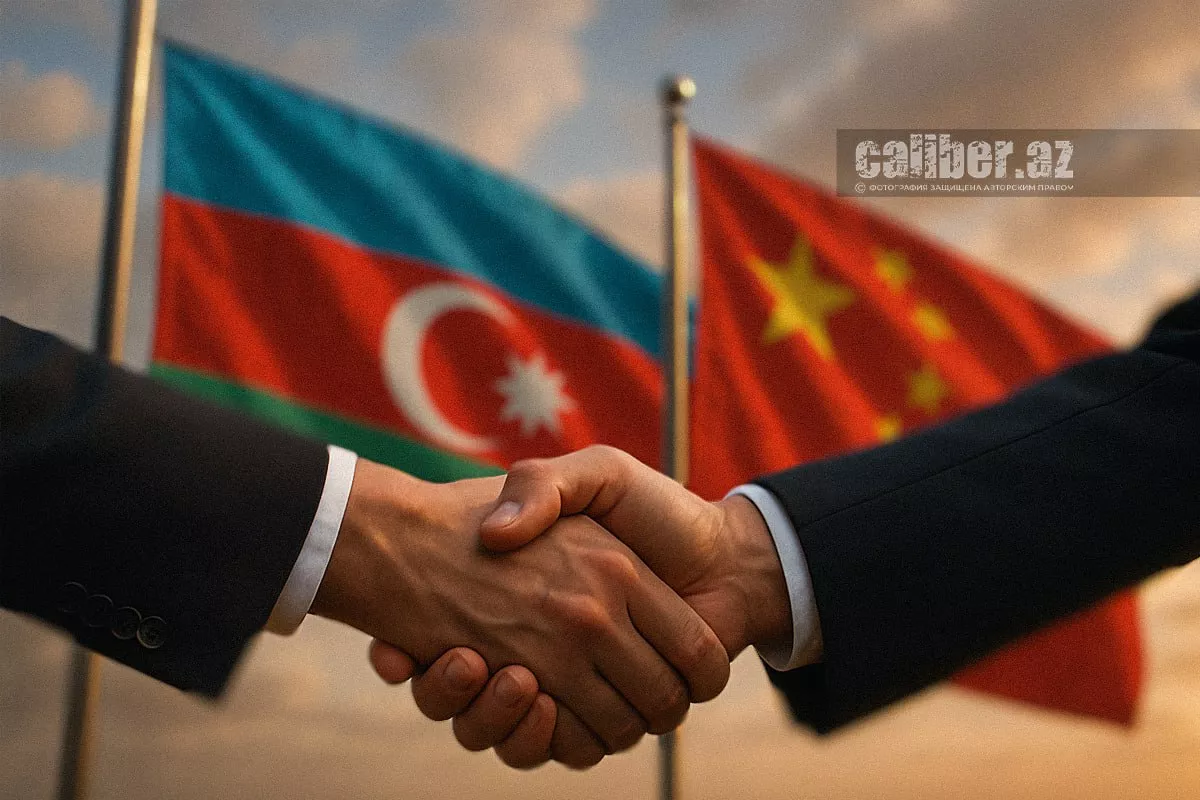
China and Azerbaijan, whose trade turnover is rapidly increasing, are today building relations at the level of a strategic partnership. Both countries are focused on expanding investment cooperation, including implementing joint business initiatives in sectors such as manufacturing, green energy, transportation, and IT technologies.
According to recent data from the Eurasian Development Bank (EDB), over the past ten years, Chinese foreign direct investment (FDI) in the South Caucasus region has increased 2.5 times, with just under two-thirds of these investments going to Azerbaijan and the remainder to Georgia. Notably, in the structure of Chinese investment, nearly 90% of the funds in Azerbaijan today are concentrated in the manufacturing sector.
Cooperation between Azerbaijan and the People’s Republic of China (PRC) in various formats has, in recent years, taken on the character of a strategic partnership, with a strong focus on expanding trade and economic ties. For many years, Azerbaijan has been China’s largest trading partner in the South Caucasus region, accounting for about half of the region’s total trade turnover with China. China is Azerbaijan’s fourth-largest trading partner overall and its main source of imports. In particular, last year, the two countries managed to increase trade by 21%, reaching $3.7 billion. According to data from the Azerbaijani State Customs Committee, this growth continued in January–October of the current year, rising by 26.5% and bringing the trade turnover to $3.815 billion.
As part of China’s Belt and Road Initiative, Azerbaijan plays a key role in providing China with a direct overland transit route to European markets. Alongside joint efforts to develop bilateral cargo transportation via the Middle Corridor, trade cooperation between Baku and Beijing is also expanding rapidly.
“Trade turnover between Azerbaijan and China is expected to reach a historic record by the end of 2025, marking the third consecutive year that bilateral trade remains at a high level,” said China’s Ambassador to Azerbaijan, Lu Mei, at a recent briefing. “At the same time, investment, economic, and technological cooperation between our two countries continues to deepen.”

And, apparently, the main trend of the past two years is that alongside expanding trade and transportation initiatives, Baku and Beijing are placing greater emphasis on the investment component, aimed at establishing joint ventures (JVs) in the manufacturing sector. “The volume of China’s FDI stock in the South Caucasus countries has grown 2.5 times over the past 10 years, from $0.28 billion to $0.69 billion, but the subregion’s share is still small, accounting for about 1% of China’s total investment in the Eurasian region. The investment portfolio is distributed between Azerbaijan (about 60%) and Georgia (about 40%),” the Eurasian Development Bank report notes. Notably, against this backdrop, the share of Chinese investment in Armenia is almost negligible.
According to the Eurasian Development Bank, the priority sectors for Chinese investment in the South Caucasus are manufacturing and green energy, indicating a gradual shift by Chinese companies away from an investment model focused on hydrocarbon extraction. In Azerbaijan, Chinese FDI in the first half of this year is estimated at $405 million, compared with $259 million in 2017, with an average annual growth of 4.8% in 2016 and nearly 9.7% since 2022.
Alongside this growth in monetary terms, the structure of investments has also changed qualitatively: the main driver of China’s investment portfolio is manufacturing, which accounts for 88% of cumulative FDI—around $355 million in the first half of this year. Investment in the industrial sector has increased almost 40-fold compared to 2016.
Where are Chinese investors mainly focusing their investments in Azerbaijan? At recent Azerbaijan–China business forums, partnership agreements and memoranda of understanding have been signed covering investments in green energy and transportation, the digital economy, smart logistics, the Internet of Things (IoT), industrial digitalisation, technological innovation, and more.
In particular, Chinese companies plan to implement renewable energy projects with a total capacity of 2 GW. Beyond contracting initiatives—such as the construction of a 160 MW solar power plant in Fuzuli and the 240 MW “Khizi–Absheron” wind farm—investors from China, through the joint venture Universal Solar Azerbaijan, will soon raise $100 million to begin construction of the 100 MW Gobustan solar power plant. This will be Azerbaijan’s first renewable energy project awarded via an auction with Chinese FDI participation. At the same time, China Datang Overseas is preparing a 100 MW solar power plant with a 30 MW energy storage system near Lake Boyukshor.
Investment cooperation between the two countries is not limited to the commissioning of green power plants; it also includes the construction of facilities for producing renewable energy generators. For example, the Chinese company Sichuan Sunsync Photovoltaic Technology plans to transfer technology and co-finance a solar panel manufacturing plant in the Alat Free Economic Zone, with the possibility of exporting part of the production.
Cooperation in the renewable energy sector also forms the basis of the partnership between China Energy Engineering Corporation Limited (Energy China) and Azerbaijan’s State Oil Company (SOCAR). Prospects are being explored for the construction of offshore wind farms, installation of photovoltaic panels on water reservoirs, wastewater treatment, recycling and reuse, as well as the optimisation of water resource management operations in Azerbaijan.
Ambitious plans also exist in the field of green transport: an agreement has been reached with the Chinese company BYD Company Limited to establish the enterprise Electrify Azerbaijan and a major assembly facility for electric buses in the Sumgayit Chemical Industrial Park (SCIP). Initial investment in the bus project amounts to $17 million, with potential future investments rising to $60–94 million if a decision is made to expand localised production. In the Aghdam Industrial Park, a private Chinese investor is launching Fujiai Azerbaijan, a factory producing elevators and escalators using Chinese components.
A key part of the cooperation is attracting Chinese know-how and capital to Azerbaijan’s non-oil sector, including high-tech and innovation areas, industrial and agricultural digitalisation, and joint initiatives for the development of artificial intelligence (AI).
The mining and metallurgical sector has not been forgotten either. In July of this year, in Beijing, a subsidiary of AzerGold JSC — Dashkasan Filizsaflashdirma (ore dressing) OJSC — signed an agreement with the Chinese company Sinosteel Equipment & Engineering Co., Ltd. The agreement involves preparing a feasibility study to reassess mineral resource volumes and develop a new mine exploitation plan in Dashkasan, followed by the construction of an iron ore processing plant at the site.
Judging by the strength of Azerbaijan–China intergovernmental ties and the dynamics of economic relations, investment in the industrial cluster appears to be a long-term trend. Currently, around 370 companies with Chinese capital are registered in Azerbaijan, and Chinese investment in the country’s economy has reached $950 million. Azerbaijani companies’ investments in China are estimated at $300 million (according to Chinese data); however, including funds from the State Oil Fund of Azerbaijan, the total investment volume approaches $2.1 billion.







 editor@caliber.az
 +994 55 444-88-98
 Азербайджан, Баку, ул. Низами, 203, Af Business House, 5-й этаж