










Container boom on the Caspian Azerbaijan expands its fleet and cargo transport
Over the past decade, Azerbaijan and its partners in the Caspian region have been actively developing the transport and logistics infrastructure of the Middle Corridor. A key focus has been on modernising port hubs and expanding the fleet of ferries, cargo ships, and tankers. In this sector, Azerbaijan is the regional leader, possessing the most powerful cargo fleet in the area.
In 2025, the Caspian Shipping Company (ASCO) increased bulk cargo handling by 45%, while ferry container throughput more than doubled. In line with the growth of Trans-Caspian shipments, ASCO is expanding its fleet, placing orders at the Baku Shipyard. Recently, the Baku Shipyard began constructing two container ships under a contract with the AD Ports Group from the UAE.
With active support from the Caspian states, the combined land-sea corridor — the Trans-Caspian International Transport Route (TITR) — has been operating very successfully for the eighth consecutive year. Over the past four years, delivery times along this route have been reduced from 58–60 days to just 15 days, while cargo volumes have increased more than sevenfold — from 600,000 tonnes in 2021 to 4.5 million tonnes in 2024.
This growth has occurred against the backdrop of the ongoing Russia–Ukraine conflict and restrictions on shipments via the Northern Corridor, which has shifted the main flow of goods from China and Central Asian countries towards Türkiye and Europe onto the Trans-Caspian route.
Cargo traffic along the Middle Corridor is growing dynamically, prompting Azerbaijan to steadily expand its transport and logistics infrastructure. These efforts are crucial, as the World Bank forecasts that cargo handling on the TITR could reach 10–11 million tonnes by 2030.
As Vice Premier Samir Sharifov highlighted at the recent New Silk Road forum in the UAE, Azerbaijan has modernised the Baku–Tbilisi–Kars (BTK) railway, increasing its annual capacity to 5 million tonnes, while the capacity of the Baku International Sea Trade Port is being gradually raised to 25 million tonnes. Currently, the port’s container terminal can handle 150,000 TEU (standard 20-foot containers) and is expected to reach 260,000 TEU within two years.
“Last year, cargo traffic along the Middle Corridor grew by 11%, while container throughput at Baku International Sea Trade Port increased by 40%, exceeding 107,000 TEU,” Sharifov noted. According to the Vice Premier, the implementation of the Zangezur Corridor under the Trump Route for International Peace and Prosperity (TRIPP) initiative, besides creating a reliable land link between Europe and Central Asia, has the potential to handle up to 865,000 TEU by 2040.
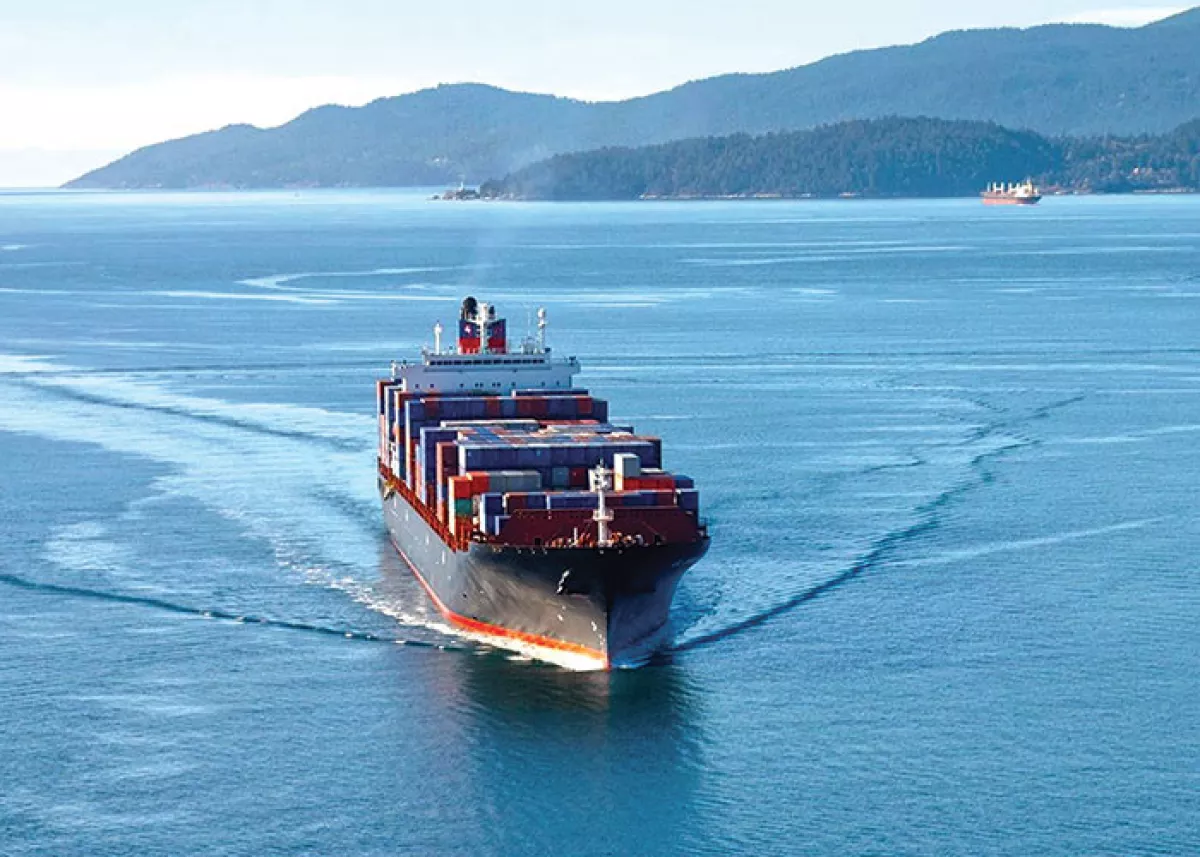
However, even today, cargo handling on the Caspian is leading the region in growth dynamics. Last year, ASCO, part of the state-owned AZCON Holding, transported nearly 1.324 million tonnes of cargo by bulk carriers, exceeding the figures from the year before last by more than 45%. The container segment showed even stronger growth: ferries and other ASCO vessels moved 22,030 TEU, 203% higher than in 2024.
Container transport appears set to remain the mainstream direction of the Trans-Caspian route for many years, prompting Caspian states and their international partners to invest in this segment of the fleet. In particular, last Tuesday, the Baku Shipyard held a ceremony to cut the first steel plates for new ships, officially beginning the construction of two container vessels under a contract with the AD Ports Group from the UAE.
The new container ships will be built to modern engineering standards to ensure operational efficiency, safety, and reliability. According to approved technical specifications, each vessel will have an overall length of 149.50 metres, a width of 21.00 metres, a draft of 4.50 metres, and a container capacity of 780 TEU. This contract marks the first order received by the Baku Shipyard from a non-regional customer and is considered an important milestone in the strategic development of the shipyard.
Notably, the Baku Shipyard now has the opportunity to attract potential regional customers. In August last year, Uzbekistan’s Minister of Transport Ilkhom Makhkamov stated that his country plans to operate its own ferries on the Caspian Sea and announced plans to place orders at shipyards in Azerbaijan and Turkmenistan. According to media reports, the project is estimated to cost around $150 million. In this context, an agreement was also signed between the relevant agencies of the three countries to establish joint companies in transport and logistics services, facilitating seamless cargo transit, providing forwarding services, and offering certain cargo-handling preferences.
Meanwhile, in Azerbaijan, the tonnage of ASCO’s cargo fleet — the largest on the Caspian, comprising nearly sixty vessels of various types, including about twenty tankers of different capacities — continues to grow. ASCO is implementing its 2022–2030 strategic shipping development plan, which foresees the acquisition of roughly fifty vessels, including cargo and passenger ships, with most orders placed at the Baku Shipyard.
Over the past twelve years, the Baku Shipyard has built eleven vessels of various types, including one transport ship (SOCAR-1), three supply-passenger vessels (Ufuq, Zafar, and Turan), four tankers (Lachin, Kalbajar, Akademik Khoshbakht Yusifzade, and Zangilan), two Ro-Pax ferries (Azerbaijan and Zarifa Aliyeva), and a specialised vessel (Khankendi).
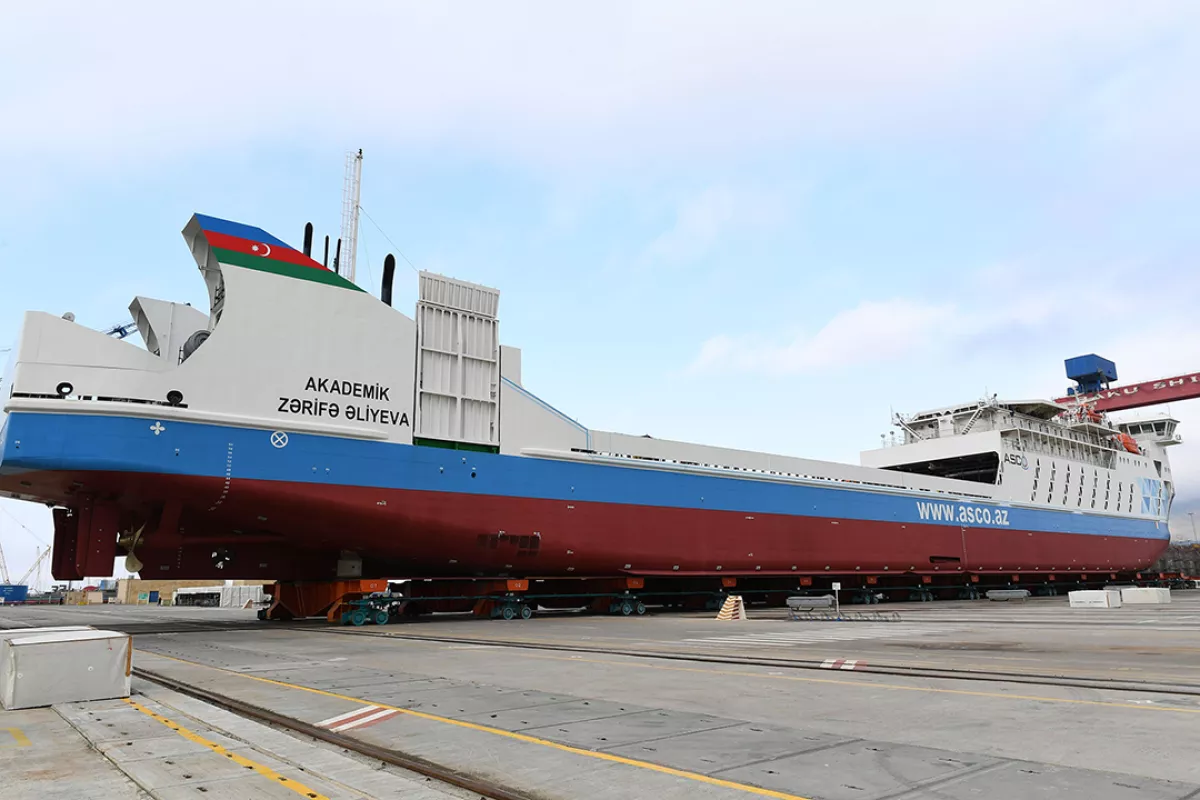
Notably, the construction at the Baku Shipyard of highly demanded multipurpose ferries for the TITR system — capable of carrying both railway wagons and wheeled vehicles — is progressing successfully. As of January this year, construction of the third Ro-Pax ferry has entered its final stage: assembly of the main hull blocks is complete, and the installation of pipelines and electrical cabling is nearing completion. In parallel, work is ongoing on ventilation systems, mechanical equipment installation, insulation of living quarters, and partitioning of cabins.
Compared to the first two ferries in this series, the third Ro-Pax incorporates several innovations: a three-tonne service crane, additional reservoirs for the compressed air system, an electrical supply system for refrigerated containers, a hazardous gas detection system in the lower cargo hold, an additional foam fire monitor, an automatic system for handling railway wagons onboard, and a braking system on the cargo platform. The third Ro-Pax is designed for a maximum speed of 14 knots and will be able to carry up to 100 passengers while accommodating 56 tank wagons or 50 cargo trucks simultaneously.
Meanwhile, the Baku Shipyard continues construction of three new tankers with a deadweight of 7,740 tonnes and a maximum speed of 10 knots. As of late January, 40% of work is completed on one of the vessels, and around 35% on the other two. In addition to oil, the new tankers are designed to transport chemical products, with a structural feature allowing them to access shallow ports on the Caspian Sea even when fully loaded.







 editor@caliber.az
 +994 55 444-88-98
 Азербайджан, Баку, ул. Низами, 203, Af Business House, 5-й этаж