










Algorithm of development: Azerbaijan sets course for AI Overview by Khazar Akhundov
UN experts classify artificial intelligence (AI) as one of the key technologies of the 21st century that is radically transforming the business and social environment as well as public administration systems worldwide. These trends are becoming a mainstream direction of development in Azerbaijan, where efforts have recently been intensified to implement global experience and capabilities in the field of AI into the country’s digitalisation processes.
The potential of artificial intelligence and the work carried out in the country to develop this area were discussed at the first meeting of the Digital Development Council, held on June 29 under the chairmanship of Azerbaijan’s First Vice-President, Mehriban Aliyeva.

As Mehriban Aliyeva emphasised at the meeting, “artificial intelligence is no longer the future—it is the main driving force of development today. At the same time, its role in ensuring the security of states is growing and has already come to the forefront.” This statement is hard to disagree with, given the enormous breakthroughs achieved in the field of AI in recent years: modern computers and robots are capable of self-learning, improving their performance, and making autonomous decisions.
Encompassing a wide range of technologies that can be described as self-learning and adaptive systems — from computer vision and speech recognition to robotics — artificial intelligence is aimed at extending human capabilities and covers virtually all sectors of the economy, social sphere, and other areas of public life. Today, AI-based hardware and software systems are gradually taking over the management of complex industrial facilities, energy systems, and transport networks, regulating utilities and traffic flow, while bot services are serving customers in the financial sector and government e-government platforms.
As a result, according to estimates by leading global vendor Nvidia, by 2030 the total volume of investments in data centres and Big Data processing that support AI systems could reach $3–4 trillion. In turn, the added value generated in the artificial intelligence segment by the same year could amount to approximately $16 trillion. These figures are comparable to the GDP of the world’s largest economies and indicate that global business perceives AI not as an experiment or a decorative label for reports and presentations, but as a strategic direction.

The enormous potential of artificial intelligence is also planned to be harnessed in Azerbaijan, where, in order to accelerate the digital transformation of the economy, the “Digital Development Concept of Azerbaijan” and the “Artificial Intelligence Strategy of Azerbaijan for 2025–2028” were adopted last year on the initiative of the head of state.
In her address at the meeting of the Council, the First Vice-President of Azerbaijan recalled that in February of this year, a meeting dedicated to the country’s new digital development strategy was held under the chairmanship of President Ilham Aliyev. Following the instructions issued at that meeting, the “Action Plan for Accelerating the Digital Development of the Republic of Azerbaijan for 2026–2028” was approved, establishing a concrete roadmap for the next three years.
“Our goal is to transform Azerbaijan into one of the leading countries in the region in the fields of digital development and artificial intelligence. We must study international experience and adopt successful models. At the same time, all decisions must be based on Azerbaijan’s national interests and address the country’s specific needs,” Mehriban Aliyeva emphasised, noting in particular that the Council’s priorities include the development of digitalisation, artificial intelligence, cybersecurity, and an innovation ecosystem in public administration, as well as support for investment and start-ups.

It is also worth noting that the field of artificial intelligence is among the key priorities of the Centre for Analysis and Coordination of the Fourth Industrial Revolution (C4IR), operating under the Ministry of Economy. In particular, work is underway to develop a regulatory framework, ethical standards, and rules for governing the AI sector, as well as to build an educational and scientific base for training young specialists and preparing society for the changes brought by artificial intelligence.
With the participation of the Centre, pilot projects for the responsible use of AI are already being tested in areas such as healthcare, energy, education, agriculture, sports, e-government, as well as its active application in call centres. In addition, there are plans to support private business initiatives capable of generating an added value of 70 million manats ($41 million) through solutions based on generative AI.
As stated by Deputy Minister of Digital Development and Transport of Azerbaijan Sameddin Asadov during the recent 14th Private Sector Forum of the Islamic Development Bank Group, “a strong digital public infrastructure is the foundation for the development of artificial intelligence, and over the past five years our country has made significant progress in this direction.” He also emphasised that, in order to develop the national AI ecosystem, a National AI Centre is being established in the Republic, AI services in the public sector are being expanded, and a regulatory “sandbox” for artificial intelligence products has been launched.
Particularly notable in this context is Azerbaijan’s first systemic concept for the application of AI in the energy sector. The document, “Artificial Intelligence Solutions in Energy,” defines possible directions for AI deployment based on 40 global concepts and contributes to the deepening of digital transformation in the energy sector. In addition, this year the country plans to launch a new AI-based application — a digital platform that will provide comprehensive information on living, working, and doing business in Azerbaijan for foreign investors, start-ups, and talent seeking to relocate to the country.
Work is also underway on the implementation of large language AI models and the creation of a digital twin of the country, aimed at improving the understanding and real-time reflection of economic processes.
At the same time, the Central Bank of Azerbaijan (CBA) is developing relevant regulatory standards and governance frameworks, while also supporting the introduction of AI tools in domestic banks and other financial institutions to enhance their operational resilience and the efficiency of cybersecurity processes. With the support of the CBA, the potential of AI is also being integrated into insurance processes, making them more efficient, transparent, and customer-oriented.
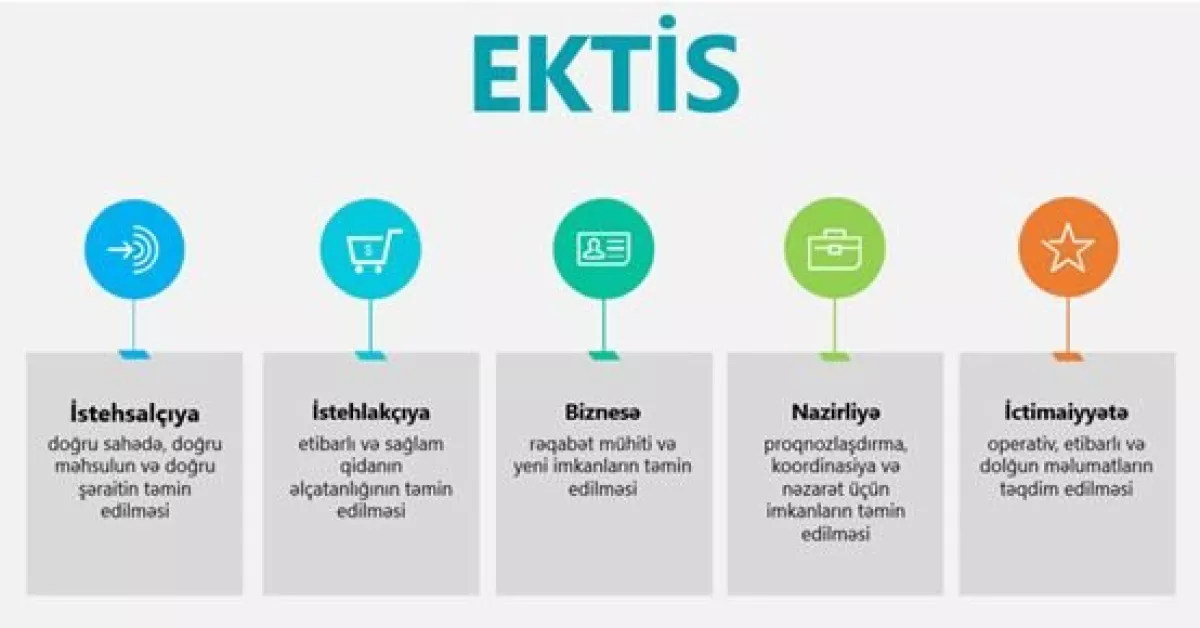
The country’s agricultural sector is also keeping pace with modern trends, as demonstrated by the electronic agriculture system EKTİS, within which 33 AI-capable modules are being integrated under the “Agricultural Artificial Intelligence” project. These modules will combine data on soils, climate, water resources, satellite information, and more.
Artificial intelligence is also being actively introduced into Azerbaijan’s transport and logistics sector, particularly in the multimodal transit of goods along the Middle Corridor. At the Baku International Sea Port, for instance, intelligent management systems and IoT sensors are being implemented to track cargo, significantly reducing container processing times. In addition, Azerbaijan is initiating the establishment of a headquarters for an artificial intelligence cooperation mechanism for all countries along the Middle Corridor.

At the same time, the rapid development of artificial intelligence also generates certain risks. As the First Vice-President of Azerbaijan, Mehriban Aliyeva, emphasised at the Council meeting, “we must be prepared to address emerging challenges, particularly the risks associated with cybersecurity and information security.”
It is precisely to counter such threats that the National Cybersecurity Agency, a public legal entity operating under the Ministry of Digital Development and Transport, was recently established. Its functions include coordination, regulation and monitoring in this field, ensuring the resilience of information infrastructure, and providing early warnings on cyber threats.
In turn, the Central Bank is improving the regulatory framework and developing AI and blockchain technologies to build a robust Antifraud system — a set of measures and technological solutions aimed at preventing card-related fraud and theft in the banking sector.
A key prerequisite for the safe large-scale adoption of artificial intelligence technologies is the availability of highly qualified specialist personnel in the country. In order to train such experts, the Artificial Intelligence Academy (AI Academy) was opened in Baku in September last year, operating with the support of the state-owned AZCON Holding. The main objective of this educational institution is to prepare specialists in the field of AI and accelerate the country’s digital transformation, with cooperation established with leading international universities to optimise this process.
Thus, as can be concluded from the above, the Azerbaijani state intends in the near future to further strengthen its position in the field of artificial intelligence implementation, as well as in addressing the risks arising from the evolution of neural networks.







 editor@caliber.az
 +994 55 444-88-98
 Азербайджан, Баку, ул. Низами, 203, Af Business House, 5-й этаж