










Paris’s hybrid campaign Baku changes the rules of the game
The activities of the French authorities in relation to Azerbaijan, encompassing a broad range of hybrid threat components, are ongoing — this is precisely the axiom set out in the statement adopted by the Milli Majlis (Parliament) Commission on Countering Foreign Interference and Hybrid Threats. And in this document, released on June 16, what draws greater attention is not so much the list of anti-Azerbaijani actions by Paris, but rather how this catalogue concludes. After the points describing how the Élysée Palace is implementing its multi-layered pressure campaign against Azerbaijan, the statement makes an unusual turn for diplomatic language: it is addressed not to French officials, but directly to the French people.
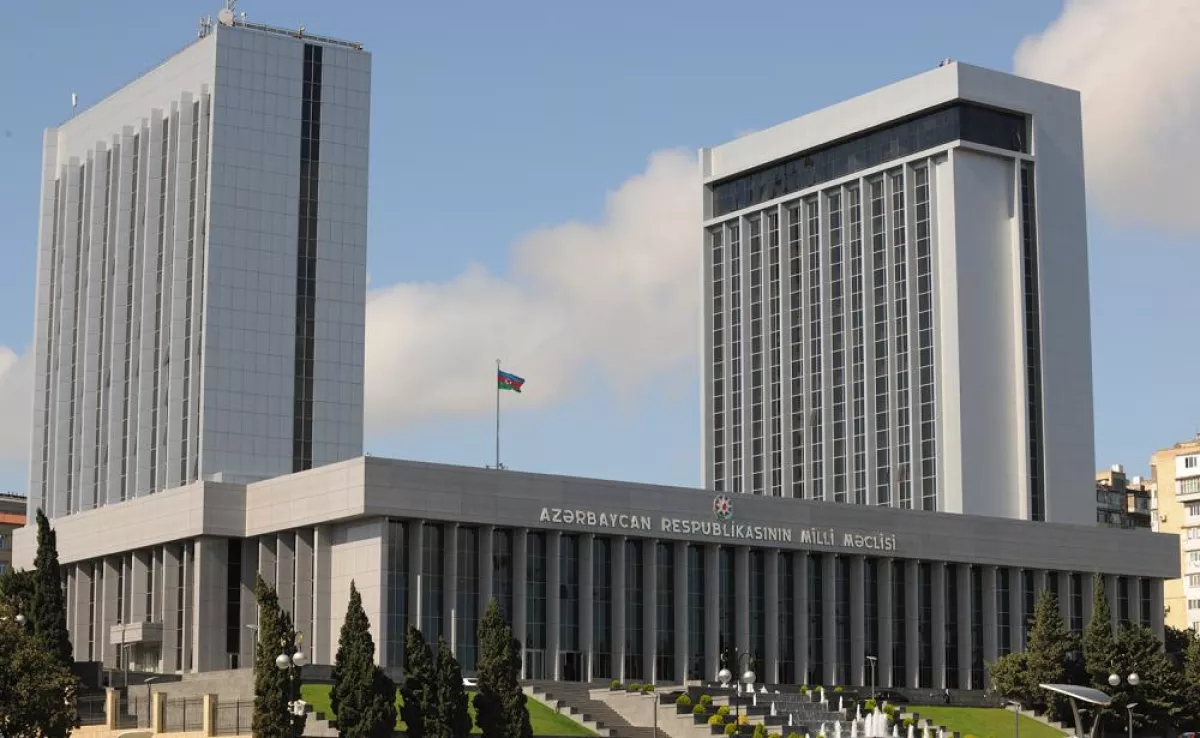
And this is by no means a rhetorical figure or a gesture of courtesy. It is a deliberate division of the Fifth Republic into two vectors: the state machinery, operating under the influence of the Armenian lobby and in pursuit of its own interests — which are far from always altruistic — and society, which is being invited to see what this apparatus is turning the country’s international image into. This division constitutes the core meaning of the statement, and it is precisely what distinguishes it from a routine exchange of diplomatic notes.
The list of anti-Azerbaijani steps by the French authorities is structured not as a catalogue of isolated incidents, but as the description of a system. It opens with what is referred to in international practice as lawfare — the use of law as a weapon. Since November 2020, both chambers of the French Parliament have adopted a series of resolutions against Azerbaijan; while they carry limited legal force, the commission notes that they function as instruments of political pressure and as a template that is subsequently replicated in environments where French influence and Armenian lobbying structures are strong. A revealing example of the mechanism is the Belgian case: a parliamentary resolution initially introduced under a neutral title supporting the peace process gradually accumulated, by the time of the final vote, a set of sharply anti-Azerbaijani demands. The text evolved along the way, and the direction of these changes was consistently the same. Behind individual documents, a recurring pattern emerges.
The second layer is activity on international platforms. Since 2020, French diplomats, parliamentarians, and public figures have sought to use the tribunes of the UN, EU institutions, the Council of Europe, PACE, the OSCE, and the International Organisation of La Francophonie to advance decisions that would harm Azerbaijan’s interests, with the aim of isolating the country and pushing it out of certain cooperation formats.
The third layer, according to the commission’s description, is the media sphere, presented as the most intensive: only in May and June, approximately forty anti-Azerbaijani articles and dozens of television reports appeared in the French press. One of the triggers for such waves, as previously noted by the Azerbaijan Media Development Agency, was a routine criminal incident in France, which was presented in a one-sided and tendentious manner. A single report on its own proves nothing, but forty articles in two months is no longer a reaction to events — it is the manufacturing of a narrative environment.
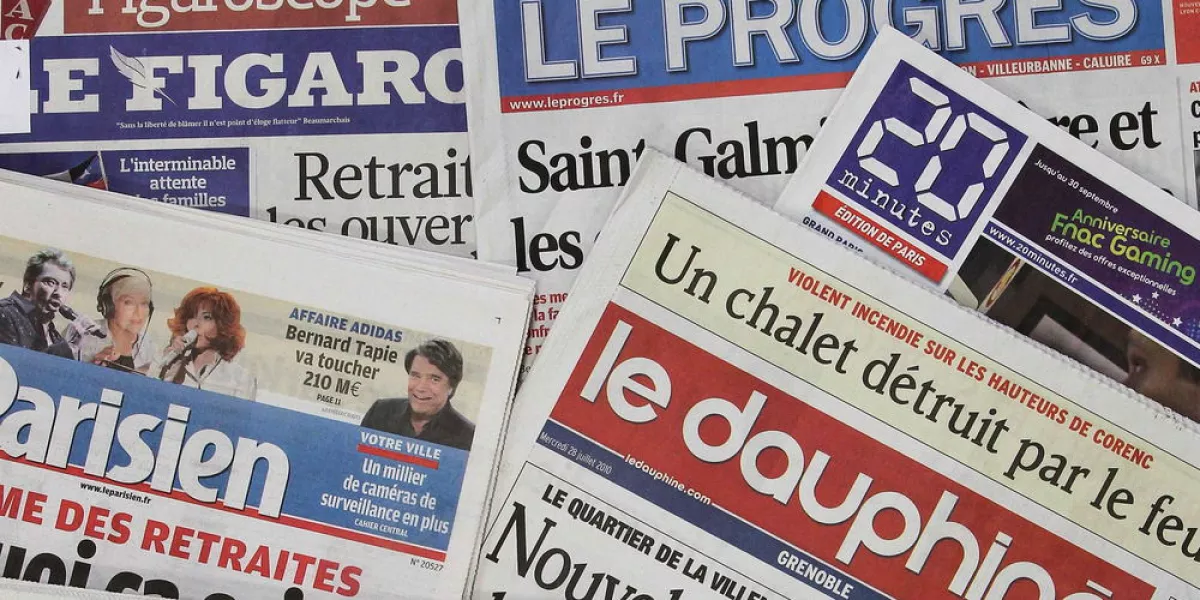
A separate group of points concerns the French side’s engagement with the so-called Azerbaijani “opposition,” and here we are dealing with matters that are quite observable. The press and television of this country have long and systematically provided a platform to marginal figures who have no political weight either inside Azerbaijan or beyond its borders — individuals who are not elected or supported at home, but who are presented in French media as the voice of some alternative perspective.
For years, the narrative of “violated rights” of certain radical migrants has been sustained in the information space; their politically motivated demands are packaged in the language of democratic values, while the official position of Baku and alternative viewpoints are consistently filtered out of such materials.
This is not journalism that verifies facts from all sides, but the construction of an image according to a set pattern: “Azerbaijan as a repressive regime — its critics as persecuted righteous figures.” This is accompanied by coordinated campaigns on social media involving fake profiles and automated networks that reproduce the same set of narratives. In this context, France is not engaging with real Azerbaijani politics, but with a simulacrum of it, constructed to serve the needs of its own propaganda.
Even more significant are elements supported by material actions and judicial procedures, rather than mere media monitoring. France is actively supplying weapons to Armenia — this is not a matter of interpretation, but a fact reflected in defence contracts.
As for the espionage-related point, which might easily be dismissed as a figure of speech, it has in fact been examined in a court of law: in March, the Baku Court on Grave Crimes sentenced French citizen Martin Ryan to 10 years in prison to be served in a high-security correctional facility on charges of espionage in favour of France; Azerbaijani citizen Azad Mammadli, who was also involved in the case, was sentenced to 12 years in prison. The case included references to specific French embassy personnel through whom, according to the prosecution materials, contacts were established, as well as testimony regarding the transfer of military-related data to the French side.
To this is added a detail from an open source: the specialist publication Intelligence Online reported that French intelligence services intend to expand the exchange of satellite and electronic intelligence data with Yerevan, interpreting the victory of Pashinyan’s party in the elections as a signal to transfer more sensitive technologies, with less concern than before about their potential leakage to Moscow.

A separate storyline concerns the European Union’s civilian mission in Armenia — EUMA, which the commission, citing its own special study from April 2025, characterises as an instrument that has been turned by Paris primarily into an intelligence-gathering platform near the Azerbaijani border.
Deployed under the banner of monitoring stability, EUMA is, in this interpretation, operating in the opposite direction — collecting data and contributing to heightened tensions at a moment when the two countries are moving towards peace. Taken together, defence contracts, court rulings in a criminal espionage case, signals from French intelligence, and a monitoring structure deployed along the border form a picture that can no longer be dismissed as bias from one side.
Behind the entire set of directions, the commission identifies a single underlying motive, and this part of the statement moves beyond description into diagnosis. The creation of an image of Azerbaijan as an external enemy is interpreted as a way of addressing an internal task for the French government — diverting public attention from the socio-economic crisis and growing distrust in political leadership. This mechanism has long been described in political science and operates far beyond France: the image of an external other is traditionally used to shore up eroding domestic legitimacy.
If this framing is accepted, Paris’s anti-Azerbaijani activity ceases to be an independent foreign policy line and becomes an extension of domestic politics: Azerbaijan is not the objective here, but a convenient target onto which internal difficulties can be projected. It also makes clearer why the statement ends by addressing the French public rather than its government — it strikes directly at this linkage, suggesting that the country’s internal problems are being managed at someone else’s expense.
The choice of addressee is itself a strategy. Addressing the French government with a list of grievances would mean entering a debate on terrain where Paris holds all procedural advantages and where diplomatic exchanges would ultimately fade into inertia. Addressing society shifts the conversation out of the diplomatic sphere into the reputational one — and there the balance is different.
Baku is telling the French public something that is harder to refute: the hostile course pursued by their leadership brings France neither political nor economic dividends, and instead worsens its international image. This is not a threat or a bargaining position, but an indication of the costliness of this strategy for the French themselves.
This is reinforced by a deliberate separation between the people and the authorities: the Azerbaijani side explicitly states that it has considered, and continues to consider, the French people a friend and is ready to build relations on the basis of mutual respect. The adversary here is not a nation, but a specific political group operating within a non-transparent network of lobbying influence.
This move also has a broader context beyond bilateral relations. Azerbaijan has long stopped taking a defensive position in its dealings with Paris and has shifted to its own agenda — from a platform on decolonisation that raises questions about French overseas territories to direct appeals to French society over the heads of its government.
The logic in all cases is the same: not to justify itself in response to accusations, but to redirect the conversation to a space where France does not hold a monopoly on moral framing. The commission’s statement is one link in this approach. It reflects the fact that Baku no longer treats French pressure as something to be answered strictly within Paris’s rules, and instead prefers to reshape the rules themselves.







 editor@caliber.az
 +994 55 444-88-98
 Азербайджан, Баку, ул. Низами, 203, Af Business House, 5-й этаж