










War and oil Global markets feel the Gulf Conflict
The ongoing war between Iran and the US-Israel bloc has affected most countries in the Persian Gulf and the Middle East as a whole. The recent intensification of mutual strikes on the region’s oil and gas infrastructure and ports, as well as the effective closure of the Strait of Hormuz, has triggered higher energy prices. In particular, on March 9, the price of Brent crude oil for May futures on the London ICE exchange approached $119 per barrel, surpassing the peak levels of 2022 for the first time. Although Brent retreated later in the day, prices still remain above the symbolic $100 mark. In this context, the G7 countries recently discussed the joint use of oil from emergency reserves.
Global conflicts, especially those affecting the Middle East, have a direct impact on commodity price dynamics. This is evidenced by the entire experience of the 20th century and the first quarter of the 21st century, including the fierce Iran-Israel conflict that took place from June 13 to 24 2025. The Islamic Republic of Iran’s (IRI) refusal to abandon its nuclear and missile programmes once again became a pretext for military action by the United States and Israel, which began on February 28 of this year. Recent bombings by US-Israeli aircraft targeting IRI military facilities, and Iran’s retaliatory strikes with ballistic missiles and drones against American military bases and critical infrastructure in the Gulf Arab states, have affected several oil terminals, refineries, tankers, and other energy facilities, which has inevitably influenced oil prices.
However, the greatest impact on commodity markets came from Iran’s effective blockade of the Strait of Hormuz. Under normal circumstances, around 20 million barrels of crude oil and petroleum products pass through this 33-kilometre stretch daily, accounting for roughly a quarter of global seaborne oil trade and one-fifth of the world’s oil consumption. About half of this volume comes from exports by Saudi Arabia and the UAE, while the remainder is contributed by Iraq, Kuwait, and Iran. Just under 50% of tanker exports from the Gulf countries are destined for China and India.
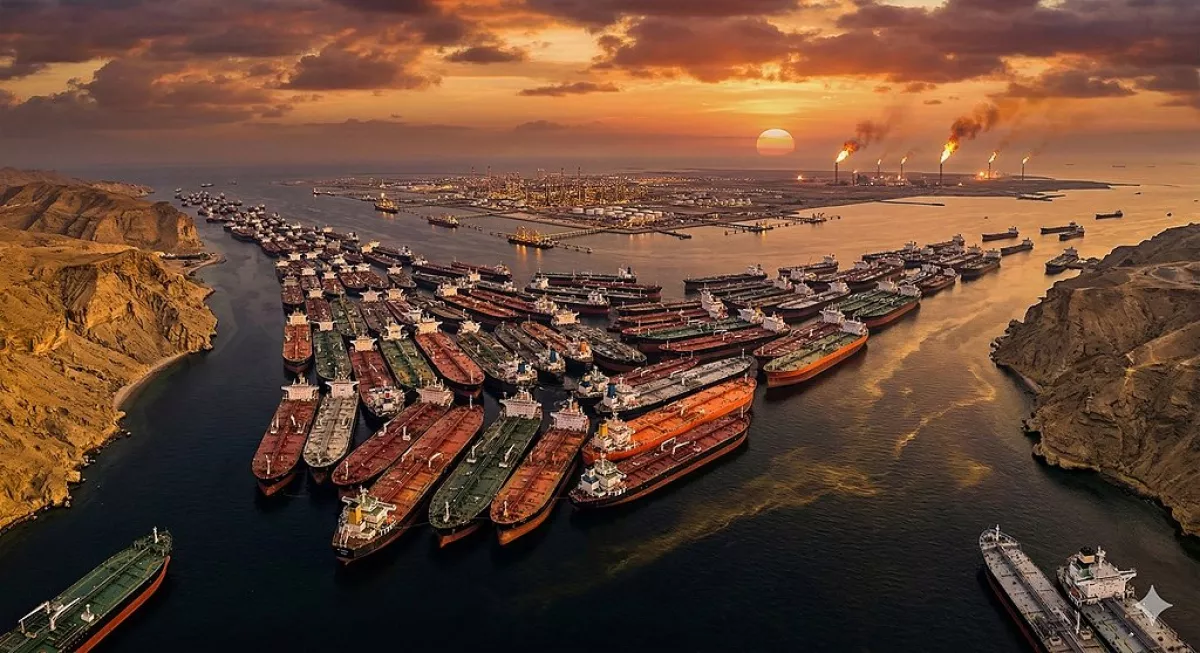
“The strait is not formally closed, but vessels are increasingly avoiding it given the risk of attack by Iran or its proxies. Oil majors have halted shipments for safety reasons, and insurers are cancelling war risk cover for vessels,” reports the international ratings agency Fitch Ratings. “However, we expect this effective closure of the strait to be temporary. It is a vital artery for seaborne oil transportation, with limited alternative routes.”
Fitch does not rule out that if the Strait remains closed for an extended period, the possibility of naval escort for tankers could be considered, similar to what occurred during the Iran-Iraq war in the 1980s.
Several sources note that Saudi Arabia and the United Arab Emirates (UAE) have alternatives to shipping oil through the Strait of Hormuz: for instance, the state-owned Saudi Aramco operates the East-West pipeline with a capacity of 5 million barrels per day to the Red Sea, while the UAE uses a pipeline with a capacity of 1.5 million barrels per day to the Fujairah export terminal. However, these pipelines can only provide relief for a limited period, as they cannot compete with tanker shipments in terms of volume or various infrastructure parameters at port terminals.
At this stage of the conflict, the shortfall in oil could be mitigated by oil already in transit or awaiting shipment: as of early March, 170–180 million barrels of Russian and Iranian oil were at sea, approximately one-third above the average level in September of the previous year. According to Fitch, global oil supply is expected to increase by 2.4 million barrels per day in 2026, with about half of the additional supply coming from non-OPEC+ producers unaffected by the conflict. Meanwhile, OPEC+ has spare production capacity of 4.3 million barrels per day.
However, it is possible that the conflict in the Persian Gulf could drag on for a longer period or become more destructive, especially as attacks on critical infrastructure have intensified in recent days. Despite initial statements by the parties that the strikes would be limited to military targets, Iranian drones and missiles have hit Saudi Aramco’s Ras Tanura refinery, as well as energy facilities in the UAE — including the Fujairah oil port and several oil industrial zones. In Qatar, Qatar Energy’s liquefied natural gas (LNG) plant in Ras Laffan was affected, while in Oman, fuel storage tanks at the port of Duqm were hit, and damage was also reported at the port of Khasab, where a tanker was attacked. On the morning of March 9, Bapco Energies’ refinery in Bahrain came under attack by Iranian missiles and drones.
These actions by the IRI have not gone unanswered: over the past weekend, Israeli air forces seriously damaged oil storage complexes in Tehran and Karaj.

The lack of compromise is only driving further escalation of the conflict: not only does it prolong the effective closure of the Strait of Hormuz, but it also increases the risk of destruction to terminals and other port infrastructure in the Gulf, whose lengthy repairs would reduce the region’s ability to remain a major global energy supplier. All these threats are pushing oil traders and global energy markets to raise prices: on March 9, the price of Brent crude for May 2026 delivery on the London ICE exchange approached $119 per barrel for the first time since June 29, 2022. According to Bloomberg, amid rising oil prices on March 9, coal prices jumped by 9% — their highest level since November 2024 — while gas prices in Europe surged by 30%.
Notably, several experts do not rule out further increases in energy prices. According to The Guardian, the supply situation has turned out to be far more serious than initially assumed. Goldman Sachs had expected oil supply reductions of up to 15% of normal levels, but the blockade imposed by Tehran has reduced transport to only 10% of pre-conflict volumes. The bank estimates that the current shock is 17 times larger than in April 2022, when oil prices surged to $110 per barrel, and forecasts that if the situation is not resolved within a week, prices could reach triple digits. Financial conglomerate Barclays even warns that oil prices could rise to $120–150 per barrel if the conflict is not resolved by the end of March.

Against this backdrop, South Korean President Yoon Jae-myung on March 9 called on authorities to implement fuel price caps in the domestic market and to begin seeking alternative energy supply routes. Meanwhile, Japanese media are discussing the possibility of tapping national oil reserves. On March 8, U.S. Energy Secretary Chris Wright told CBS that, if necessary, the country could deploy 400 million barrels of oil from its strategic reserves.
Current developments are also prompting several countries to explore alternative transport routes. Kazakhstan, which had been allocated land at the Shahid Rajaee port in Bandar Abbas, Iran, for access to global markets, is now considering using ports in Pakistan. Regarding oil shipments, Kazakhstan currently transports about 80% of its oil through the Caspian Pipeline Consortium (CPC); however, due to increased drone attacks by Ukraine on the Novorossiysk port terminals in recent years, it seeks to diversify exports, including via the Baku–Tbilisi–Ceyhan (BTC) pipeline in Azerbaijan.
It is clear that the complex global situation will further stimulate these processes. In February 2026, Kazakhstan exported 115,000 tonnes of oil via the BTC pipeline, an increase of 8.5%. Overall, since 2023, over 3.5 million tonnes of oil, mainly from the Tengiz field, have been shipped to global markets via BTC. By 2027, this volume is expected to reach 7 million tonnes per year, with further increases possible on mutually beneficial terms.
Today, it is difficult to make precise predictions about the global oil market, but experts believe that if the conflict ends quickly and shipping in the Gulf is restored, Brent prices could return to an average of $70 per barrel by the end of April 2026. For Azerbaijan, this would be an acceptable level: it should be recalled that, under a conservative scenario and taking global risks into account, the “cut-off price” used to calculate oil revenues in Azerbaijan’s 2026 state budget was lowered to $65 per barrel. Overall, Azerbaijan clearly supports OPEC+ policies aimed at limiting oil production and maintaining a balance between supply and demand.







 editor@caliber.az
 +994 55 444-88-98
 Азербайджан, Баку, ул. Низами, 203, Af Business House, 5-й этаж