










Iran and Ukraine: How real is the threat of a missile conflict? Expert opinions on Caliber.Az
Information has appeared on Ukrainian Telegram channels claiming that Iran may launch a strike on Ukraine with three ballistic missiles within the next two days.
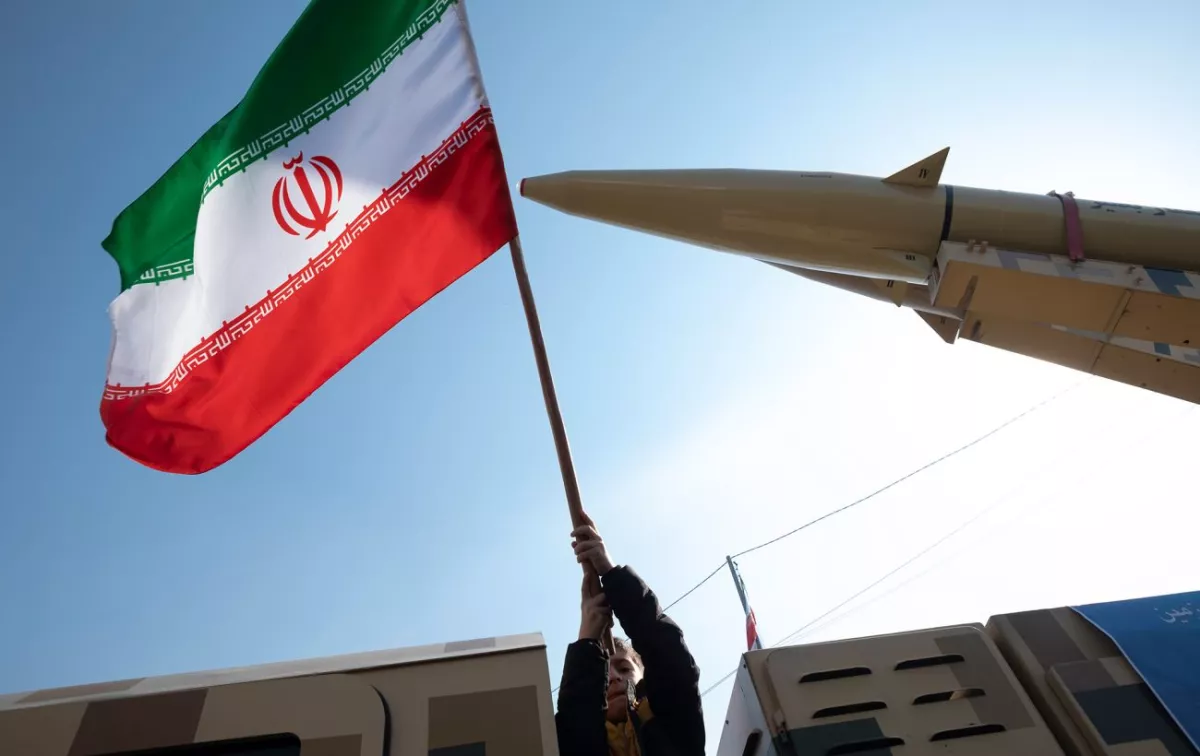
Previously, Tehran threatened retaliatory action against Kyiv following a strike on an Iranian merchant vessel in the Caspian Sea, which resulted in the death of a sailor.
According to Defense Express, Iran possesses several types of ballistic missiles capable of reaching Ukrainian territory. These include the Ghadr, Emad, and Sejjil missiles, with a stated range of around 2,000 km, as well as the Khorramshahr missile, whose estimated range may reach 4,000 km.
The publication notes that the most effective systems for intercepting such missiles are the THAAD and Arrow missile defence systems, neither of which is in service with Ukraine. At the same time, the capabilities of the Patriot system against such targets are limited.
Experts point out that Iran's stockpile of medium-range missiles has been significantly reduced following strikes on Israel, as well as attacks on Iranian launchers, warehouses, and production facilities.
Are such Iranian attacks on Ukraine possible at all? Is Tehran capable of taking such a step in its current difficult situation? How could Ukraine respond? And how would Iran's principal adversaries—the United States and Israel—react if events were to unfold in this way?
Well-known foreign experts shared their views on these questions with Caliber.Az.

Serhiy Danylov, Deputy Director of the Kyiv-based Center for Middle Eastern Studies, stated that such a possibility exists from a technical standpoint.
"Iran possesses Ghadr, Emad, and Sejjil medium-range ballistic missiles which, if launched from the country's northern and northwestern regions, are capable of reaching certain parts of Ukraine. The Khorramshahr family of missiles has an even greater range. However, the mere possession of missiles capable of reaching Ukraine does not, in itself, mean that Tehran is prepared to use them.
A direct missile strike on Ukraine would be an extremely risky decision for Iran. It would not provide Tehran with any significant military advantage but would considerably expand the circle of its adversaries. In effect, Iran would be opening another front at a time when it is already under intense pressure from the United States and Israel, suffering losses, and being forced to conserve its missiles and air defence assets.
Moreover, the Ukrainian-Iranian conflict has no independent strategic significance for Tehran. Ukraine does not threaten Iranian territory, does not seek regime change in Iran, and is not involved in the war in the Middle East. The confrontation emerged because of Iran's military cooperation with Russia and the use of Caspian logistics to transport cargo linked to Russia's war effort.
That is why the most likely purpose of Iran's current rhetoric is to encourage political restraint on Ukraine's part, deter further strikes on Caspian logistics, and demonstrate to its domestic audience that the leadership is defending national interests. In this case, the threat of retaliation is primarily a tool of political pressure.
The conversation between Andrii Sybiha and Abbas Araghchi indicates that both sides are still seeking to keep the situation within diplomatic boundaries. The Ukrainian side explained the causal link between the strike, the vessel's route, its role in Russian-Iranian military logistics, and Ukraine's right to self-defence. Iran, for its part, demanded compensation while at the same time emphasising that it does not seek further escalation," the expert said.
In his opinion, when a state is genuinely preparing for an immediate military response, it usually avoids declaring that it does not seek escalation and does not reduce the dispute to the issue of compensation.
"In this case, Tehran is leaving itself room to present diplomatic explanations or symbolic concessions as a satisfactory outcome.
Ukraine has also chosen a pragmatic approach. Kyiv has not responded to the Iranian statements with emotional threats, but neither has it abandoned its principled position: assets involved in supporting Russia's war effort cannot automatically be considered neutral simply because they formally belong to a third country.
The issue of compensation will most likely remain, for the time being, at the level of diplomatic protocol. Ukraine may express regret over the loss of human life.
The likelihood of a direct Iranian missile strike on Ukrainian territory can be assessed as low, although it cannot be completely ruled out. In such a scenario, Kyiv could continue striking ships, warehouses, and transport routes used to supply weapons to Russia.
Iran is technically capable of launching a missile strike against Ukraine; however, at present, such a scenario does not appear to be the most likely. Tehran stands to gain too little while risking too much. A direct strike would transform the limited dispute over Caspian military logistics into a separate international conflict.
Both sides understand this. Ukraine has made its position clear, has not renounced its right to strike Russia's military logistics, and at the same time has not given Iran an opportunity to portray Kyiv as an uncontrollable participant in someone else's war. Iran, for its part, has maintained its combative rhetoric but has effectively shifted the conflict into the realm of diplomatic complaints and demands for compensation.
Therefore, the most likely scenario is not a direct Iranian strike on Ukraine, but continued pressure exerted through Russia," Danylov believes.

Ukrainian analyst, PhD in Political Science, and President of the International Security Studies Institute, Oleksii Buriachenko, noted that the incident in the Caspian Sea can be explained as follows: the Iranian vessel, which according to publicly available information was transporting weapons for the Russian Federation, became the target of a Ukrainian long-range strike.
"First of all, everyone should clearly understand that those who supply the Russian Federation with weapons become co-aggressors in the Russian-Ukrainian war. If they are co-aggressors, then Ukraine's actions, including preventive ones, are fully consistent with international law and are lawful. Any actor, any third party—regardless of whether it is Iran or anyone else—must understand that assisting the Russian Federation in carrying out its aggression and supplying it with weapons makes them a legitimate target for Ukraine.
There is nothing surprising about this incident. The only difference is that Ukraine previously did not possess the highly effective long-range capabilities it has today. Iran should draw the appropriate conclusions. If it intends to continue supplying Russia with weapons, as it has done since the beginning of the war—including at the very least drones that, regardless of the manufacturer, have become widely known as 'Shaheds'—it must understand that Ukraine will take measures aimed at disrupting such logistics.
The key point here is that Ukraine is not acting aggressively toward Iran. It is not striking Iranian territory and has not joined the U.S.-Israeli coalition.
Ukraine's actions are directed exclusively against the supply of Iranian weapons to the Russian Federation," the researcher said.
According to him, if Ukraine is already capable of operating more than 2,000 km deep inside the territory of the Russian Federation, including against Iranian military logistics supporting Russia, then it undoubtedly has the means to respond to Iran itself.
"I believe the question should be framed differently: does Iran itself need this? Against the backdrop of its confrontation with the United States and Israel, is it really in Tehran's interest to increase the number of its adversaries? Under the current circumstances, such a configuration would benefit only one player—the Russian Federation. Naturally, Moscow would greatly welcome Iran becoming fully drawn into a war against Ukraine; it would applaud such a development.
But is it in Tehran's interest to fall for such manipulation? I certainly cannot rule out the possibility that the Russian Federation may soon stage some kind of provocation and blame Ukraine for it. All parties should understand one simple fact: the Russian Federation is the aggressor state. Assisting an aggressor means becoming its co-aggressor and violating international law.
Iran now faces a choice: either continue assisting Russia in its war against Ukraine and thereby acquire another dangerous adversary, or halt its weapons supplies to Moscow, in which case Ukraine will have no grievances against it. Previously, Kyiv had never taken any action against Iran itself. However, military logistics supporting the delivery of weapons to Russia remains an entirely legitimate target.
I am firmly convinced that neither Iran nor Ukraine needs mutual escalation. Ukraine remembers that Iran has been supplying Russia with weapons since the beginning of the war, yet it has not taken retaliatory steps against Iran itself. Therefore, I believe both sides should set emotions aside and seek to resolve the situation through political and diplomatic means.
Because escalation would benefit only the enemies of both Ukraine and Iran," Buriachenko concluded.







 editor@caliber.az
 +994 55 444-88-98
 Азербайджан, Баку, ул. Низами, 203, Af Business House, 5-й этаж