










Kallas’s claim vs ground reality in the South Caucasus Peace despite Brussels
The rhetorical line observable in statements by representatives of the European Union regarding the peace process between Baku and Yerevan continues to astonish with its systematic distortion of concepts.

And once again, a recent remark by the EU’s High Representative for Foreign Affairs, Kaja Kallas, that the normalisation of relations between Azerbaijan and Armenia is “very important for us (the EU – ed.),” at first glance sounds quite correct and even moderately diplomatic. However, on closer examination, it reveals the same hidden subtext and the desire to ascribe to the EU the role of a participant and even an architect of processes in which it has no real involvement.
And to verify this, it is enough to take even a brief historical excursion into the now-defunct Armenian-Azerbaijani conflict. As is known, for almost 30 years, indigenous Azerbaijani lands remained under Armenian occupation. At the same time, the aggressor state – Armenia – deliberately ignored international law, including United Nations Security Council resolutions that demanded the complete and immediate withdrawal of all Armenian armed forces from the occupied Azerbaijani territories.
This continued not for a year or two – it lasted for decades. And here a logical question arises: “What did the European Union undertake with regard to a country that trampled on the norms and principles of international law?”
The answer to this question is quite simple; it is, so to speak, publicly available. The EU did nothing to compel Yerevan to comply with the requirements of international legal documents. In the same way, Brussels turned a blind eye to the Khojaly genocide, ethnic cleansing, ecocide, urbicide, and the destruction of Azerbaijan’s historical, cultural, and religious heritage in the occupied territories of Azerbaijan. Not a single sanction was imposed by the European Union against the country that committed these atrocities.
Everything happened in exactly the opposite way: in Europe, which lectures almost the entire world on democratic values, events took place that can hardly be described as anything other than political cynicism. For instance, friendship groups with the so-called “NKR” — a separatist entity illegally established on the internationally recognised territories of Azerbaijan — operated within the European Parliament.
In addition, a number of French cities concluded “twinning” agreements with settlements located in the occupied Azerbaijani territories. Incidentally, France in general played a particularly active role in all the EU’s political manoeuvres concerning the now historical Armenian-Azerbaijani conflict.
Paris not only shaped a biased agenda within the EU, but also attempted to promote anti-Azerbaijani initiatives on international platforms. The culmination of this hypocrisy was France’s position during the 44-day war in the autumn of 2020, when Azerbaijan conducted military operations on its own territory, exercising the right to self-defence enshrined in Article 51 of the UN Charter. At that time, a large-scale political and information campaign was launched against Baku, with European countries at the forefront.
The French Senate, in particular, stood out in this so-called show of “defence and support for the long-suffering side,” adopting a resolution on the recognition of the “independence” of the so-called “NKR.”
Attempts at pressure, accompanied by accusations lacking any substantiated basis, continued in the Parliamentary Assembly of the Council of Europe (PACE) and the European Parliament even after September 2023 — that is, after Azerbaijan had fully restored its territorial integrity and sovereignty as a result of a one-day counter-terrorism operation in the Karabakh region.
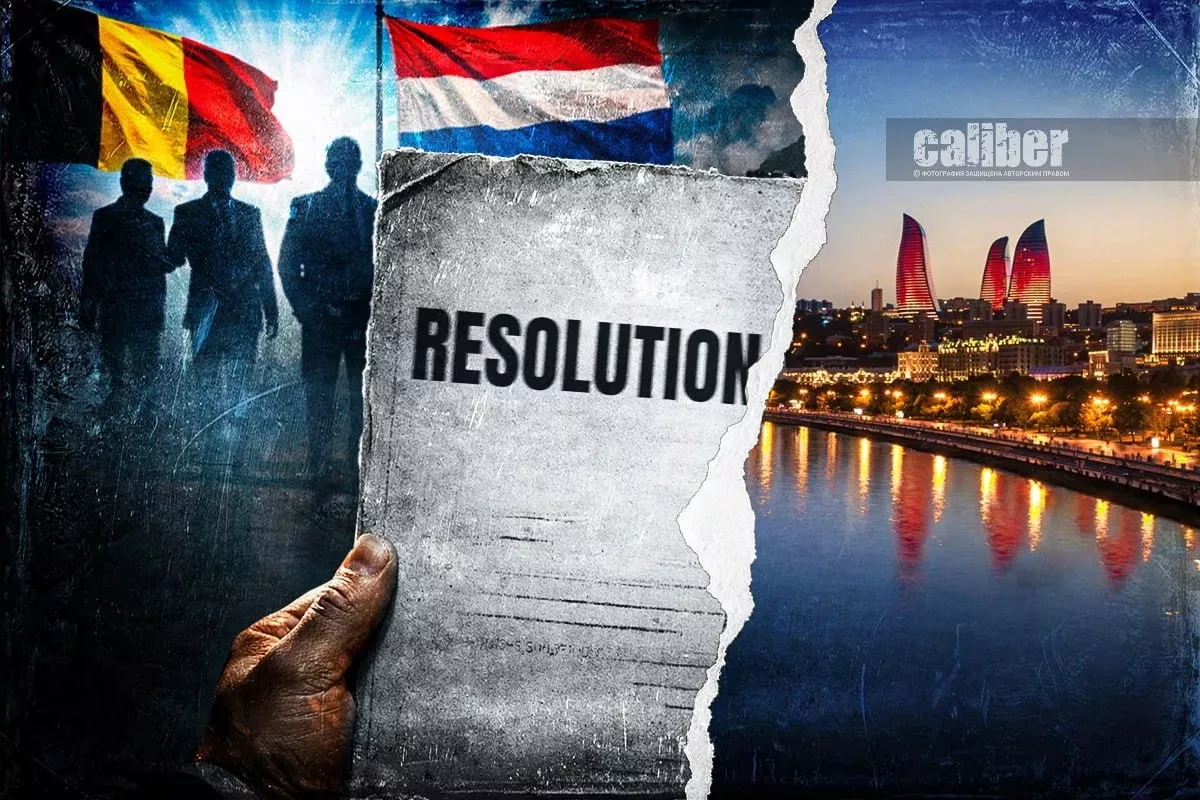
Following the Washington summit in August last year, it may have seemed that Europe’s self-proclaimed “defenders of rights and freedoms” had finally calmed down, but that was not the case. A recent example is the resolutions adopted on April 16 this year by the parliaments of the Netherlands and Belgium, which constitute an open interference in the internal affairs of the Azerbaijani state and completely ignore the realities of the region. These “documents” are not merely detached from facts — they contradict the very spirit of the normalisation process between Baku and Yerevan and undermine the foundations of the fragile peace that has recently been de facto established in the South Caucasus, achieved exclusively as a result of Azerbaijan’s military and political successes.
Against this backdrop, Kallas’s statement appears, to put it mildly, unconvincing and more like an attempt to “attach oneself” to a process in which the European Union not only has no real role, but has in fact repeatedly made every possible effort to prevent it — namely, to stop the region from transforming from an area of confrontation into a space of cooperation and development.
Thus, any attempts by the EU to position itself as an objective and neutral mediator appear not merely questionable, but openly untenable. In such a situation, it would be more reasonable for the European Union to abandon its rhetoric of self-aggrandisement and acknowledge the obvious: peace in the South Caucasus has become possible not thanks to Brussels, but in spite of it.







 editor@caliber.az
 +994 55 444-88-98
 Азербайджан, Баку, ул. Низами, 203, Af Business House, 5-й этаж