










Sun, wind and power: Azerbaijan’s green energy transformation Overview by Khazar Akhundov
As part of the global energy transition towards 2030, Azerbaijan is steadily developing its renewable energy sector, including by attracting foreign investment. To support this process, the country has established a modern legislative framework, introduced fiscal and other incentives for investors, and expanded cooperation with leading specialised companies from Türkiye, the United States, the Gulf countries and Europe. China has also emerged as one of Azerbaijan's key partners in the renewable energy sector. On September 16, Azerbaijani President Ilham Aliyev attended the inauguration of the 100-MW Gobustan solar power plant in the Garadagh district of Baku. The facility was built by Shanghai-based Universal International Holdings Limited.
The inauguration ceremony was also attended by Energy Minister Parviz Shahbazov, Chinese Ambassador to Azerbaijan Lu Mei, and Yi Nan, Chief Executive Officer of Universal International Holdings Limited.
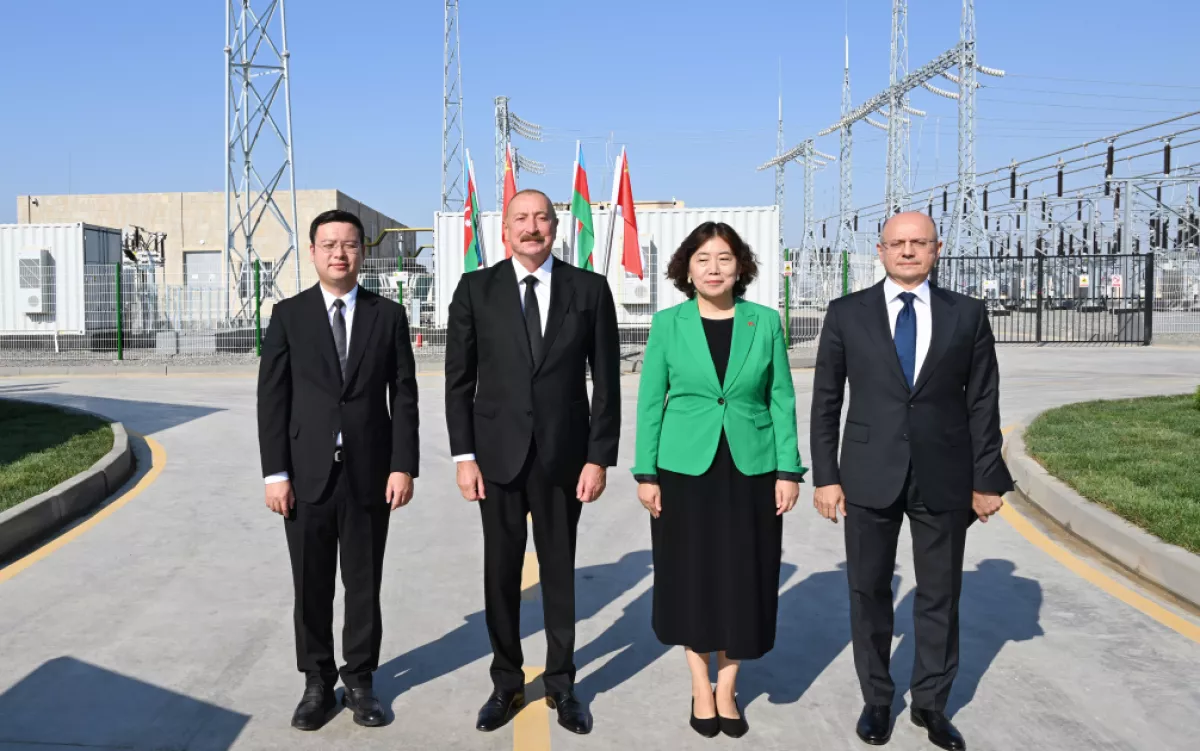
During the ceremony, officials noted that the Gobustan solar power plant is Azerbaijan's first renewable energy project to be implemented through an auction. In 2023, a Cabinet of Ministers decision allocated a 300.77-hectare plot in the Pirsaat settlement of Baku's Garadagh district for the construction of a solar power plant and put the project out to auction. The Chinese company won the competitive selection process in 2024, securing its first contract to develop a renewable energy facility in Azerbaijan.
It is noteworthy that the new solar power plant was completed in an exceptionally short period. In addition to the solar panels, the facility is equipped with field inverters and transformers, while all cable installation works have been completed. Once operating at full capacity, the Gobustan solar power plant is expected to generate around 200 million kilowatt-hours of electricity annually, saving approximately 45 million cubic metres of natural gas each year and reducing carbon dioxide emissions by an estimated 97,000 tonnes.
With the plant's commissioning, the total capacity of Azerbaijan's renewable energy facilities has reached 2,170 MW, while the number of renewable energy plants has risen to 85.
The development of green energy has been identified as a key priority of Azerbaijan's energy policy and an important means of attracting foreign direct investment (FDI). This strategy also seeks to connect Azerbaijan's power system more closely with international markets through major projects to expand transmission infrastructure, including power lines, substations and subsea power cables across the Black and Caspian seas, enabling the export of electricity to Türkiye and European countries.

Meanwhile, studies confirm that Azerbaijan has a natural renewable energy potential of 135 GW onshore and 157 GW offshore. At the same time, the technically and economically viable potential is estimated at 27 GW, including 3 GW of wind energy and 23 GW of solar energy, while the bioenergy potential is estimated at 380 MW and the potential of mountain rivers at 520 MW.
Alongside the Caspian Sea coast, the Karabakh and East Zangezur economic regions and the Nakhchivan Autonomous Republic have also been designated as green energy zones. In this regard, specialists from the Ministry of Energy, with the support of the Japanese company TEPSCO, prepared a comprehensive concept and action plan for the liberated territories, which are now being implemented. Over the past five years, small diversion and dam-based hydropower plants with a combined capacity of 310 MW have been commissioned in the Karabakh region, while solar and wind power facilities are also under construction.
The country's green natural resources are being developed in stages, and renewable energy generation already accounts for approximately 20.8% of the total capacity of Azerbaijan's power system. According to estimates by the Ministry of Energy, investment in the construction of 11 solar and wind power plants will exceed $2.7 billion by 2027, adding another 2 GW of capacity to the country's power system. Under medium-term plans, by 2030, 6 GW of solar, wind and hydropower capacity will be integrated into the national power system, with this potential expected to increase to 8 GW by 2032.
As Minister of Energy Parviz Shahbazov said in his speech at the recently held fourth Climate Week of the UN Framework Convention on Climate Change (CW4), “by the end of 2026, Azerbaijan expects almost a sixfold increase in wind power generation and more than a 26% increase in solar power generation. Alongside the implementation of solar and wind energy projects, electricity grids are currently being strengthened, energy storage systems are being introduced, the flexibility of the power system is being enhanced, and new energy interconnectors are being established.”
It is noteworthy that solar and wind power plants are being built with financial and technical support from companies from Saudi Arabia and the United Arab Emirates, through investments by a number of Chinese companies, as well as through projects by bp and Nobel Energy. The flow of foreign direct investment into Azerbaijan's green sector also remains strong. According to information published in recent days, UAE-based Masdar is exploring the possibility of expanding the Garadagh Solar Power Plant and implementing new renewable energy projects in Azerbaijan. To this end, a cooperation agreement was signed with the Azerbaijan Green Energy Company (AGEC).
Another joint initiative by Masdar and AGEC envisages the potential implementation of a 100-MW green energy generation project capable of supplying electricity around the clock. The project is planned to be integrated with a large-scale energy storage system to ensure reliable and controllable electricity supplies.
Meanwhile, one of the most important effects of developing the renewable energy sector in Azerbaijan is expected to be the saving of natural gas for domestic consumption and the expansion of profitable chemical production. As European Commissioner for Energy and Housing Dan Jørgensen recently noted, this creates additional opportunities for Azerbaijan to increase its export revenues.
Thus, Azerbaijan's efforts to develop the renewable energy sector not only strengthen the country's contribution to protecting the planet from climate change, but also enhance its international standing as a reliable partner making a valuable contribution to diversifying global energy supplies and ensuring the energy security of many countries.







 editor@caliber.az
 +994 55 444-88-98
 Азербайджан, Баку, ул. Низами, 203, Af Business House, 5-й этаж