










World under the “law of the jungle” Reflections by Teymur Atayev
The first direct negotiations between Iran and the United States in nearly half a century have once again brought to the forefront a key question: where is the line between political pressure and the threat of the destruction of an entire civilisation?
Here it is appropriate to recall Herbert Spencer’s idea: “[...] every man has freedom to do all that he wills, provided he infringes not the equal freedom of any other man.”

However, reality sounds different. Majid Moosavi, commander of the IRGC Aerospace Forces, in response to US Defense Secretary Pete Hegseth, stated that “Hollywood illusions have so contaminated your thinking that you threaten a civilization that is over 6,000 years old with a meager 250-year history.”
Will wars that have shaken the planet in recent years — taking the lives of tens of thousands of innocent people and leading to ethnic cleansing under various “noble” pretexts — come to an end at all?
Pope Leo XIV immediately described anti-civilisational calls “against the entire people of Iran” as unacceptable and urged all people of goodwill to “reject war—especially a war which many people have said is unjust.” He also referred to attacks on civilian infrastructure as actions contrary to international law.
At the same time, the head of the Roman Catholic Church emphasised an important moral dimension of the situation: attacks on civilian infrastructure are “a sign of the hatred, division, and destruction that the human being is capable of.”

In doing so, he effectively brought back into focus the reflections of the outstanding German theoretical physicist and mathematician, one of the founders of quantum mechanics, Max Born, who as early as the mid-20th century defined scientific activity as a direct contribution to the development of civilisation.
At the same time, Born very precisely characterised a situation that in many ways resonates with today’s reality: “Science in our technical age has social, economic, and political functions.” This definition is truly unique, as today we can observe even more clearly how the technological boom has given scientific development a distinctly political dimension. The latest advances, including artificial intelligence, have turned science into a direct participant in global political life.
Moreover, Max Born emphasised that modern weapons of mass destruction leave no space “for any ethical constraints, reducing the soldier to the position of a technological killer.” He linked the disappearance of an “ethical code” to the substitution of moral categories with the “laws of the state.” Born explicitly used the concept of the “law of the jungle,” transforming into a “new ethics.”

Today, we are increasingly confronted with manifestations of the “law of the jungle” in international relations. As early as the 20th century, Max Born warned that in conditions of moral degradation even “conventional weapons” turn into an “instrument of unlimited destruction” — directed not only against military targets but also against infrastructure and civilian populations, destroying people and “irreplaceable achievements of civilisation.”
It is striking how precisely these assessments reflect what is happening today. Even then, Born was in effect describing the “concept of total war,” stressing that humanity could be saved only through the renunciation of the use of force and the strengthening of moral and ethical principles. Only this path, he argued, could ensure peaceful coexistence. To support his conclusions, he cited the example of the bombing of German cities in the final years of the Second World War, which had no direct military significance. Beneath their ruins lay “hundreds of thousands of civilians.” According to him, it was precisely then that the moral barriers were destroyed — when “evil was met with even greater evil.” It was also then that forms of “inhuman killing” emerged through the use of remote technologies — without personal risk and, consequently, without responsibility. Born called these phenomena “push-button war.”
After the surrender of Germany and the de facto collapse of Japan, which “through diplomatic channels requested peace,” nuclear weapons were used in Hiroshima and Nagasaki.
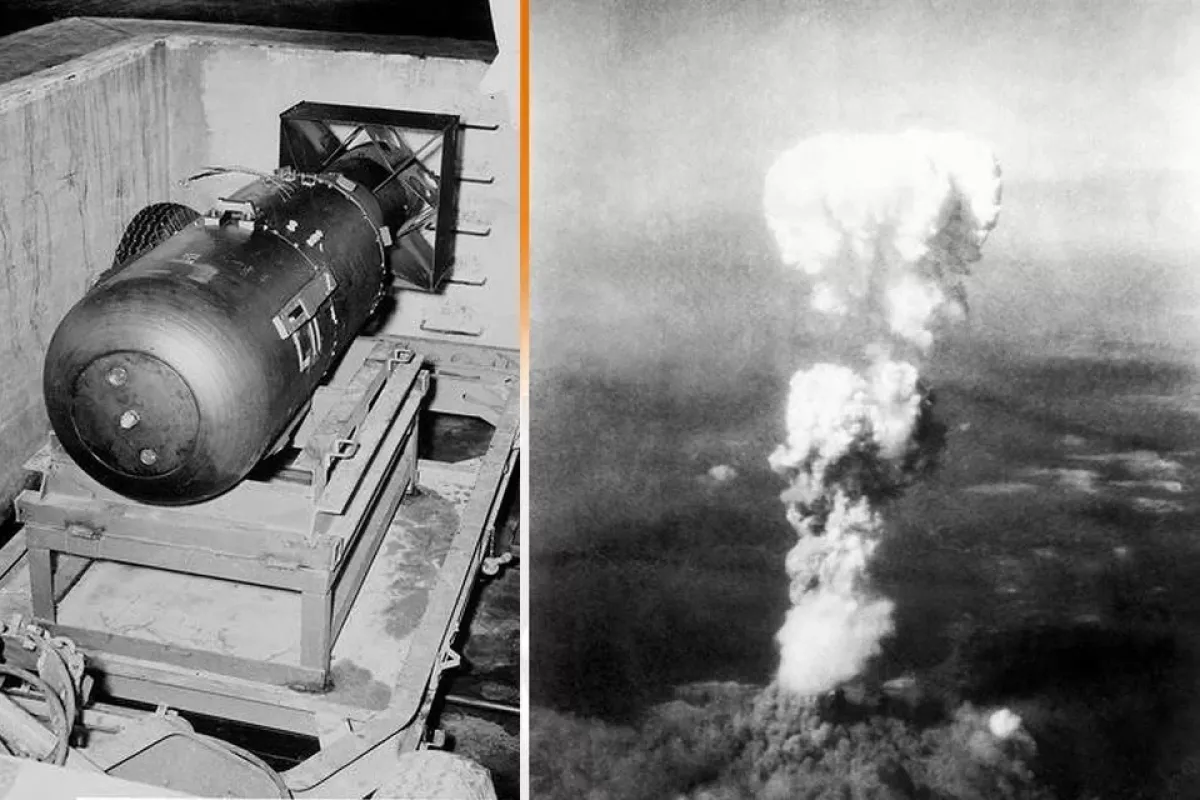
As a result, the great powers came to possess many times more nuclear weapons than would be required to destroy all of humanity, and politics began to be structured around maintaining a “balance of fear.” People, in Born’s words, became “indifferent to danger due to the spread of moral paralysis.”
Starting from the thesis of the constancy of human nature, according to which “wars have always existed and will always exist,” Born concluded that only universal peace could become a condition for the survival of the human race. In this regard, the key question is formulated as follows: can political, economic and ideological contradictions be resolved solely “by means of force or war”?
Against this backdrop, the Nobel Prize-winning physicist expressed hope that only the union of two spiritual principles — “a moral awareness of the inadmissibility of war, which has degenerated into mass murder of the defenceless, and a rational understanding of the incompatibility of modern war with the survival of humanity” — could prevent a global catastrophe.
The relevance of these assessments only continues to grow. The world is becoming increasingly unstable. As Born warned, “a human or technical error, the blind bias of a political leader, or an outbreak of mass nationalist psychosis can at any moment lead to catastrophe.” At the same time, he explicitly stated that overcoming the “amorality and recklessness that govern the world” depends on people themselves.
In essence, Born described today’s reality, in which the destruction of infrastructure and the killing of civilians — including strikes on schools — are presented as acceptable. Against this backdrop of what is, in effect, a destructive civilisational crisis, a few sober voices still emerge.
The English historian Basil Matthews, decades before the publication of Samuel Huntington’s well-known work “The Clash of Civilisations and the Remaking of World Order” (1996), also expressed ideas resonating with Born’s reflections. He noted that humanity had turned the material achievements of science against itself — using them to destroy “millions in wars” and bringing technology to “diabolical perfection” on the eve of new conflicts in which Western civilisation itself could ultimately destroy itself.
According to Matthews, despite achieving significant success, “the West has suffered a catastrophic failure in controlling the moral and spiritual dimensions of material power.” As he wrote, even if Western civilisation — obsessed with material well-being and intoxicated by scientific progress — is capable of destroying the old order in Islam, it is unable to offer a viable alternative.
The article may be concluded with the words of one of Arthur Conan Doyle’s characters: “So-called progress may at any moment turn into a terrible disaster, because we have forgotten that the only possible progress is the improvement of man. The mind and spirit must be constantly trained, for both are neglected in us. With age we should become better, kinder, more generous, more tolerant. The Earth is a kind of factory of souls, but at present it produces rejects.”







 editor@caliber.az
 +994 55 444-88-98
 Азербайджан, Баку, ул. Низами, 203, Af Business House, 5-й этаж