










Azerbaijan’s roadmap to a multipolar world Baku at the SCO anniversary summit
Today, Bishkek is hosting the anniversary summit of the Shanghai Cooperation Organisation (SCO), marking 25 years since the organisation’s founding documents were signed in Shanghai. The main meeting of the Council of Heads of State will take place on September 1, while high-level events will be held on August 31 and September 1 under the chairmanship of Kyrgyz President Sadyr Japarov and the theme of Kyrgyzstan’s SCO presidency: “25 Years of the SCO: Together Towards Sustainable Peace, Development and Prosperity.” Eighteen countries and seven international organisations are represented in the Kyrgyz capital.
President of the Republic of Azerbaijan Ilham Aliyev will participate in the SCO+ meeting. The session’s theme is stated without diplomatic euphemisms: the UN as a key element of a just world order and the contribution of SCO+ states to shaping a multipolar world. The wording itself is a diagnosis of the current era. The organisation, which began in 2001 as a mechanism for building border confidence among six states, is now discussing the architecture of the world order.
What “SCO partner” means in practice
Baku joined the organisation’s orbit in 2016 as a dialogue partner, and in 2024 applied to upgrade its status to that of an observer. Last year’s Tianjin summit resolved the issue in an unexpected way: the observer and dialogue-partner statuses were merged into a single status — “SCO partner.” Today, sixteen countries fall into this category, ranging from Türkiye and Saudi Arabia to Mongolia and Myanmar.
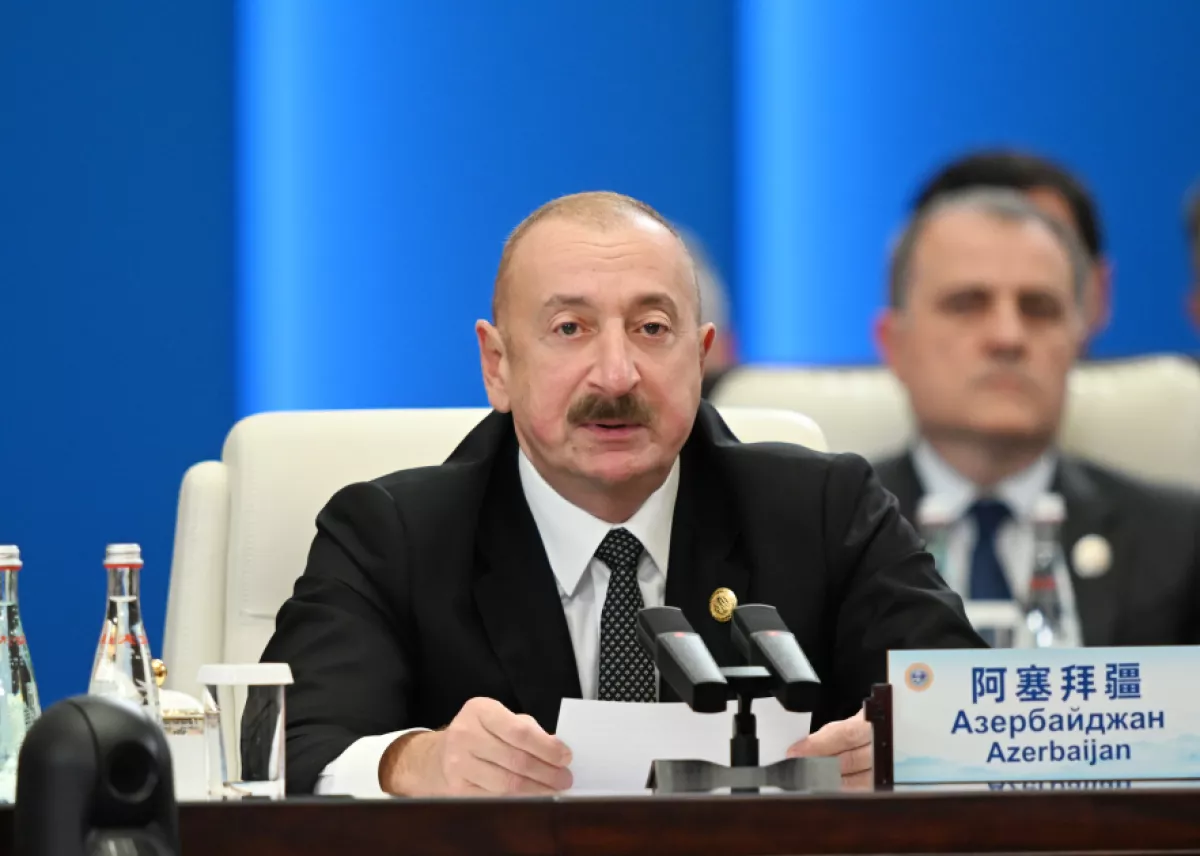
A sceptic may note that the status is non-binding, but that is precisely where its value lies. Azerbaijan is building its relations with the SCO not as a country seeking entry into the club, but as a state whose transport and energy assets are vital to the club. President Ilham Aliyev’s presence at the summits in Samarkand (2022), Astana (2024), Tianjin (2025), and now Bishkek is a consistent reaffirmation of one point: Eurasian connectivity does not work without Azerbaijan.
The substance of the cooperation confirms this. It covers regional security and stability; countering terrorism, extremism and separatism; combating drug trafficking and cybercrime; customs and legal cooperation; trade; investment; energy; telecommunications; the agricultural sector; and ties among small and medium-sized businesses. One separate area is the efficient use of existing transport infrastructure, the development of interregional multimodal corridors, and the expansion of transit potential. There is also a humanitarian dimension: science, education, healthcare, tourism, emergency assistance, intercivilisational dialogue and multiculturalism — areas in which Baku has decades of practical experience to show, rather than mere declarations.
Corridors as an argument
The key areas of Azerbaijan’s interaction with SCO member states are the East-West and North-South routes. Here, abstract talk of multipolarity is translated into container counts and transit times.

The Middle Corridor went from a Chinese theoretical concept to a European necessity after 2022, and every possible configuration of the route converges on the same stretch: the Caspian Sea — Azerbaijan — Georgia and Türkiye. None of the SCO members interested in accessing Western markets can bypass this geography. At the same time, Baku remains a key link in the North-South Corridor, connecting Russia with Iran and India. Operating simultaneously on two routes whose participants compete with one another is not so much a logistical challenge as a political one. Azerbaijan has been managing this balancing act for years.
A new element has now been added. The initialling of the peace agreement between Armenia and Azerbaijan in Washington on August 8 last year, along with the agreements on the TRIPP route, removes the last geographical obstacle to direct connectivity between the Caspian Sea and Türkiye and onward to Europe. For SCO states, this means something concrete: a shorter route and the removal of political risk along a section that had remained closed for decades. It is telling that in Bishkek, the SCO+ meeting will bring together the leaders of both Azerbaijan and Armenia — a situation that would have been unthinkable just a few years ago and became possible only because Baku restored its territorial integrity and sovereignty through its own efforts and then offered the region peace rather than revanche.
Bishkek as a bilateral story
The current summit also has a second, strictly bilateral dimension. A month ago, on July 30–31, Ilham Aliyev made a state visit to Kyrgyzstan — the second such visit in the history of bilateral relations. In Cholpon-Ata, the Treaty on Allied Relations between the Republic of Azerbaijan and the Kyrgyz Republic was signed, while a decision adopted at the third meeting of the Interstate Council was approved.
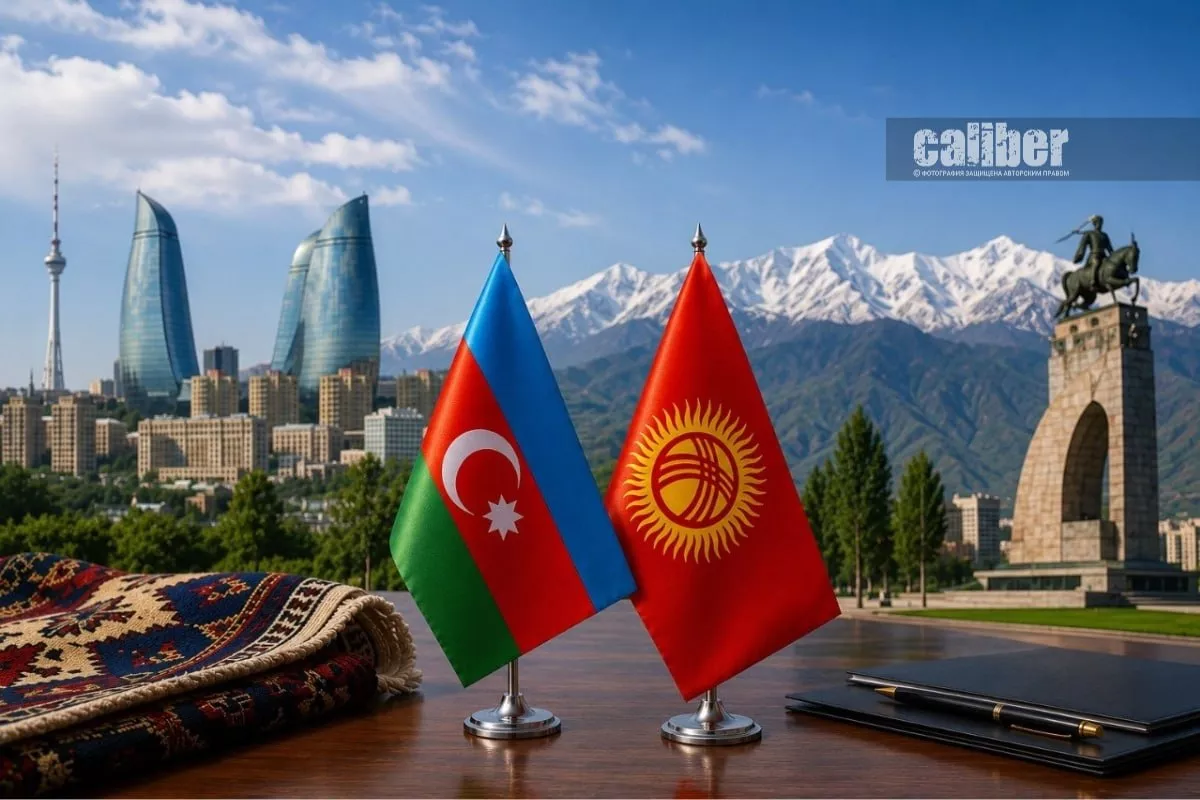
It is worth taking stock of the distance covered. Diplomatic relations were established on January 19, 1993; Azerbaijan’s embassy in Bishkek opened in 2007, while Kyrgyzstan’s embassy in Baku opened in 2014. The Declaration on Strategic Partnership was signed in April 2022, when the Interstate Council was also established. It took just four years to move from strategic partnership to allied relations. In total, the two countries have signed 119 bilateral documents.
The humanitarian dimension is no less telling than the legal framework. In Bishkek, with financial support from Azerbaijan, the Kyrgyz-Azerbaijani Friendship Park was established, while Gymnasium Complex No. 20 named after Heydar Aliyev and School No. 103 named after Nizami Ganjavi were opened. In Baku, School No. 133 was named after Chingiz Aitmatov, and a monument to the writer was erected in the Binagadi district. Sister-city ties now link Baku and Bishkek, as well as Goychay and Kant. In the liberated village of Khidirli in the Aghdam district, the Kyrgyz government has funded the construction of a full secondary school named after Aikol Manas, with a capacity of 528 students — a gesture that needs no translation in the Turkic world. AZAL operates four scheduled flights per week on the Baku–Bishkek–Baku route, as well as one non-scheduled flight to Issyk-Kul.
Multilateralism as an operating model
There is also a detail that officials in Beijing like to recall: in 2021, at the initiative of the Heydar Aliyev Foundation, a bust of the poet Nizami Ganjavi was installed at the SCO headquarters to mark the 880th anniversary of his birth — the second bust there after that of Confucius. The symbolism is remarkably precise. Azerbaijan’s presence in the organisation began with the cultural dimension and only later expanded into the transport and political spheres.
The term “middle power” describes a state that does not seek global dominance but possesses sufficient resources to shape the agenda in its region and remain an indispensable intermediary beyond it. No one appointed Azerbaijan to this category. It earned its place through sustained work.
The geography of Azerbaijan’s diplomacy in recent years can be read as a map of overlapping international platforms. From its successful chairmanship of the Non-Aligned Movement from 2019 to 2023 to its hosting of COP29 and the World Urban Forum, Azerbaijan has steadily expanded its diplomatic reach. Its membership in the D-8, the Economic Cooperation Organisation (ECO) summit held in Khankendi in July and the first-ever ECO Week that followed, the Organisation of Turkic States summit in Gabala in October, and its chairmanship of CICA in 2024–2026 all point in the same direction. Azerbaijan is also preparing to host upcoming summits of the CICA and Organisation of Islamic Cooperation, while the European Political Community summit is scheduled to be held in the country in 2028. At the same time, Baku’s ties with countries across Asia and Africa are gaining momentum, while the historic Washington visit has opened the way for a new stage in relations with the United States.
At first glance, this may seem like an eclectic collection of forums, organisations and diplomatic tracks. In reality, they reflect a coherent strategy: for Baku, multilateralism is not simply a foreign-policy tool but an operating model. The wider the network of partnerships and platforms, the less dependent Azerbaijan becomes on any single one of them.
That is why Azerbaijan’s participation in the Bishkek summit is not a question of seeking membership or waiting for an invitation to a particular organisation. A country that has hosted the ECO summit in Khankendi, is preparing to host the OIC summit, chairs CICA, and has a seat at the SCO+ table has already demonstrated where it sees itself in the emerging international order.
Baku’s answer has not come in the form of a grand declaration. It has been built, step by step, into a diplomatic roadmap.







 editor@caliber.az
 +994 55 444-88-98
 Азербайджан, Баку, ул. Низами, 203, Af Business House, 5-й этаж