










Route with guarantees: Why logistics is turning to the Caspian Analysis by Khazar Akhundov
As a key transport hub on the Caspian Sea, Azerbaijan is strengthening logistics cooperation with Central Asia (CA), Türkiye, China and Europe. Amid today’s complex geopolitical environment, the country’s port and railway infrastructure is becoming increasingly important to the development of the Middle Corridor. At the same time, further growth in freight traffic will require stronger logistical links among countries across the region, greater integration of digital systems and the removal of existing bottlenecks. These issues were discussed in Baku at the international conference “The Role of Ports in Regional Connectivity and Strategic Cooperation”, as well as at the 5th Black and Caspian Freight Forum 2026: Corridors, Infrastructure, Investments, held a day earlier.

With the active support of the Caspian states, the Trans-Caspian International Transport Route (TITR) has been operating successfully for eight years, forming the backbone of the Middle Corridor. As part of the historic trade routes of the Great Silk Road, Azerbaijan also remains a key participant in the Europe-Caucasus-Asia Transport Corridor (TRACECA), an initiative launched by the EU three decades ago. Along a parallel route, the Azerbaijan–Turkmenistan Lapis Lazuli corridor is also developing. In addition, Baku and Ashgabat, together with Tbilisi and Bucharest, are promoting the prospective Black Sea–Caspian Sea transport route.
Middle Corridor: Faster transit and growing freight volumes
The main advantage of the Trans-Caspian route is its growing importance as a transit artery for China, one of the world’s largest industrial and trading powers, as containerised cargo flows between China and Europe continue to increase. To facilitate these trade and transport links, China launched the Belt and Road Initiative, while the Caspian states have in recent years steadily modernised their port and railway infrastructure in cooperation with Beijing.
At the same time, countries across the region are simplifying cross-border and customs procedures and speeding up transit through the introduction of electronic consignment notes (e-CMR), digital permit systems and single-window platforms. These measures are creating greater opportunities for the efficient handling of multimodal freight.
As a result, transit times along the TITR have fallen sharply over the past four years, from 58–60 days to 15–17 days. Over the same period, the volume of transit cargo has increased more than sevenfold, from 600,000 tonnes in 2021 to 4.5 million tonnes in 2025.
The momentum has continued into 2026. According to Kazakhstan’s Ministry of Transport, the total volume of freight transported along the TITR increased by 22% in January–August 2026, while east-west transit traffic grew by 55%.
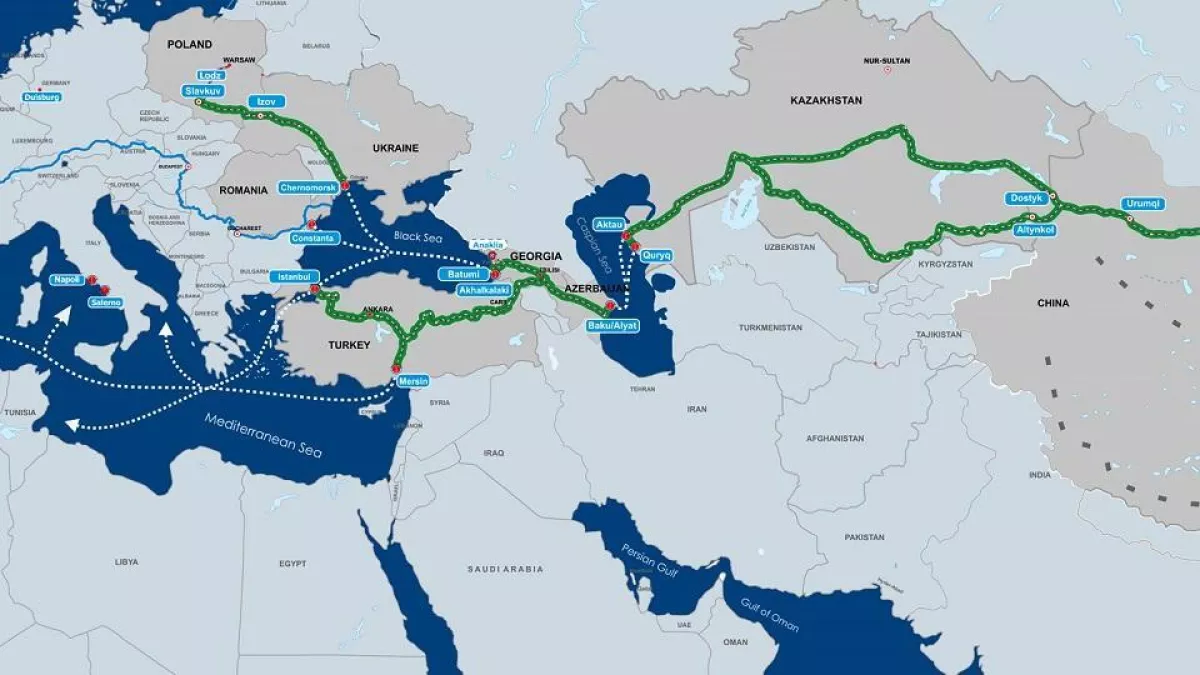
Positive trends are also being recorded on the western shore of the Caspian Sea. Speaking at the conference “The Role of Ports in Regional Connectivity and Strategic Cooperation”, Eldar Salahov, Director General of Baku International Sea Trade Port LLC (BISTP), said: “More than 85,000 containers (TEUs) were handled at the Baku Port in January–August 2026, 22% more than during the same period last year. Growth has been recorded across all areas: during the reporting period, 1.6 million tonnes of dry cargo were handled, 80% more than a year earlier.”
For the full year, cargo throughput at BISTP is projected to reach 8.8 million tonnes, while container traffic could rise to 121,000 TEUs. Khudayar Hasanli, an adviser to the director of BISTP LLC, said: “Against the backdrop of recent geopolitical developments, an increasing number of traders and logistics companies are choosing the resilient Middle Corridor, and the pace of freight growth along this route is enormous.”
How can the “bottlenecks” be overcome?
According to World Bank forecasts, freight traffic along the Middle Corridor could reach 11 million tonnes by 2030. This is prompting Azerbaijan and its Central Asian partners to expand transport and logistics infrastructure while accelerating digitalisation.
The need is particularly pressing given persistent “bottlenecks” at Caspian and Black Sea ports and at cross-border railway crossings. High traffic volumes and delays in cargo handling were recorded in the summer of 2022 and resurfaced in April 2026, when the conflict in the Persian Gulf resulted in a queue of 1,500 trucks at BISTP. The trucks were travelling from Türkiye to Central Asia while bypassing Iran and passing through Georgia and Azerbaijan.
Avoiding similar disruptions will require not only continued investment in physical infrastructure but also a major push to develop digital tools capable of streamlining cross-border cargo movements.
“Significant difficulties along the Middle Corridor are linked to shortages of rolling stock and containers, as well as weak coordination: shortages and the inefficient use of railcars cause delays, while their prolonged idling at ports reduces overall productivity,” Hasanli said. He also stressed that the lack of railway electrification on a section of the network in Kazakhstan increases costs for shippers.
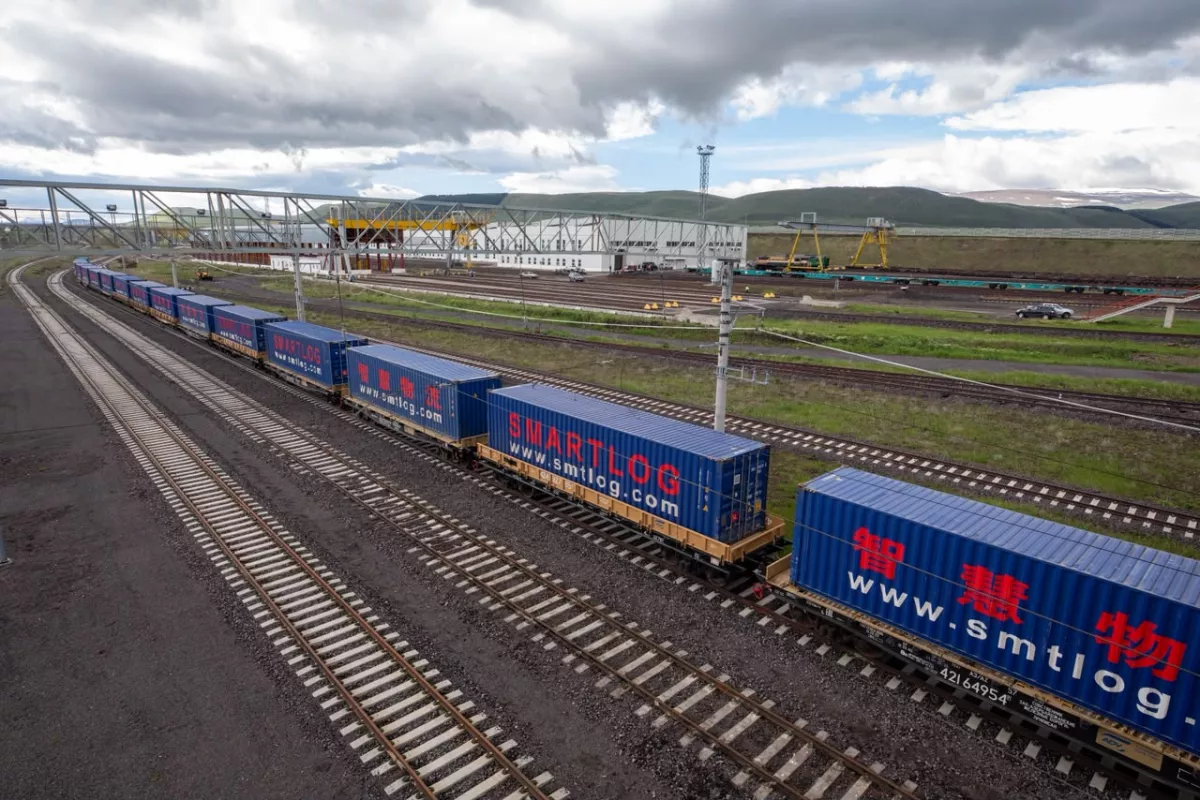
To address these challenges, Azerbaijan Railways CJSC (ADY) plans to expand its railcar fleet, streamline the process for returning leased railcars and increase the overall availability of rolling stock. The company also plans to develop a joint IT platform with Georgian Railways.
ADY Chairman Rovshan Rustamov identified the declining level of the Caspian Sea as one of the major challenges facing shipping and port connectivity. At the same time, tensions and conflicts along international trade routes highlight the need for closer coordination among the ports of the Caspian states.
“I believe we should prioritise coordinated investment, the creation of digital corridors and the simplification of border-crossing procedures. At the same time, we need to share solutions for improving the security and resilience of port operations, as well as for closer integration between ports and railways. This will ensure the uninterrupted flow of trade and improve the quality of customer services,” Rustamov said.
According to Rustamov, Baku International Sea Trade Port currently has a cargo-handling capacity of 15 million tonnes, while the expansion project is expected to add a further 10 million tonnes. “The port’s designed container-handling capacity was initially set at 100,000 TEUs, but last year this figure was increased to 150,000 TEUs through operational efficiency. This year, capacity is planned to rise to 200,000 TEUs and, by the end of 2027, to 300,000 TEUs, which will significantly expand the overall capacity of the Middle Corridor,” the ADY chairman added.
Another key priority is the creation of a single transit operator for the Middle Corridor to improve transparency and efficiency. Such a move would strengthen coordination among the more than 10 transport companies operating along the TITR, deepen cooperation between customs authorities and accelerate the launch of a joint IT platform with shipping lines. The platform would enable fleet operations to be planned according to an agreed schedule, helping to make the corridor more predictable and efficient.
Traffic imbalances on the East-West route need to be addressed
Another key challenge identified at the 5th Black and Caspian Freight Forum 2026: Corridors, Infrastructure, Investments is the imbalance in freight flows along the Middle Corridor.
“The current development model for the corridor is not ideal, as it depends on the economic conditions of countries exporting and importing goods. In recent years, we have focused primarily on attracting traffic from China and Central Asia. At present, Chinese cargo accounts for the bulk of the flow. This trend is characteristic not only of our region but of the world as a whole: cargo is moving predominantly from East to West,” said Emil Mammadov, an adviser to the chairman of Azerbaijan Railways CJSC (ADY).
According to Mammadov, securing return cargo is the next stage in the development of the Middle Corridor.
“The corridor cannot develop in a chaotic or fragmented manner; we are seeking a systemic approach. To achieve this, it is necessary to increase cargo volumes in the eastbound direction. This will allow us to boost overall freight volumes and optimise transportation costs by returning containers to their countries of origin,” he said.
To this end, ADY is actively seeking to attract more eastbound cargo. The approach is also in the interests of European shippers, with whom the railway operator is developing mutually beneficial partnerships.
At the same time, Azerbaijan is expanding cooperation with Central Asian countries by providing access to its transport-hub infrastructure and helping them reach international markets.
“There is a distinction between the concepts of land-locked and land-linked countries. The idea is to provide access to ‘open water’ through Azerbaijan. Such cooperation will significantly increase the economic potential of the entire region and, from a logistics perspective, help expand the cargo base of the Middle Corridor,” Mammadov noted.
To realise these prospects and enable transport companies to adjust their operations in a timely manner, greater regional coordination is also planned.
“The Special Council on Sustainable Connectivity of the Conference on Interaction and Confidence-Building Measures in Asia (CICA) is intended to promote cooperation in transport infrastructure, multimodal corridors, digital logistics and green mobility, as well as to ensure balanced trade and transit flows,” said CICA Secretary General Kairat Sarybay.
The idea of establishing the Council as a CICA consultative body was initiated at the highest political level. Its practical implementation is expected to strengthen mutual understanding, predictability and shared interests across the Caspian region.







 editor@caliber.az
 +994 55 444-88-98
 Азербайджан, Баку, ул. Низами, 203, Af Business House, 5-й этаж