










The shadow of Theresienstadt over the Red Cross A lesson from Azerbaijan for the South Caucasus
In the horrifying history of the Holocaust, marked by its brutality and inhumanity, there is one detail that a part of “humane Europe” has still not been able to come to terms with. On 23 June 1944, the delegate of the International Committee of the Red Cross, Maurice Rossel, visited the Theresienstadt concentration camp and, in his subsequent report, described favourable conditions: good living standards, self-administration, cultural life, and no signs of cruelty.
At the same time, trains were departing from there to the largest complex of Nazi concentration and extermination camps in occupied Poland — Auschwitz. The moved and apparently convinced Maurice Rossel returned to Geneva with photographs of smiling children, even though, in reality, out of 15,000 children held in Theresienstadt, only 100 survived.
But that is not all: in the same year, Rossel also visited Auschwitz and… did not discover either gas chambers or crematoria.
Decades later, the International Committee of the Red Cross attempted to attribute the episode to a single individual — supposedly a naïve, trusting delegate deceived by the Nazis. However, archives revealed a different reality. Geneva made no mention of Theresienstadt in its 1946 report on activities in the concentration camps. It simply erased it. It was no longer Rossel alone, but an entire organisation — and indeed a country — that chose not to see what was inconvenient to see.

This episode is not accidental, nor is it confined to the distant 1940s. It reveals how the ICRC, over eight decades, has repeatedly reshaped its narrative whenever its activities have effectively aligned with a force holding territory or people against their will. The case of Karabakh is particularly illustrative in this regard.
The ICRC arrived on Azerbaijani territory in the early 1990s — amid the First Karabakh War, at the moment when Armenia was beginning a thirty-year occupation of Karabakh. Since then, the organisation has built in the region a system that, structurally, worked to entrench the status quo as it existed at that time: an office in Khankendi operating bypassing the Baku delegation and without any coordination with the Azerbaijani state; cooperation with the puppet structure calling itself the “NKR”; and a long-standing terminological habit of referring to Azerbaijani territory as a “conflict zone” even in documents from 2023–2024, when there was in essence no longer any conflict, but rather the restoration of sovereignty.
In effect, Geneva legitimised a fiction — one that could not have been legitimised by any other international instrument.
A characteristic episode occurred in 2005, when Armenia began archaeological excavations in the Aghdam district, in the vicinity of the Shahbulag fortress, on a site it sought to present as “Tigranakert”. Baku repeatedly called on the International Committee of the Red Cross to take a position on this issue and condemn what was happening. However, the organisation chose not to do so, thereby indirectly contributing to the destruction and falsification of Azerbaijani cultural heritage on the territory of Azerbaijan.
The 44 days of the autumn of 2020 stripped the organisation of its mask. In October 2020, in the Fuzuli district, as we have already noted in one of our previous articles, representatives of the ICRC attempted to slow the advance of the Azerbaijani Armed Forces. The Red Cross appealed to the Government of Azerbaijan with a request to ensure humanitarian access to an encircled group of Armenian servicemen, who were allegedly described as “severely wounded, incapable either of resisting or fighting for their lives.”
Baku responded positively. However, the Azerbaijani side was outraged when it was revealed that among those evacuated by the ICRC, there was not a single wounded individual. All of these Armenian militants, rescued from certain destruction, immediately returned to combat and continued fighting against the Azerbaijani army.
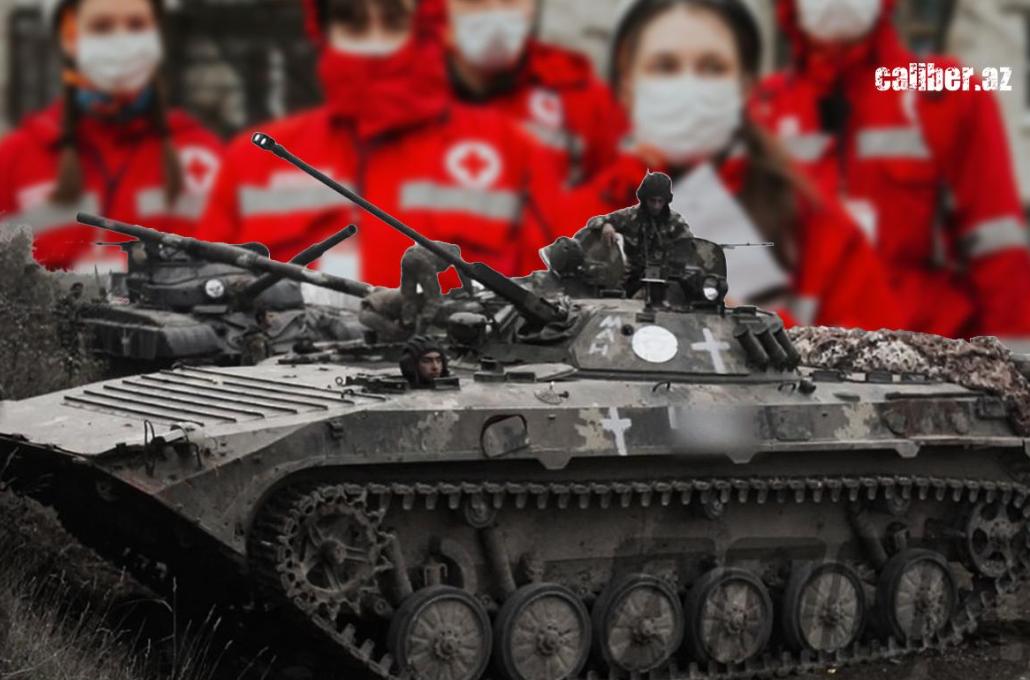
On the approaches to Lachin from the direction of Gubadli, representatives of the ICRC persistently sought contacts with the Azerbaijani side, with the apparent aim of determining whether the so-called “corridor” was planned to be brought under control. There was no genuine humanitarian content in this activity. It was operational information-gathering and an attempt to buy time for a disorganised retreating force. This can only be described as neutrality if words have already lost their meaning.
After the war, the focus of activity also shifted. In 2023, amid Baku’s legally unambiguous decision to establish border control on the Lachin direction, the Red Cross, through Ariane Bauer, the Regional Director for Europe and Central Asia at the International Committee of the Red Cross (ICRC), launched a campaign for a “humanitarian consensus”. It was presented as a call to both sides, but there was only one real addressee: Azerbaijan.
At the same time, Azerbaijani border guards repeatedly discovered goods in ICRC vehicles that had no connection to humanitarian activity. On July 1 — fifteen undeclared mobile phones; on July 5 — 848 packs of cigarettes and 320 litres of petrol in one truck; 125 packs and 1,000 litres of petrol in another. All vehicles bore the emblem of the Red Cross.
Geneva initially denied everything, but a few days later admitted that four “hired drivers” had indeed been transporting commercial cargo, but that they were not ICRC employees and their contracts had been terminated. This manoeuvre mirrors Theresienstadt in reverse. There, the ICRC attributed its failure to a single Rossel; here, to four unnamed drivers. In both cases, an organisation caught in the act agreed to sacrifice the reputation of one or two accountable individuals in order to avoid confronting itself.

No less indicative was the situation when, against the backdrop of a launched campaign about an alleged “famine” in Karabakh, a large-scale anti-Azerbaijani information attack was unfolding. At that moment, a neutral humanitarian structure — the Azerbaijani Red Crescent Society — sent flour and other food supplies to the Armenian residents of the Karabakh region of Azerbaijan. However, instead of welcoming an exclusively humanitarian initiative, the International Committee of the Red Cross attempted to exert pressure on the Society, thereby clearly demonstrating its involvement in the anti-Azerbaijani campaign.
Let us now turn to the strictly political aspect of its activity. According to our sources, it was Bauer who, during closed-door meetings in Yerevan in the first half of 2024, participated in promoting the thesis of an allegedly “imminent Azerbaijani attack on the southern regions of Armenia.”

In this context, Bauer reportedly demanded from her colleagues that the ICRC become more active in the Karabakh region of Azerbaijan and across the South Caucasus as a whole. In the view of the ICRC Regional Director, the Russia–Ukraine war should not divert this international organisation from other strategically important directions. This narrative was subsequently echoed by several European capitals.
The organisation’s underlying rationale was transparent. Against the backdrop of the war in Ukraine, the South Caucasus was rapidly slipping out of the international agenda, and with it — funding and the relevance of Geneva’s presence in the region. The creation of an illusion of a “smouldering threat” became a way to retain attention and financial support.
A separate issue concerns the very mandate for which the ICRC exists under the Geneva Conventions — the fate of missing persons. Over nearly thirty years, with regard to almost 4,000 Azerbaijanis who went missing during the First Karabakh War, the organisation has done virtually nothing of substance. Neither pressure on Yerevan regarding mass burial sites nor meaningful forensic engagement was undertaken.
Beyond the South Caucasus, the pattern extends further. In 2008 and in the years that followed, the ICRC built a parallel infrastructure in South Ossetia and Abkhazia, operating effectively without the consent of official Tbilisi. The occupation of Georgian territories was institutionally repackaged as a “conflict zone” requiring a permanent neutral intermediary, while the presence of this “intermediary” itself helped solidify the zone. The Georgian model is a direct continuation of the Karabakh one: the same template repeated. A territory seized by force is turned into an internationally serviced “humanitarian space” under the Geneva emblem, and thereby its status is effectively frozen.
Beyond the South Caucasus, the picture is similar. In Ukraine, since February 2022, the ICRC has found itself at the centre of an open confrontation with Kyiv. The Ukrainian Human Rights Ombudsman, Dmytro Lubinets, publicly stated that the vast majority of Ukrainian prisoners of war returned from Russian captivity had never once met with ICRC representatives during their detention, and drew a blunt conclusion: the organisation had failed to fulfil its mandate and this needed to be acknowledged publicly.
Overall, since the beginning of the war, the ICRC has frequently been at the centre of scandals and subject to criticism. For example, Ukrainians were outraged that a Red Cross mission left Mariupol, leaving people without assistance. Ukrainian President Volodymyr Zelenskyy accused the ICRC of inaction in protecting the rights of Ukrainian prisoners of war and called on it to visit the notorious Olenivka detention facility in the occupied eastern part of the country.

Pierre Krähenbühl
And above all this lies a highly illustrative personnel episode. In April 2024, Pierre Krähenbühl became Director-General of the ICRC. The same individual who, in November 2019, was forced by the UN to step down as head of UNRWA — the United Nations Relief and Works Agency for Palestine Refugees in the Near East — amid an internal ethics investigation: allegations of abuse of authority, nepotism, and a relationship with a staff adviser for whom he created a position funded by Swiss resources.
The scandal was such that Switzerland, Belgium, the Netherlands, and New Zealand simultaneously froze funding to UNRWA. Two years earlier, in February 2017, Krähenbühl held a meeting in Beirut with leaders of Hamas, the Palestinian Islamic Jihad, and the Popular Front for the Liberation of Palestine, during which — according to documents published in November 2024 by the organisation UN Watch — he spoke of a “spirit of partnership” with them and stated that “we are united and no one can separate us”, while simultaneously asking for the meeting to be kept confidential so as not to damage the agency’s “credibility” with donor countries.
It was this same individual whom the ICRC establishment elected as its Director-General in December 2023 — a nomination against which 17 US senators signed a protest. And it is under his leadership that in 2024–2025 the organisation continues to address sovereign states with moral sermons.
When a structure built on the principle of ethical credibility places an ethically compromised figure at its forefront, it is a public admission that it has no coherent course.
This was written in January 2025 by Elliott Abrams in the Council on Foreign Relations — a former US Assistant Secretary of State, a veteran of three administrations, and someone who knew the “old” ICRC from the inside. His article, “The Sad Decline of the ICRC,” describes what Baku had already observed through its own experience.
Abrams noted that the international organisation had done “precisely nothing” for the Israeli hostages held at the time by Hamas, systematically evaded its core obligations, and deserved a reassessment by Congress and the Trump administration of the $622 million in annual US contributions — roughly a quarter of the ICRC’s entire budget.

Elliott Abrams
Azerbaijan’s response fits into this global picture rather than standing apart from it. On March 5, 2025, the Azerbaijani government notified the ICRC of the closure of its representation in the country. On September 3, 2025, the office in Baku ceased operations. There was nothing dramatic beyond the procedure itself. Cooperation with the ICRC, if necessary, will be conducted through its headquarters in Geneva.
Eighty years ago, a delegate of the International Committee of the Red Cross returned from Theresienstadt with a favourable report on a Nazi camp from which trains were departing for Auschwitz. The organisation later quietly removed this visit from its own historical record.
In 2023–2025, the same structure found itself at the centre of Ukrainian criticism over the fate of prisoners of war. It came under sharp US scrutiny regarding the allocation of hundreds of millions of dollars in contributions. At the same time, a senior official with a controversial track record and a public history of dealings with armed non-state actors was elevated to the post of Director-General. In substance, little was done to restore the organisation’s standing.
The difference between 1944 and 2025 is that today, the evidence of institutional failure no longer needs to be searched for in archives — it is available in open sources.
By closing the ICRC office in September 2025, Baku recorded an institutional conclusion: the activity of this structure in its current form is incompatible with sovereignty — neither Azerbaijani nor, ultimately, any other. It is likely that, in time, similar conclusions will be drawn in other capitals of the South Caucasus as well.







 editor@caliber.az
 +994 55 444-88-98
 Азербайджан, Баку, ул. Низами, 203, Af Business House, 5-й этаж