










Between words and weapons What lies behind Yerevan’s “peaceful” agenda?
In Yerevan’s Republic Square on May 28, a military parade took place — the first in ten years and the first since the autumn 2020 war. Opening the event, Nikol Pashinyan delivered remarks that, in effect, outweighed all analytical assessments of the true substance of Armenia’s peace agenda.
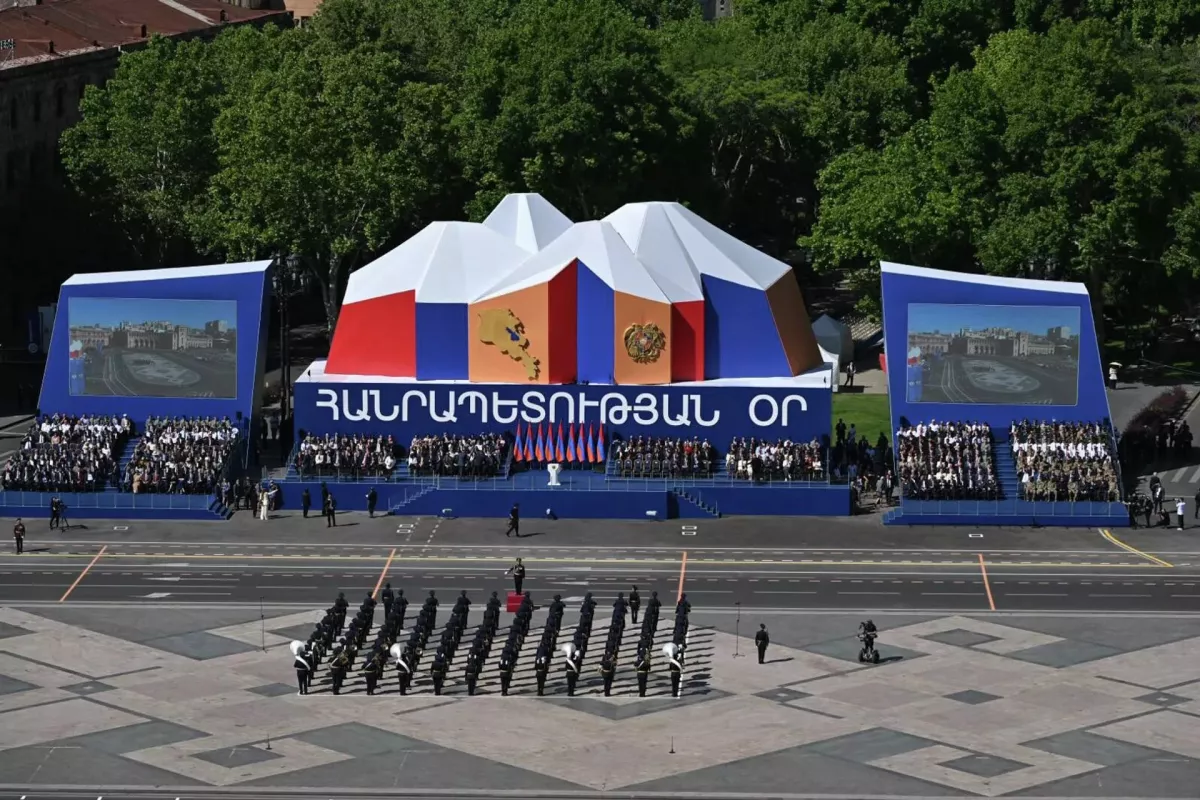
“Until 2022, international markets for weapons and military equipment were largely closed or difficult to access for the Republic of Armenia, as international partners refused to supply arms to the Republic of Armenia, arguing that they were convinced Armenia would use this weaponry beyond its internationally recognised territories. And only after the agreements reached in Prague on October 6, 2022, when Armenia and Azerbaijan, on the basis of the 1991 Alma-Ata Declaration, recognised each other’s territorial integrity — only after this agreement did the international arms market open up for Armenia,” the Prime Minister stated.
At first glance, his statement appears to demonstrate a commitment to peace. However, on closer examination, what lies behind this veil of peacemaking becomes clear: Yerevan is using the peace process as a gateway to the global arms market, rather than as a genuine renunciation of military revanchism. This conclusion is further supported by what actually took place at the military parade.
If arms are now being sold to Armenia on the premise that it has renounced any intention of fighting beyond its borders, then logically it should be acquiring predominantly defensive systems — assets for territorial protection, air defence coverage, fortification, and counter-battery warfare along its own front line.
However, the weapons displayed on the cobblestones of Yerevan’s Republic Square tell a different story. Among them were the Pinaka multiple launch rocket systems with a range of nearly 80 kilometres, towed ATAGS howitzers and self-propelled MArG artillery systems of Indian origin, French CAESAR self-propelled artillery units, Russian ТОS-1 heavy flamethrower systems, and Chinese CH-4 strike drones.
As can be seen, this is far from an arsenal designed purely for defending national borders. Rather, it is a set of long-range firepower and offensive combat systems, whose operational logic is directed outward rather than inward.
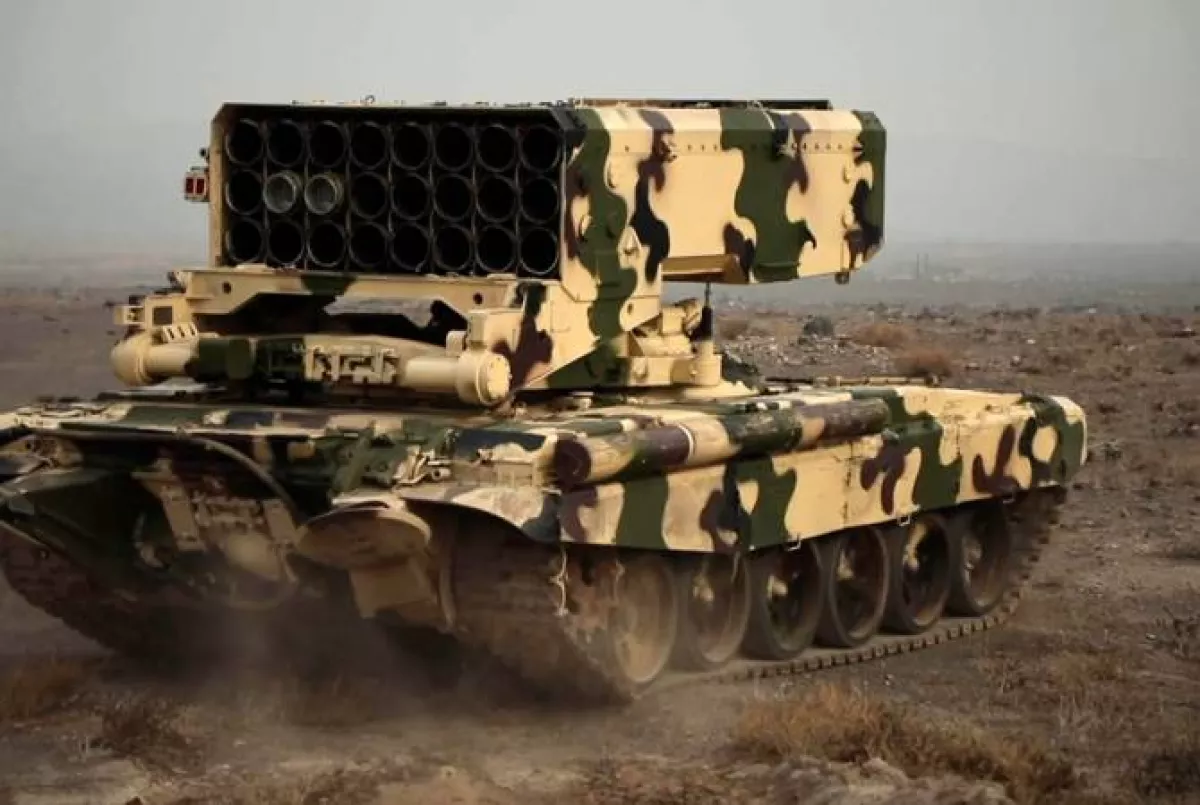
Particularly telling in this list is the ТОS-1 heavy flamethrower system, which, even with the greatest effort, cannot be fitted into any defensive doctrine. It is unequivocally a weapon of area saturation, designed to destroy manpower and fortifications on occupied territory — in other words, a tool of offensive warfare by definition.
It is followed by the Pinaka multiple launch rocket system and CH-4 strike drones, which belong to the same category: systems whose value is realised when striking targets deep inside an adversary’s defences, rather than when repelling an attack on one’s own territory.
A border defence doctrine would require a different set of priorities: layered air defence, counter-battery systems, engineering and fortification assets, and anti-tank defensive belts. Some of these elements are present in Armenia’s procurements, but they did not define the tone of the parade. Instead, it was long-range strike systems that were placed in the spotlight — systems whose operational logic only makes sense in the context of projecting force beyond national borders.
Thus, the argument outlined above finds its factual basis: Armenia is acquiring precisely the type of weaponry that contradicts its declared peaceful posture and corresponds instead to a fundamentally different strategic intent. The gap between Pashinyan’s statements about renouncing the use of force beyond its borders and the characteristics of the equipment showcased at the parade is so evident that it requires no additional proof beyond the parade images themselves.

At the same time, and not least importantly, the financial mechanism behind this buildup is something that Yerevan prefers not to discuss openly. Western assistance flowing into Armenia after 2020 through humanitarian, economic, and security channels has significantly eased the government’s budgetary burden in these areas. Funds that would otherwise have been spent on social and infrastructural needs were effectively freed up — and a substantial portion of them was redirected toward arms procurement.
What emerges is a double-layered scheme: external partners finance Armenia’s civilian budget lines, while Yerevan converts the savings into military hardware with offensive capabilities. Formally, no one is directly supplying weapons as aid; in practice, however, Western support indirectly underwrites militarisation, while the language of peace serves as a protective wrapper for this process in the eyes of outside observers.
The convenience of this arrangement for Yerevan lies in its near-immunity to direct criticism. On paper, Western funds go to schools, roads, and hospitals, while Armenia’s own resources are spent on armaments — resources that would otherwise have been absorbed by the same civilian sectors without external assistance. Accounting practices separate the flows in such a way that militarisation appears to be an independent sovereign choice financed from domestic means, even though, without external financial backing, those means would simply not be sufficient.
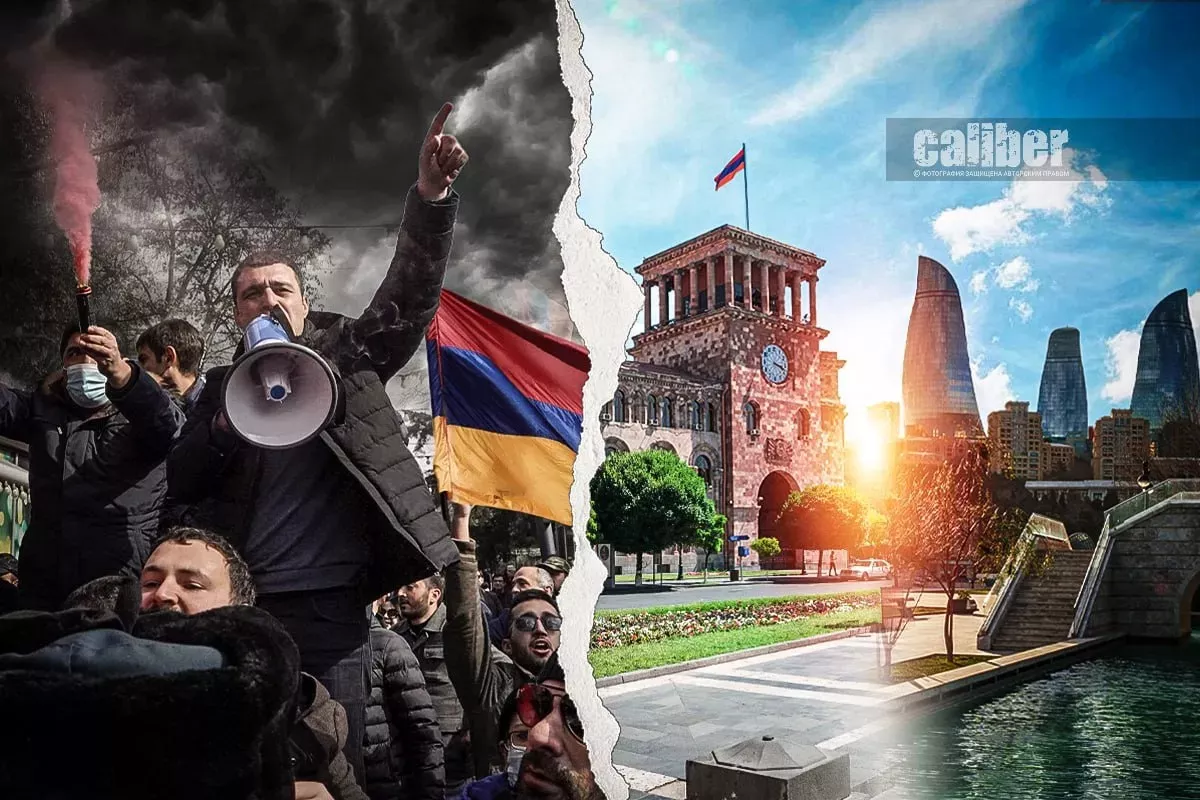
Behind all this lies a very real trend — and it is more dangerous than any ceremonial display. The acquisition of offensive systems fuels expectations within parts of the Armenian military establishment and the so-called “war party” that new weaponry could one day enable a return to a force-based scenario, or at least help avoid a firm legal consolidation of peace on paper.
These revanchist forces are clearly unwilling to accept the current realities of the region, where a tangible balance of power has already taken shape — a balance that neither Indian rocket systems nor French artillery are capable of altering. They sustain themselves on this illusion, despite the fact that it is precisely such fantasies that have historically led Armenia into catastrophe: reliance on external armour and outside support in 2020 ended as it did, and by accumulating an offensive arsenal under the rhetoric of peace, Yerevan is effectively laying the same mine beneath its own security on which it previously stepped.
The logic is revealed by chronology itself. Pashinyan explicitly linked the opening of the arms market to Prague 2022 — the moment when the peace process formally began. And it appears that the further the peace negotiations progressed, the wider Armenia’s access to armaments became: one process reinforced the other. Peace rhetoric removed restrictions imposed by suppliers, and the lifting of those restrictions filled Armenia’s arsenals. This is not a paradox or a side effect, but a coherent pattern in which negotiations perform a functional role in relation to rearmament. Armenia bargains for peace only to the extent that it opens the doors of arms markets, and slows down final codification of peace only to the extent that it seeks time to rearm.
For Azerbaijan, the conclusion is clear, and it is not a new one. Genuine commitment to peace is tested not by speeches at parades, but by the nature of the weapons being acquired and the willingness to enshrine peace in law without delay or ambiguity. Armenia, by showcasing long-range strike systems alongside rhetoric about renouncing the use of force, is sending a contradictory signal — one that Baku reads with precision.
Azerbaijan has no intention of attacking Armenia and has repeatedly stated this position. At the same time, Baku will not turn a blind eye to the accumulation of an arsenal by its neighbour whose purpose diverges from the declarations made by its leadership. If the Armenian government has truly chosen peace, the proof is straightforward: it must amend its constitution, sign a comprehensive peace treaty, and prioritise the acquisition of weaponry designed for defensive purposes rather than offensive operations.
And as long as heavy flamethrower systems and multiple launch rocket artillery are displayed in Yerevan’s central square, statements about peace remain just that — statements. Such weapons speak the language of offensive capability. Between declarations and arsenals, Baku will always give weight to the arsenal, because words can be rewritten, while deployed firepower cannot.







 editor@caliber.az
 +994 55 444-88-98
 Азербайджан, Баку, ул. Низами, 203, Af Business House, 5-й этаж