










MyGov revolution: Azerbaijan’s leap into a fully digital government era Overview by Khazar Akhundov
Just over two decades ago, Azerbaijan launched the state programme “Electronic Azerbaijan,” establishing a wide-ranging interactive e-government information system. Today, the unified e-government portal serves as a driver for the development of public administration and the provision of electronic public services to the population. A logical continuation of these trends has been the creation of the MyGov mobile application and the MyGov Business platform for entrepreneurs, where digital public services and a number of private services are integrated, offering citizens considerable benefits. Progress in this area was discussed during the first meeting of the Digital Development Council, held under the chairmanship of the First Vice-President of the Republic of Azerbaijan, Mehriban Aliyeva.

Over the past years, more than five hundred electronic services from all ministries and most state agencies in the country have been integrated into the unified e-government portal (www.e-gov.az), along with various digital services in the utilities sector, housing privatisation, fiscal and customs areas, public procurement, as well as in the social sphere, environment, agriculture, labour relations, and entrepreneurship. These services are in high demand among the population, especially within the business community.
For several years now, electronic government resources and the e-government platform have been operating within the framework of the “Government Cloud” (G-cloud) system. In addition, the country has established a National Data Centre and a system of electronic and biometric signatures, enabling citizens to obtain information from various state institutions through the use of e-signature mechanisms. Information exchange and digital document flow between government bodies have been optimised, with courts and many other institutions also involved in this process.
As the Deputy Minister of Digital Development and Transport of Azerbaijan, Sameddin Asadov, recently noted, “Over the past five years, Azerbaijan has made real progress in this direction; in particular, the MyGov mobile platform provides citizens and businesses with hundreds of public digital services through a single application.”

It is also worth noting that in recent years, several mobile applications with similar functionalities providing access to public services have been developed in the country, and citizens have often faced difficulties in determining which application to use for obtaining a specific service. In order to simplify this process, minimise contact with officials, and ensure transparency, a decision was made to eliminate fragmentation in the public services portal and transition to a unified centralised ecosystem. From now on, all public services and digital documents will be available to citizens through the MyGov platform and to entrepreneurs via MyGov Business.
During a meeting held in February 2026 dedicated to the Unified Action Plan on “Azerbaijan's New Digital Architecture,” President Ilham Aliyev outlined a clear direction for the country’s digitalisation strategy, stating: “Public services should be implemented through ‘mygov’ portal—that is, from a single center. Everyone should be aware of this, both public institutions and citizens. This will also provide our citizens with a significant advantage.” Since then, efforts to optimise the public services portal have been accelerated.
In particular, during a recent meeting of the Digital Development Council, Minister of Digital Development and Transport Rashad Nabiyev reported that the scope of services offered by the MyGov platform has significantly expanded, and the number of its users has increased from 2.7 million to 3.5 million over the past three months. He also noted that several new applications have already been integrated into the platform, and that by the end of the current year citizens will be provided with services from an additional seven government applications, placing particular emphasis on the expansion of artificial intelligence-based solutions and the launch of a virtual assistant for citizens.

It is also worth noting that in recent periods, Azerbaijan has been actively integrating AI capabilities into its e-government information systems. In particular, a digital advisory platform, E-advisory, is being developed with the ability to automatically prepare various documents. Chatbots and content-aware services are also being created that understand user intent, provide recommendations, and proactively assist in resolving issues. All these measures contribute to more convenient interaction with government institutions: today, citizens can already submit their inquiries to agencies both in written form and via voice messages, which are processed using artificial intelligence.
At the same time, the pace of integrating state agency resources into the MyGov platform remains high. Over a relatively short period, the e-Social, e-TƏBİB, and e-Su applications have been fully integrated into the platform, where services and applications such as e-Police, Mobile Notary, Azerishiq, Reseptim, e-Səhiyyə, MigAz, and ASAN Müraciət are already operational. This process is actively continuing, and by the end of the current year many other state bodies are expected to provide their services in full through MyGov.
In the near future, it will also become possible to obtain and replace key documents such as identity cards and passports, as well as submit applications for the replacement of driving licences. Through the MyGov interface, users will also be able to obtain permits from the Ministry of Justice for minors to leave the country, enrol children in pre-school institutions, register university admissions, and carry out a range of other services.
In addition, since June 1 of this year, identification processes within the smart customs system have already been available on the platform, enabling the processing of customs declarations for goods imported through e-commerce purchases.
It is also worth noting that a number of banks in Azerbaijan are using an integration mechanism with MyGov ID, allowing their customers to log into personal accounts and securely manage mortgage processes, obtain information on collateral and other conditions, collect necessary documents, and carry out all operations up to the stage of loan approval without visiting a bank branch. One of the advantages of the platform is its high level of protection against cybercrime, which is particularly important for the banking sector.
As the Chairman of the Board of the Innovation and Digital Development Agency, Farid Osmanov, emphasises: “Ensuring the security of passwords and usernames through MyGov ID has been a constant priority: in 2025, a two-factor authentication system was introduced to protect passwords.”
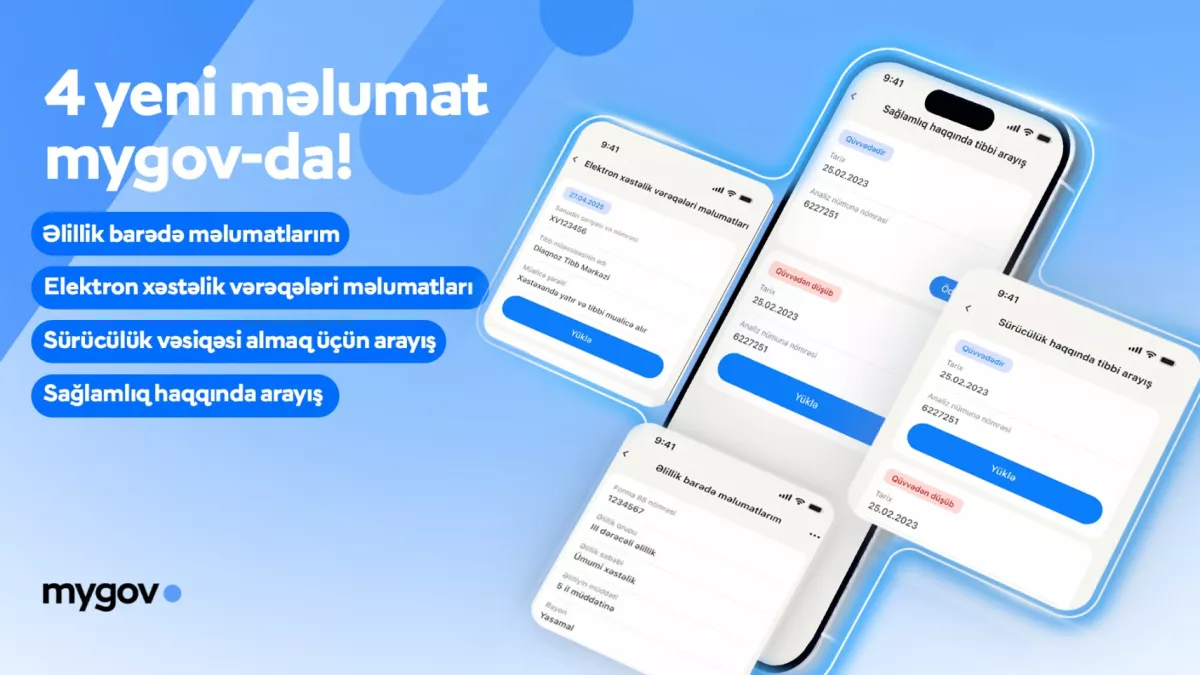
All of the above make the platform’s interface and capabilities highly in demand. Last year, more than 400 types of electronic services were delivered to citizens through it, while this year, 18 new digital services and 32 new digital documents have been gradually added to the system. As noted by Rashad Nabiyev at a meeting of the Council, “by the end of the year, the number of MyGov users is expected to reach approximately 5 million people.”
Thus, the key objectives of all transformations in the e-government system are the optimisation of existing workflows and the improvement of the quality and accessibility of internal administrative processes in state institutions. This involves a full-scale transformation and transition from the current mechanisms of “electronic government” (eGov) to the next stage of development — “digital government” (GovTech), for which the maximum use of electronic signatures is being ensured and the infrastructure of a national governmental “data pool” is being formed. All of this will contribute to the provision of proactive services to the citizens of Azerbaijan.







 editor@caliber.az
 +994 55 444-88-98
 Азербайджан, Баку, ул. Низами, 203, Af Business House, 5-й этаж