










Pashinyan vs the Armenian Apostolic Church Elegant rhetoric and contradictory goals
Another blow has been dealt to revanchist circles in Armenia. Once again, the so-called tigers have turned out to be paper ones. This time, the focus is on the Armenian Apostolic Church (AAC).
On January 14, the Church’s governing body, the Supreme Spiritual Council of the AAC, finally mustered the resolve to decide on convening a meeting of bishops in order to respond, in some fashion, to pressure from the government. However, the meeting is scheduled for February—despite the fact that it should have taken place back in December, and despite the pressure from the Armenian authorities clearly calling for a swifter response.
The Church is retreating, while Pashinyan has already gone so far as to organise a Christmas service and a religious procession bypassing the official AAC altogether. It has become apparent that the Church and its secular allies are powerless to do anything about this.
The clash between the Apostolic Church and Armenia’s current government was inevitable. For roughly the past thirty years, the AAC has functioned as a political instrument of segments of Armenia’s corrupt nationalist elites—elites whom Pashinyan has already stripped of part of their power and is now depriving them of their remaining influence in society. Objectively, this will contribute to peace in the region. At the same time, however, it is possible that the archaic Armenian nationalist project will be replaced by a modernised and pseudo-liberal one.
Church affairs: from pornography and narcotics…
The current—and so far the most serious—phase of confrontation between the Armenian Church and the government unfolded last spring, when Pashinyan decided to put an end to attempts by revanchist forces to use the AAC to organise a “church Maidan”. The opening salvo was scandalous: on May 29, during a cabinet meeting, Pashinyan likened AAC churches to storerooms, while his wife declared priests to be the country’s main pedophiles in posts on social media.
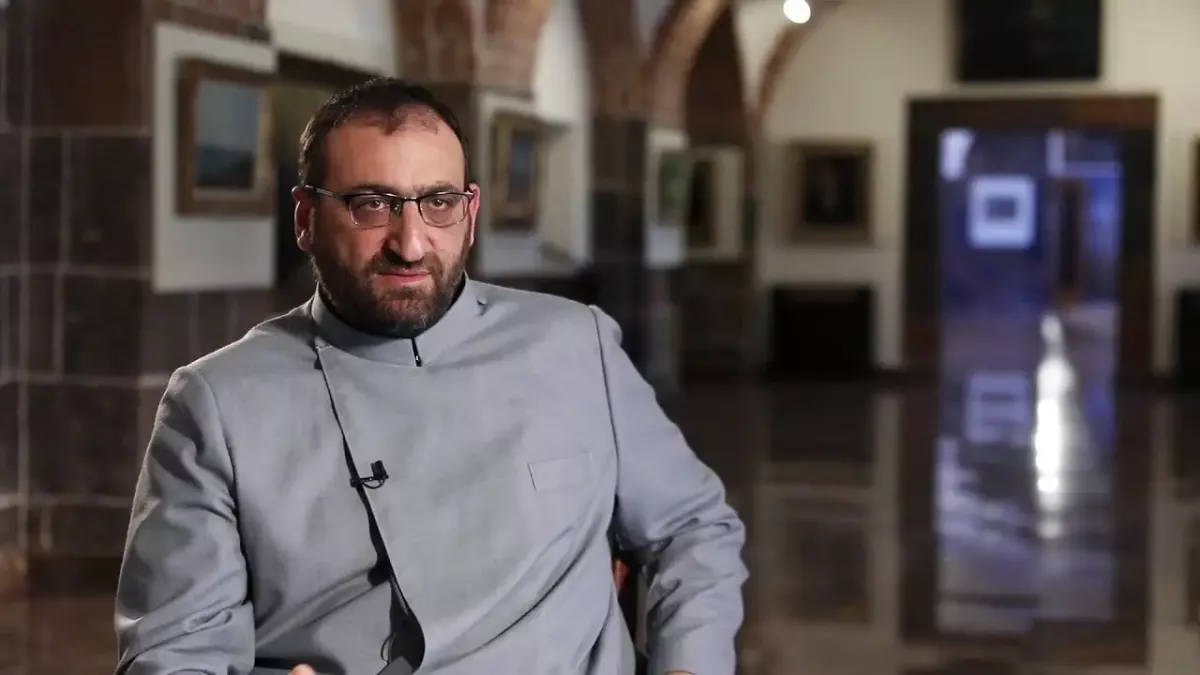
The Armenian prime minister then moved on to pursuing an almost official policy of forcing the Church to reform, pointing to blatant hypocrisy among senior clerics, corruption, and the entanglement of church circles with shady business figures—such as Karapetyan, now behind bars, whose business empire rested on what was effectively a monopoly over Armenia’s energy networks, seized under dubious circumstances. There was no shortage of salacious details either: in October, someone leaked an intimate video showing a man resembling one of the archbishops, Arshak Khachatryan. This was the final warning to the Catholicos, whose chief of staff Arshak was. Soon afterwards, Arshak was taken into custody—allegedly for drug trafficking as part of a criminal conspiracy.
By conducting investigations, arrests and searches, and accompanying them with scathing criticism of the Armenian Apostolic Church, the Armenian leadership was preparing the ground for a further showdown with the clerical institution. It turned out that beneath the seemingly monolithic façade of the Church lay numerous cracks, and that even within the clergy there was outrage at the actions of their superiors. Leaks began to appear; pro-Pashinyan priests started omitting references to the Catholicos and diocesan hierarchs during liturgies, and so on. In their protest, these priests could rely on the protection and support of the government.
By winter, the authorities in Yerevan decided to move to more decisive action, once again accompanying it with elements of political theatre. On November 27, pro-government sources published a statement by a group of AAC hierarchs accusing the Catholicos of covering up a “blasphemous act” committed by Archbishop Khachatryan (referring to the aforementioned intimate video) and of “patronising blasphemy”. At the same time, the authors of the statement met with the prime minister. A few days later, ten clergymen issued a call for the Catholicos to abdicate, accusing him of arbitrariness, interference in politics, and other actions incompatible with the office of head of the Church.
Having carried out this preparatory barrage, in early December the Armenian leader simply posted on his Facebook account a so-called “roadmap for the renewal of the Holy Armenian Apostolic Church”. After the “removal” of Catholicos Garegin II, the “primary task” of the new Catholicos was declared to be “the organisation of a process to adopt a new statute of the Apostolic Church in Armenia”. Meanwhile, pro-government bishops called on believers to gather in Etchmiadzin on December 18 and demand that Garegin step down as Catholicos. This appeal was also pointedly publicised through the newspaper Haykakan Zhamanak, owned by Pashinyan’s family. As a result, both supporters and opponents of the Catholicos gathered outside his residence, led by ten rebel bishops who were guarded by state security officers. The situation came close to descending into unrest.
However, the real test of strength came during the Christmas celebrations and services. The Church leadership and the government deliberately organised separate prayers and events. Pashinyan and his allies within the AAC held services in Yerevan, while Catholicos Garegin and the rest of the hierarchs gathered in Etchmiadzin. Building on this success, on January 5 Pashinyan announced the creation of a Coordinating Council for the Reform of the Armenian Apostolic Church and attached to it a “roadmap” of reforms. The statement establishing the Council was signed by the prime minister and ten bishops who had previously criticised the AAC leadership and who now joined the Council alongside him. Another hierarch later joined them. Given the size of the Armenian Church, this represents a fairly substantial starting base.
It is difficult to speak of morality in this context. The initiators of the anti-church campaign themselves are unlikely to treat it too seriously. Recently, Pashinyan equivocated when he was asked a perfectly reasonable question: while he criticises AAC hierarchs for immorality and dishonesty, how is it that among his allies are bishops whose integrity he himself has repeatedly questioned in public? In other words, the situation has become complicated for the government, especially since more than eighty Armenian priests last weekend condemned the “schismatic” initiative and reaffirmed their loyalty to the incumbent Catholicos, Garegin II. Nevertheless, the authorities appear ready to go to extremes: over the past year, four church hierarchs loyal to Garegin have been imprisoned. These are prominent figures within the AAC—the heads of three dioceses (two archbishops and one bishop), as well as the archbishop who headed the Catholicos’s chancellery.
…to espionage and “hybrid war”
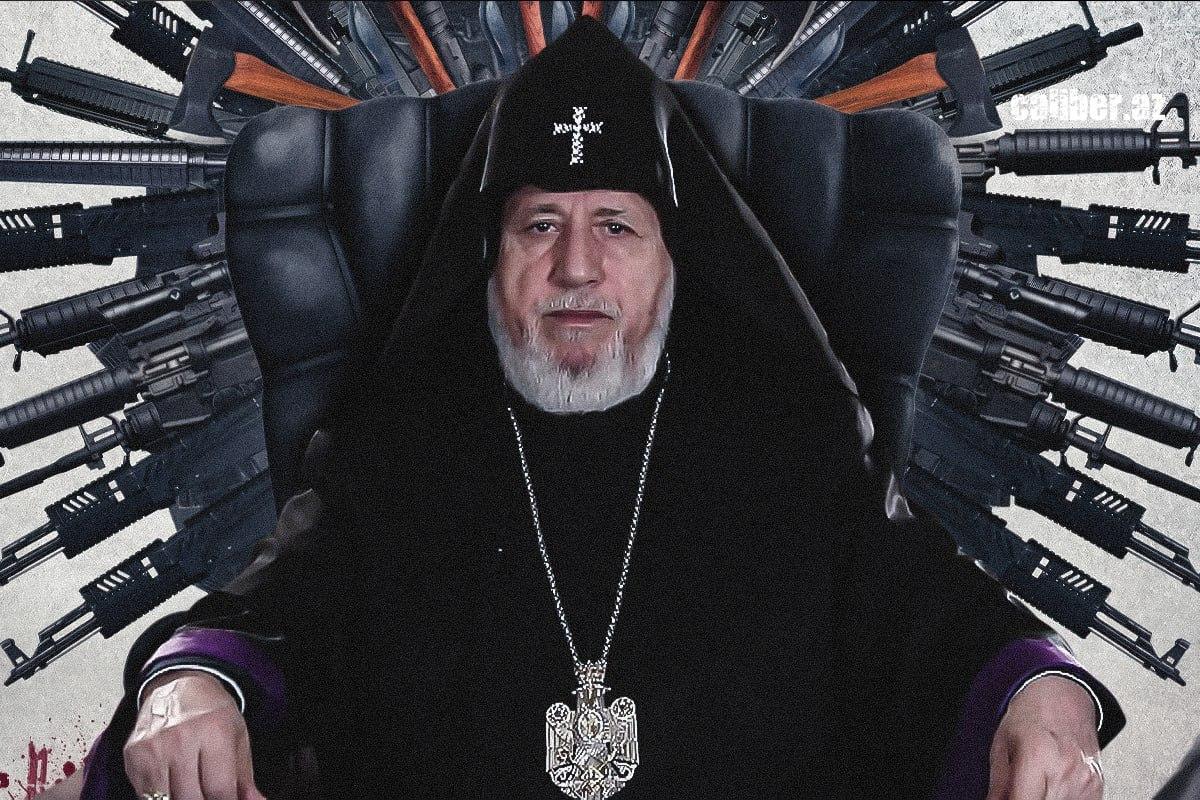
The principal target of the anti-church campaign has, quite predictably, become the head of the Armenian Apostolic Church, Catholicos Garegin. Armenia’s leadership has openly set the goal of first temporarily replacing the incumbent Catholicos with his deputy, and then holding new elections for the head of the Church. Pashinyan has placed particular emphasis on a lurid story about children allegedly fathered by the Catholicos, who had taken a vow of celibacy—but the real issue lies elsewhere.
The Catholicos has opposed Pashinyan’s course of international reorientation for Armenia and his attempt to bring the country out of isolation by abandoning the territorial gains of the Gorbachev–Yeltsin era.
Garegin, for his part, demanded Pashinyan’s resignation after Armenia’s military defeats, while the Church has repeatedly accused the prime minister in recent years of making “concessions” to Azerbaijan. Pashinyan has countered that church figures are interfering in the secular affairs of the state and seeking to seize power. More broadly, he has argued that under Garegin the “Church was turned into a political party”.
Pashinyan and his party have also spoken of alleged ties between Garegin II and foreign intelligence services, as well as those of his brother, Archbishop Ezras, head of the Russian and New Nakhichevan Diocese of the Armenian Apostolic Church. The reference, of course, is to Russia’s security services. Even before the New Year, rumours circulated that, amid the current difficult situation, Garegin II might move to Russia altogether and lead the AAC from abroad. The Russian and New Nakhichevan Diocese was forced to deny this information. In this context, Garegin was also accused of turning the Church “into an instrument of hybrid warfare by foreign forces” against Armenia—namely, of resisting Yerevan’s shift in foreign policy orientation towards the West.
It is therefore unsurprising that on January 12 Anna Hakobyan went so far as to draw parallels between the current struggle against the Catholicos and the 2018 “colour revolution” that brought her husband to power and set Armenia on a geopolitical realignment. Indeed, once again the issue is Pashinyan’s power and the political project he is seeking to advance. The Armenian government has stated that questions concerning relations between church and state could become part of the forthcoming constitutional reforms being prepared by Pashinyan. It can already be stated as a fact that they have become part of them.
Pashinyan is no Luther
Yerevan’s policies are riddled with contradictions. Under the cover of lofty rhetoric about church corruption and reform, Armenia’s prime minister is fighting to preserve his own power and to implement the radically pro-Western project on whose crest he rose to office. At the same time, objectively, there is a constructive element in his actions for Armenians and for the region as a whole. This lies, above all, in the weakening of the revanchist project of Armenian nationalism, which has brought countless disasters to the entire South Caucasus. The idea of territorial expansion gained traction in Armenian society in part thanks to AAC hierarchs during the perestroika period. They embedded the Church within an expansionist project—and as long as it remains part of it, revanchist forces find it easier to raise their heads, relying on the Church’s resources and structures.
So does this mean that Pashinyan has proved his selfless commitment to peace and cooperation in the region? Not quite. Other nuances are also clearly visible in the actions of the Armenian authorities.
First, the dismantling of the AAC’s structures and the weakening of the Church are necessary for Armenia’s leadership to implement what is arguably its main project: reorientation towards the West through accession to the EU and NATO. For them, unfortunately, this still appears to be more important than peace and good-neighbourly relations in the South Caucasus. The past few years have shown that even after military defeats, Pashinyan’s team hurried towards some semblance of peace only under Azerbaijan’s military pressure and after realising that accession to the EU would be difficult without peace with neighbouring states.
Thus, pressure on the AAC is applied not so much because it is an obstacle to peace (although it is indeed such an obstacle, and pressure on it does contribute to peace), but because the AAC stands in the way of adopting a number of radically liberal laws without which EU membership is impossible. With a ruined economy and a population fleeing in all directions—this, it seems, is permissible; without these laws, it is not. The issue, of course, concerns the protection of LGBTQ+ values and similar agendas, which the AAC is certain to oppose.
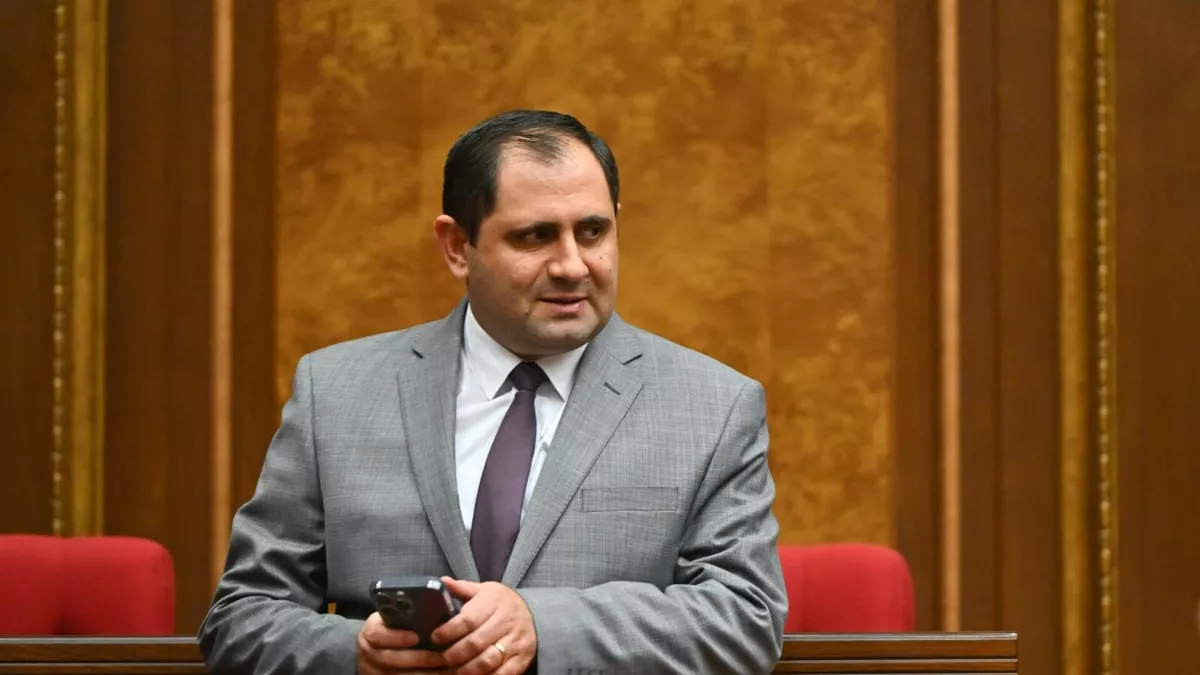
Second, if one accepts the argument that pressure on the Church is motivated solely by the pursuit of peace, a clear dissonance arises with the latest reports of a significant increase in Armenia’s military spending. As Armenia’s Defence Minister Suren Papikyan has stated, on the eve of the current ruling party’s rise to power in 2018, military expenditure stood at 245 billion drams, whereas last year it reached 664 billion drams (around $1.74 billion)—an increase of roughly $1.1 billion. Such growth in defence spending raises questions about the possible emergence among Yerevan’s elites of a project of “liberal revanchism”, one that might seek to conceal its true nature behind soothing rhetoric about European and Euro-Atlantic integration, under the banners of human rights and democracy, and through the search for a “Russian trace” among Armenia’s opponents.
There are precedents for archaic nationalisms being replaced by their “liberal” counterparts: some Greek elites, for example, have pursued confrontational policies towards Türkiye for decades, despite being deeply integrated into the Western establishment. Incidentally, even among Pashinyan’s current proposals for reforming the Church are points striking in their overt nationalism—such as placing Armenian state flags at church entrances, performing the national anthem before the liturgy, and similar measures.
In other words, there is still no clear indication that Yerevan has set itself the task of eliminating chauvinism within the Church or overcoming the interethnic and interreligious hostility that the AAC has long fostered. What is evident instead is an effort to remove opponents of the current authorities—those who adhere to an archaic version of Armenian nationalism.
For this reason, it would be premature to draw definitive conclusions. History, however, offers many examples in which actions driven by cynical and self-serving motives ultimately produced objectively positive outcomes for a particular country, a region, or even the wider world. All the more so since the results of Pashinyan’s actions are already objectively contributing to peace and settlement in the South Caucasus, while the potential negative side effects we have mentioned may only materialise in the future. By that time, they may well be neutralised by a changed international environment. For example, Pashinyan’s attempt to capitalise on his closeness to Euro-liberals such as Macron and EU bureaucrats could be offset by Azerbaijan’s success, together with the United States, in developing the Zangezur Corridor.
The EU itself may also rein in its ambitions in the region, which would narrow the room for manoeuvre available to revanchist forces in Yerevan through intrigues with European officials. Yet even allowing for the possibility of such shifts in the international landscape, an adequate understanding of the situation in Armenia and its possible trajectory requires recognising the contradictory nature of the goals pursued by the country’s current leadership.







 editor@caliber.az
 +994 55 444-88-98
 Азербайджан, Баку, ул. Низами, 203, Af Business House, 5-й этаж