










Rebuilding Europe Berlin and Rome move closer
In recent weeks, global media have increasingly discussed the rapprochement between Germany and Italy. Its culmination was the meeting between German Chancellor Friedrich Merz and Italian Prime Minister Giorgia Meloni in Rome at the end of January. During the visit, two key documents were signed: the German-Italian “Action Plan for Strategic Cooperation” and a declaration of intent in the field of defence and security. These agreements formalise joint work in crisis management, military training, and operations, while also expanding defence industry cooperation — from air defence and missile defence to shipbuilding and aviation systems.
The rapprochement between the two countries is also extending to the economy: Germany and Italy support a free trade agreement with Latin American countries that are members of the common market MERCOSUR, and they are discussing a possible revision of the ban on internal combustion engine vehicles.
According to Merz, the partnership between the two nations aims to enhance industrial competitiveness, strengthen security, and build a strong European Union backed by a reliable NATO. Meloni, in turn, emphasised that the parties have set themselves “even more ambitious goals,” signalling their readiness to coordinate actions at the EU level and jointly address issues related to migration and the defence industry.
Analysts commenting on this rapprochement unanimously point out someone notably absent from the alliance: France. This is logical, as the Germany–France duo has long been considered the engine of the EU. The idea was once expressed metaphorically—and somewhat arrogantly—by Charles de Gaulle, who described the then European Economic Community as follows: “The EEC is a horse-drawn carriage: Germany is the horse, and France is the coachman.”
While the United Kingdom was still part of the EU, this tandem served as a natural continental front against the ambitions of the island neighbour. However, with Brexit and the subsequent radical reshaping of the global system, it has become clear that the EU needs to rebuild its paradigm of existence, breaking with the romantic notions of the Cold War era and the subsequent age of Western total hegemony.
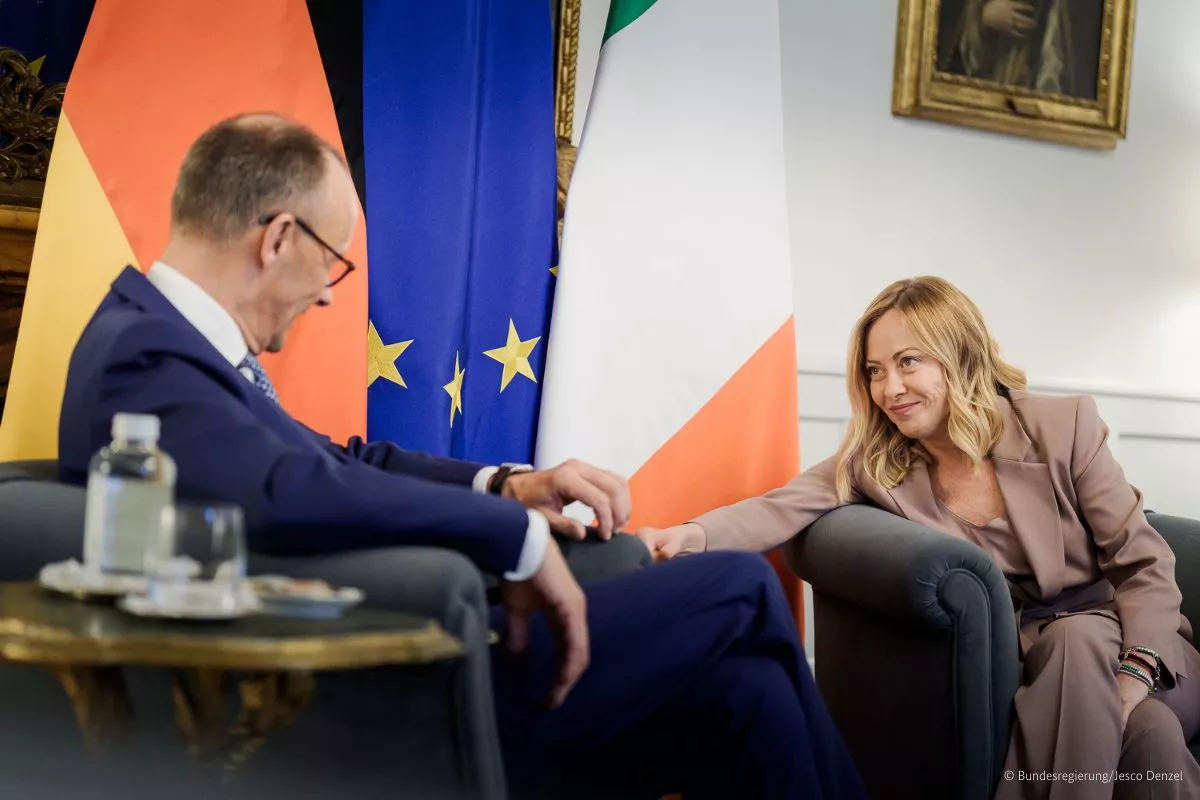
In this broader geopolitical context, France’s economic and political instability under Macron—which analysts often cite as the main reason for the cooling of relations between Berlin and Paris—is not the cause, but merely a pretext for Germany’s drive to elevate Italy’s status in counterbalance to its traditional rival, France.
The formation of this new alliance carries another important foreign policy dimension. The Rome summit confirmed both countries’ readiness to respond jointly to the threat posed by Russia and to the strategic pressure from the United States under Donald Trump. At the same time, the Russian threat is often employed as a propaganda tool to justify a much-needed, though unpopular, rearmament in Europe.
The economic and defence coordination between Germany and Italy, while strengthening Rome’s role in decision-making at the EU level, is also geopolitically aimed at reshaping the role of the aforementioned France: Berlin and Rome are effectively compelling Paris to align with common interests and abandon its previous ambitions of unilateral leadership.
It seems the time has come for the German horse to shed its hapless coachman. From now on, it’s either pulling together in the same harness or falling over the cliff.







 editor@caliber.az
 +994 55 444-88-98
 Азербайджан, Баку, ул. Низами, 203, Af Business House, 5-й этаж