










The counter economy: how to remove barriers between farmers and consumers? Analysis by Khazar Akhundov
A slight slowdown in economic indicators in the first quarter of 2026 has drawn renewed attention to a number of long-standing structural issues hindering the development of the country’s non-oil sector, including agriculture. Against this backdrop, it is hardly surprising that Monday’s Economic Council meeting focused specifically on agricultural development, the removal of obstacles constraining production and processing within the sector, and the strengthening of the role of small and micro enterprises in food production and trade in Azerbaijan.
Among the measures under discussion is an initiative by the Small and Medium Business Development Agency (KOBIA), which has introduced a set of support tools designed to expand opportunities for small producers to sell agricultural and other goods through major retail chains.
At the same time, upward pressure on food prices remains a persistent issue in the country. Alongside external factors linked to inflationary trends in key trading partner economies, domestic structural constraints also play a significant role. These include a high degree of import dependence among local processing and food enterprises, as well as limited competition within the retail sector, which continues to restrict the ability of small domestic producers to place their goods on supermarket shelves.
Strengthening public–private cooperation in agriculture and advancing the liberalisation of food markets has long been an overdue necessity in the country’s economic agenda. On April 20, a meeting of the Economic Council, chaired by Prime Minister Ali Asadov of Azerbaijan, reviewed key issues related to the sustainable development of the agricultural sector, including the current set of challenges it faces.
During the meeting, Minister of Agriculture Majnun Mammadov presented a detailed report, followed by exchanges with members of the Economic Council and other heads of the economic bloc. Based on the discussions, relevant instructions were issued to the responsible institutions.
In particular, the meeting outlined prospects for the development of the agricultural and agro-processing sectors. The proposed measures focused on increasing production and productivity in agriculture, strengthening food security, expanding agricultural trade and exports, and supporting employment in the regions, among other strategic priorities.
These problems have not accumulated over a single year, and back in March, during discussions of the government’s 2025 performance report in the Milli Majlis (parliament), the downturn in the agricultural sector was explained by a range of objective factors.
It was noted that local producers are unable to meet the high demand for food due to the limited resources of the agricultural sector, shortages of irrigation water, as well as the low productivity of a significant number of small farms. Additional constraints include the slow transition to intensive agricultural technologies, which collectively increase production costs.
Despite state policies of subsidies and technical assistance to rural producers, low procurement prices for raw materials and relatively low wages for hired workers in rural areas also deprive many farmers of incentives for development and contribute to population outflow to urban centres.
Another very serious problem faced by agricultural producers is related to the fact that small regional farms — including producers of fruit and vegetables, dairy products, and other goods — encounter logistical difficulties. They often do not have access to large retail chains, and the cost of storage in large refrigerated facilities is also prohibitively high for them.
This problem is further exacerbated by the activities of large wholesale bases and logistics companies operating in a “weakly competitive environment,” which control the storage segment in refrigerated warehouses and wholesale storage facilities. At the same time, large retail supermarket chains tend to rely on extremely high business margins.
It was expected that efforts to combat unfair competition and monopolisation of segments of the retail market, alongside the Competition Code, would be regulated by the draft law “On Internal Trade”. This document was primarily intended to govern relations between suppliers and retail chains. However, the draft law, which has been under development for five years on the initiative of the Ministry of Economy, has still not acquired the status of a law.
It is therefore not surprising that large retail chains, which are interested in purchasing food on the domestic market at the lowest possible prices, are quite successful in achieving this objective. At the same time, this does not prevent them from maintaining high retail margins.
Large processing enterprises — including canning, meat and dairy, confectionery, and other food factories — are forced to operate according to the “rules of the game” set by retail chains. Moreover, due to their relatively lower production costs, they have some room to reduce prices.
Small and micro producers and processors, however, do not have such opportunities because they lack mass-scale agricultural production. Here, an objective economic law comes into play: the smaller the scale of production, the higher the unit cost of output. This, in turn, deprives them of competitive advantages within retail supply chains.
On the other hand, leading retail companies prefer to conclude annual contracts with large producers for the purchase of many thousands of tonnes of products. This allows them to calculate logistics, the “delivery distance” (logistics burden), and ensure annual stability of food supplies.
A different picture emerges with small producers: their production volumes are significantly lower, and supermarkets find it economically unviable to engage in one-off purchases of a few hundred kilograms or a couple of tonnes of products, especially without the prospect of long-term, systematic cooperation. This is further complicated by the administrative and financial complexity of dealing with numerous small business entities.
However, there is a clear demand among ordinary consumers for access to a diverse range of food products from remote regions, and this need is not always adequately met. Unfortunately, the fairs organised on the initiative of the Ministry of Agriculture under the “From Village to City” programme have not managed to become a real alternative: they remain quite limited in number, and prices there are almost no different from those in capital city supermarkets.
Street trade from kiosks is also restricted mainly to fruits and vegetables, due to the inability to comply with storage regulations for meat, dairy, fish, and other perishable products.
Important steps toward addressing these complex challenges are being implemented on the initiative of the Ministry of Economy’s structure — KOBIA (Small and Medium Business Development Agency). This includes providing support to hundreds of small business entities in selling their products through retail chains.
Speaking at public discussions last year on the topic “The Role of Retail Chains in a Market Economy: Opportunities and Prospects,” the Chairman of the KOBIA Board, Orkhan Mammadov, noted that in 2024 alone, 550 small and medium-sized enterprises benefited from sales support mechanisms. In 10 regions of Azerbaijan, KOB Fest exhibition-fairs were organised, while in 2025, KOB Bazar fairs began to be held in the Binagadi district of the capital.
Particular attention is currently given to the free participation of business entities in KOB Fest exhibitions and fairs, which have been held since 2022. At these events, SMEs are able to showcase and sell their products and services directly to a broad consumer base.
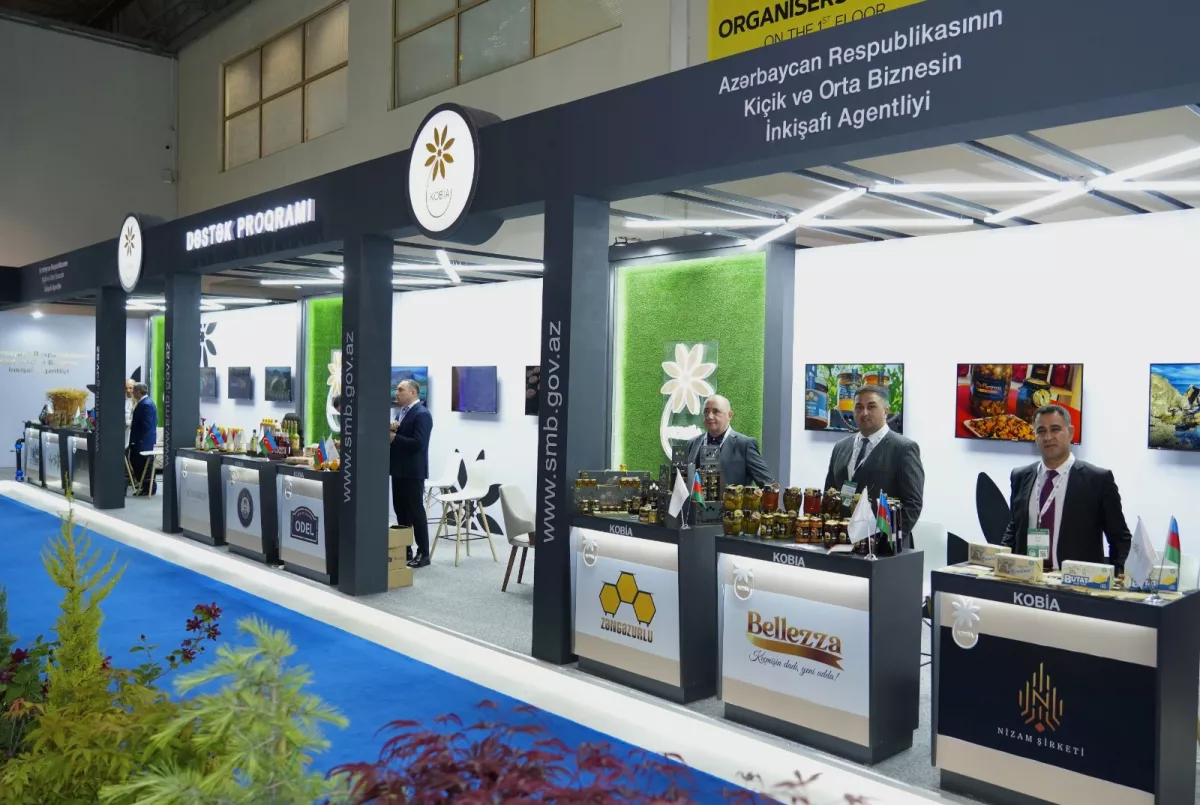
According to recent information released by the KOBIA press service, support mechanisms for small and micro food producers are being further expanded and diversified, enabling broader access to retail chains, exhibitions, and fairs.
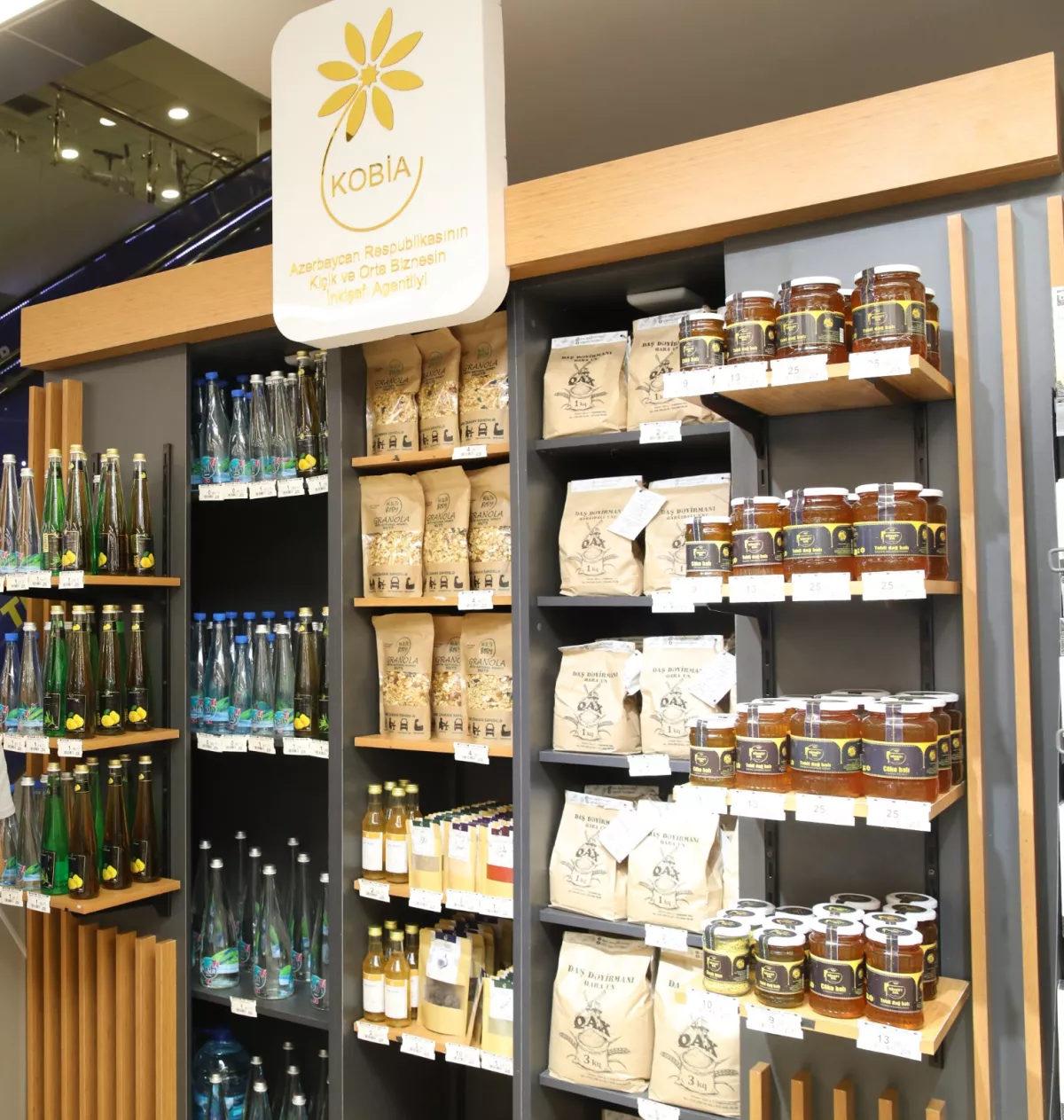
“The Agency rents retail spaces in large supermarket chains, creates unified stands, and places entrepreneurs’ products in these points of sale. The placement period is three months, and if necessary, it can be extended twice, while the retail space may also be expanded,” said Rashad Bayramov, Head of the Market Access Services Department at KOBIA’s Business Services Division. “The ultimate goal is to promote locally produced goods and expand sales opportunities.”
The department head noted that such stands have currently been established in six retail locations in Baku. Within this support mechanism, up to 140 product items from small businesses are now being sold through retail chains. These include mainly fruits and vegetables, meat and dairy products, bakery and confectionery goods, dried fruits, chips, herbs, and spices.
KOBIA has expressed readiness to further scale up these initiatives, with entrepreneurs able to apply electronically to participate and place their products at the designated stands.







 editor@caliber.az
 +994 55 444-88-98
 Азербайджан, Баку, ул. Низами, 203, Af Business House, 5-й этаж