










Unanswered fire And unfiltered Turkophobia in Yerevan
Evening of April 23, 2026. From Republic Square in central Yerevan, a torchlit column moved towards Tsitsernakaberd, which in Armenia is referred to as the “Armenian Genocide Memorial Complex.” And leading this procession, reminiscent of a Ku Klux Klan march, were by no means marginal teenagers — at the forefront marched with pride activists of the ARF “Dashnaktsutyun,” a parliamentary party that has been embedded in Armenia’s political landscape for more than a century. Before the start of their ceremonial march, its participants set fire to the Turkish flag.
The burning of the Turkish flag is repeated in Yerevan every year and is even described by Armenian media as a “tradition,” which already exhaustively characterises what is taking place. This is not hooliganism by random radicals; it is a ritual turned into a political show, and the fact that the state allows such a ritual to take place in its capital says more about Armenia’s current political structure than any official rhetoric from the authorities.
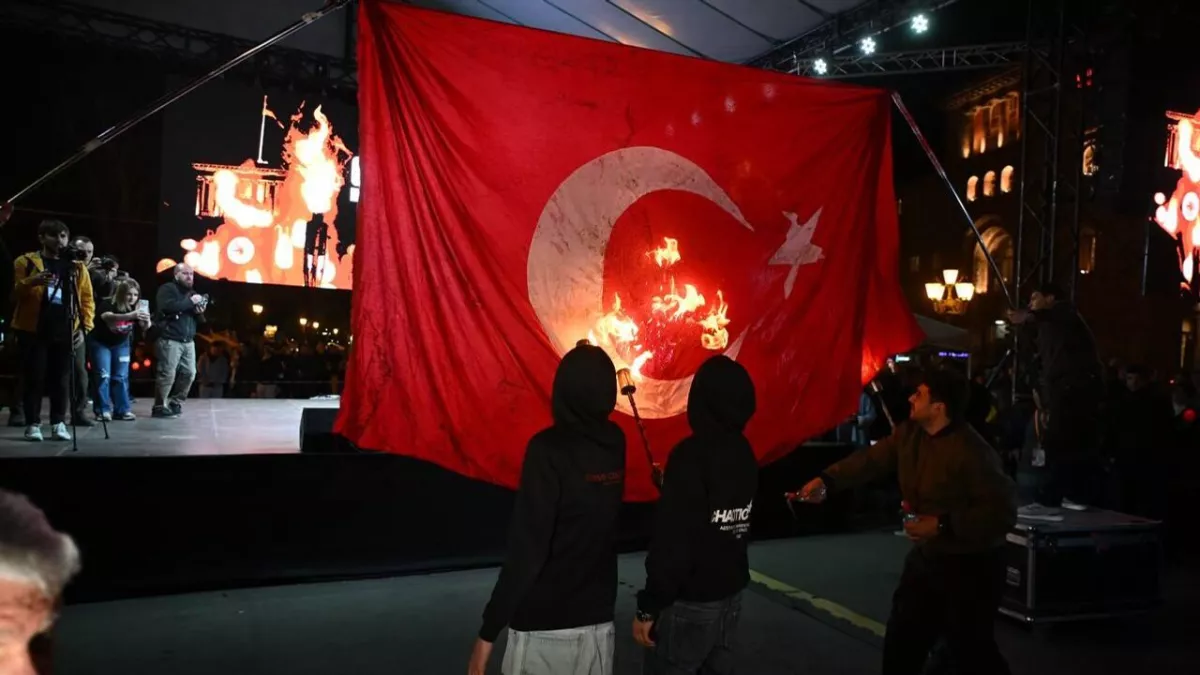
The ARF “Dashnaktsutyun” has an ideological lineage, and it is not concealed. Its legacy includes the systematic destruction of Azerbaijani religious and historical monuments, the falsification of regional history, and terrorism. All these components grew out of the same fabric — a belief in ethnic exclusivity. The bonfire in Republic Square is a visual signature of that same fabric, a continuation rather than a departure from tradition.
Of course, it would be most convenient to reduce everything to the actions of radical youth, but the party on whose behalf the march is held is represented in parliament and maintains an extensive network of youth organisations. It is precisely one of these — the ARF “Nikol Aghbalyan” student union — that conducts the annual torchlight march and exerts significant influence over a considerable part of Armenian diaspora networks in France, Russia, the United States, Lebanon, and Argentina. The ideology once cultivated by Nazi collaborator Garegin Nzhdeh is deeply embedded in the structure of Armenian political language, where Türkiye and Azerbaijan are portrayed as “forces of evil” to be eliminated.
Was there a reaction from the current authorities? Certainly. Nazeli Baghdasaryan, spokesperson for Pashinyan, stated: “Prime Minister Nikol Pashinyan condemns such an act, considering it irresponsible and unacceptable. The burning of the flag of an internationally recognised state, especially a neighbouring country, cannot be given any other assessment by the head of state.”
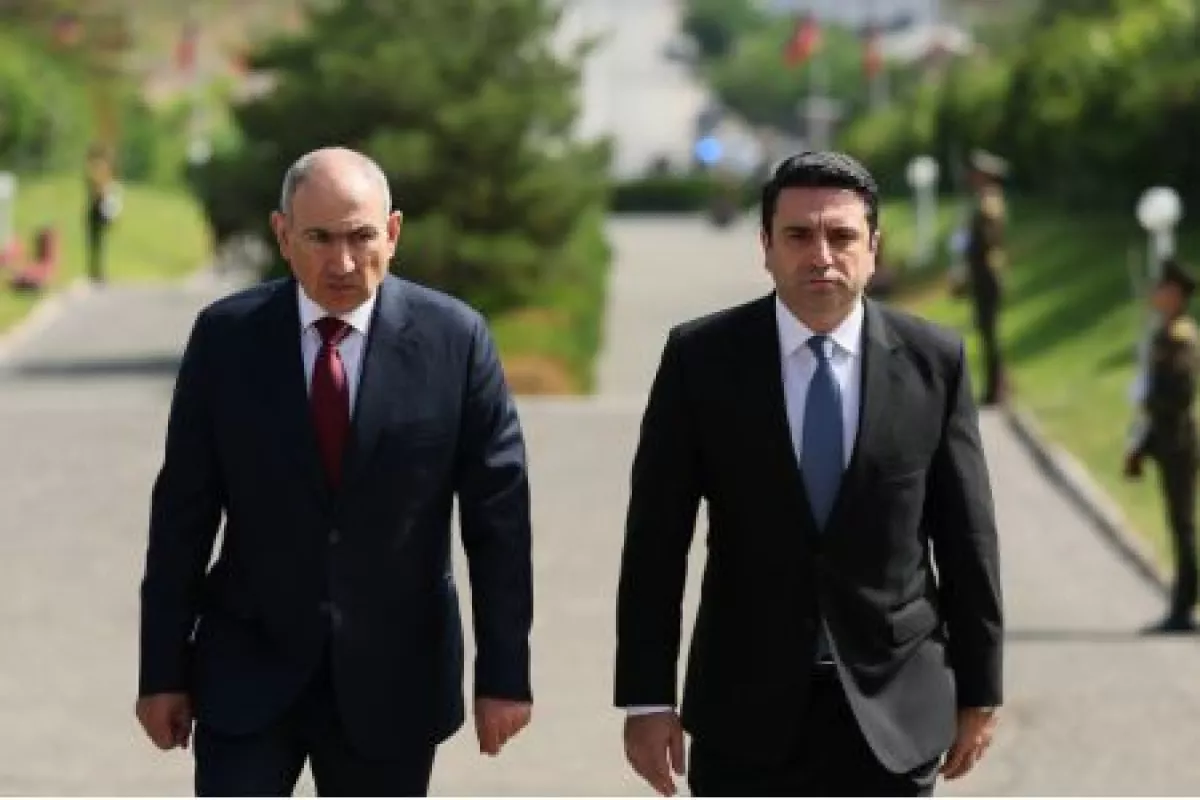
The Speaker of the National Assembly, Alen Simonyan, in turn, noted: “A meaningless, shameful and highly reprehensible act that casts a shadow over the meaning of April 24. This is about memory, unity and life, and I consider such steps to be pitiful and unacceptable provocations against peace and the future.”
As can be seen, everything has been formally stated. However, Yerevan does not detain the organisers nor does it reconsider the legal classification of such actions under the Criminal Code of the Republic of Armenia. The “sincerity” of such condemnation becomes even more transparent when placed against the backdrop in which all of this took place. A few days before the torchlight procession, the state news agency Armenpress published information that the company Genetic Production had begun filming a biographical movie titled “Monte,” with its premiere scheduled for November 2026.
The protagonist of the film is Monte Melkonyan, an ASALA militant, a participant in the terrorist campaign against Turkish diplomats between 1975 and 1984, and one of the organisers of ethnic cleansing during the First Karabakh War, who, on July 31, 1980, in Athens, shot at a vehicle carrying Turkish diplomat Galip Özmen and his family. Along with 45-year-old Özmen, his 14-year-old daughter Neslihan was also killed; his wife and 16-year-old son were seriously injured.
And this figure is being honoured in Armenia with a film, announced by the country’s official state agency — in the same state whose prime minister condemns irresponsible acts.
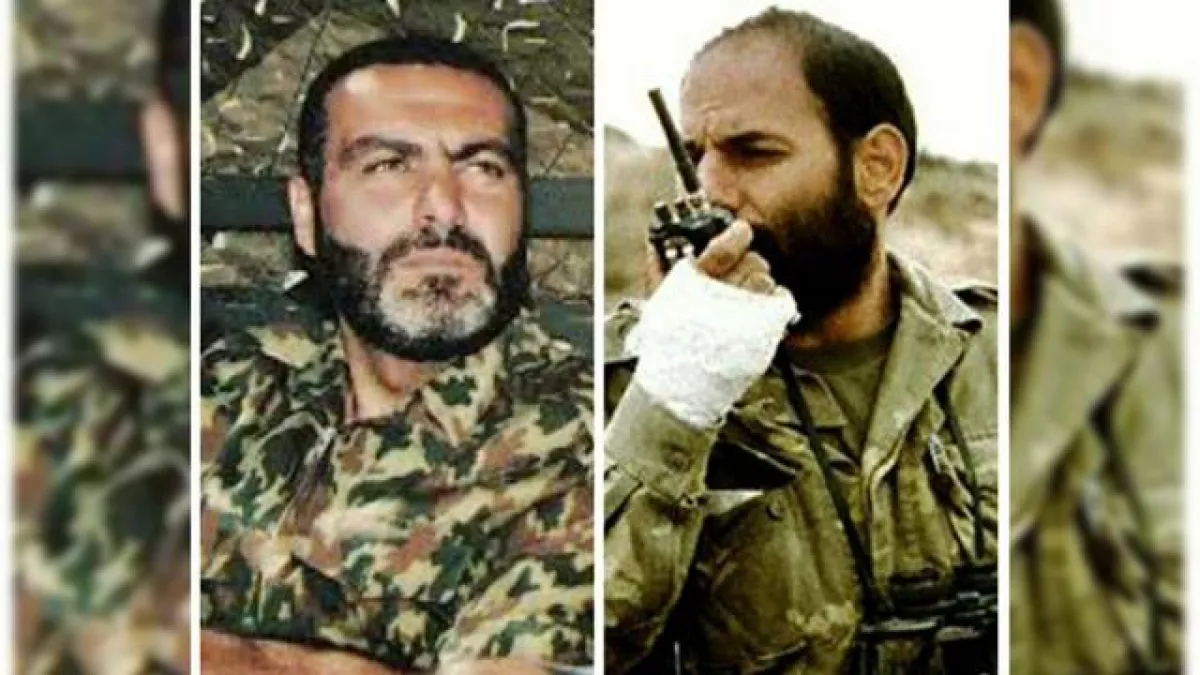
The picture is neither accidental nor unprecedented. In 2025, Genetic Production released the film “Vazgen: The Last Sparapet” about former Armenian Defence Minister and Prime Minister Vazgen Sargsyan, who in Armenian military mythology occupies the place of one of the main architects of the occupation of Azerbaijani territories. Special screenings of “Vazgen” were held in various military units in Armenia. The same production circle is now preparing “Monte”: the chief producer of both projects is Nona Sargsyan, niece of Vazgen Sargsyan. One family and ideological trajectory, a single agenda — the transformation of terrorists and participants in ethnic cleansing into a gallery of heroes and the reinforcement of revanchist sentiments.
A state whose prime minister condemns the burning of a flag in the capital, through its official agency, announces the glorification of a child-killer.
A separate issue is the reaction of Turkish media. Outlets that are usually extremely sensitive to any affront to the flag have, by and large, ignored the Yerevan incident. The same editorial offices that are ready to fire criticism at Azerbaijan over the slightest pretext have responded with silence to the open burning of the Turkish Republic’s flag in the Armenian capital.
The explanation cannot be reduced to a lack of information: the incident was widely covered across Armenian, European, and Russian sources. Nor can it be attributed to fatigue with the topic — this concerns the state symbol of a country. The silence has a direction, and it is not difficult to read.
In Turkish media, there has long been a circle that prefers to separate the Armenian-Azerbaijani and Armenian-Turkish tracks as two independent narratives. According to this logic, Ankara should move forward with Yerevan at its own pace — opening the border, launching trade — without taking into account Baku’s position on the matter. This framework is convenient for those who would like to see Türkiye –Armenia normalisation treated separately from Azerbaijani interests. In Baku, this circle is well known by name; its presence in the Turkish media space has been recorded for a long time and is neither a secret nor a revelation.
The real position of the Turkish state is not reflected in media silence, but in the architecture of bilateral relations. On April 17, Erdoğan invited Aliyev to the Antalya Diplomacy Forum.
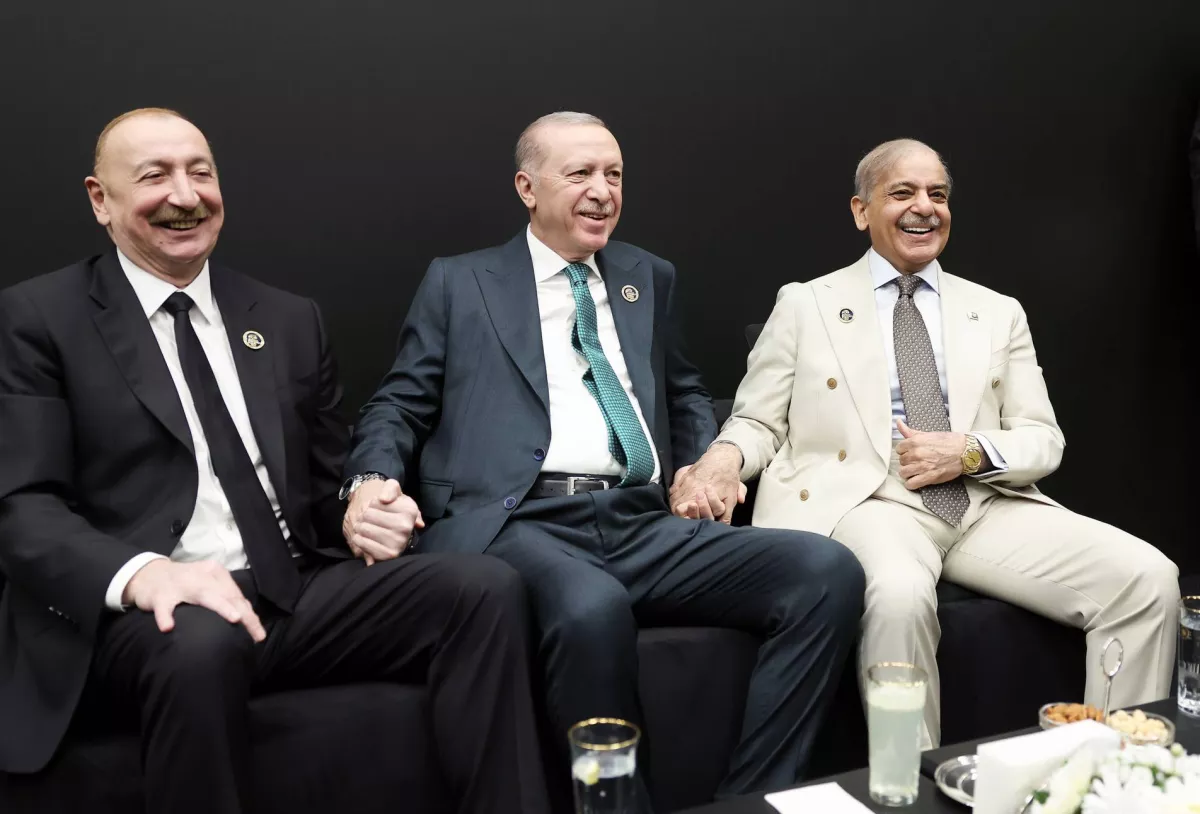
They were seated side by side — and that single frame was worth any communiqué. From the podium, the Turkish president stated clearly that the normalisation process with Armenia is being conducted in coordination with Azerbaijan. The formula was concrete and unambiguous. Ankara refuses to play a game of separating tracks. In Erdoğan’s understanding, the Armenian question is not local; it is regional and can only be resolved together with Baku. The principle of “one nation — two states” rests on the dense day-to-day alignment between Baku and Ankara. It is no coincidence that the Ministry of Foreign Affairs of Azerbaijan strongly condemned the burning of the Turkish flag.
“The government of Armenia should have prevented such a campaign, embodied in ethnic hatred, and should have taken appropriate security measures on time. It is completely unacceptable to turn a blind eye to such unacceptable acts under the pretext of democratic norms, freedom of assembly, and freedom of expression. Such acts, which are a clear manifestation of a revanchist and ethnic hatred-based fascist mindset in Armenia, should be condemned and prevented at the international level. We urge the Armenian government to hold those responsible for these acts accountable,” the statement of Azerbaijan’s Foreign Ministry reads.
And returning to the fire in Republic Square: it was not burning “against Turks,” as the Dashnaks themselves apologetically explain. It was burning to preserve the fuel of old hatred and to secure material for ignition when the moment comes. In Baku, this is clearly understood — and closely monitored.







 editor@caliber.az
 +994 55 444-88-98
 Азербайджан, Баку, ул. Низами, 203, Af Business House, 5-й этаж