










Epstein files: double standards of those who taught morality Subject: Mona Juul
A new batch of declassified files in the Jeffrey Epstein case has become one of the most discussed events in recent days. Millions of pages of correspondence, witness testimonies, passport data, and flight logs have revealed to the world the extent of the connections of the financier, accused of running a network for the sexual exploitation of minors. The international public now has access to names that were hidden behind legal barriers for years. Global media outlets began analysing the lists, looking for familiar names from politics, business, and culture.
However, the Caliber.Az editorial team decided to examine this story from a different angle. We were interested in one specific question: Are there people in Epstein’s inner circle who, in recent years, presented themselves as “holier than the Pope,” lecturing other countries—including Azerbaijan—on their shortcomings, giving moral lessons on human rights and democratic values?
We began examining the files methodically, one by one. And we came across a familiar name: Mona Juul. She is a senior Norwegian diplomat who has held posts as Norway’s ambassador to Israel and later to the United Kingdom. From January 2019 to September 2023, Mona Juul served as Norway’s permanent representative to the United Nations.
In this capacity, she spoke at sessions of the UN Security Council, including on the topic of the Armenian-Azerbaijani conflict. In one official statement on behalf of Norway at the UN Security Council, she used the term so-called the “blockage of the [Lachin ] corridor,” effectively conveying accusations against Azerbaijan.
Norway has traditionally positioned itself on the international stage as a defender of human rights, and its diplomats have often assumed the role of judges, assessing the actions of other states. Mona Juul was one such figure.
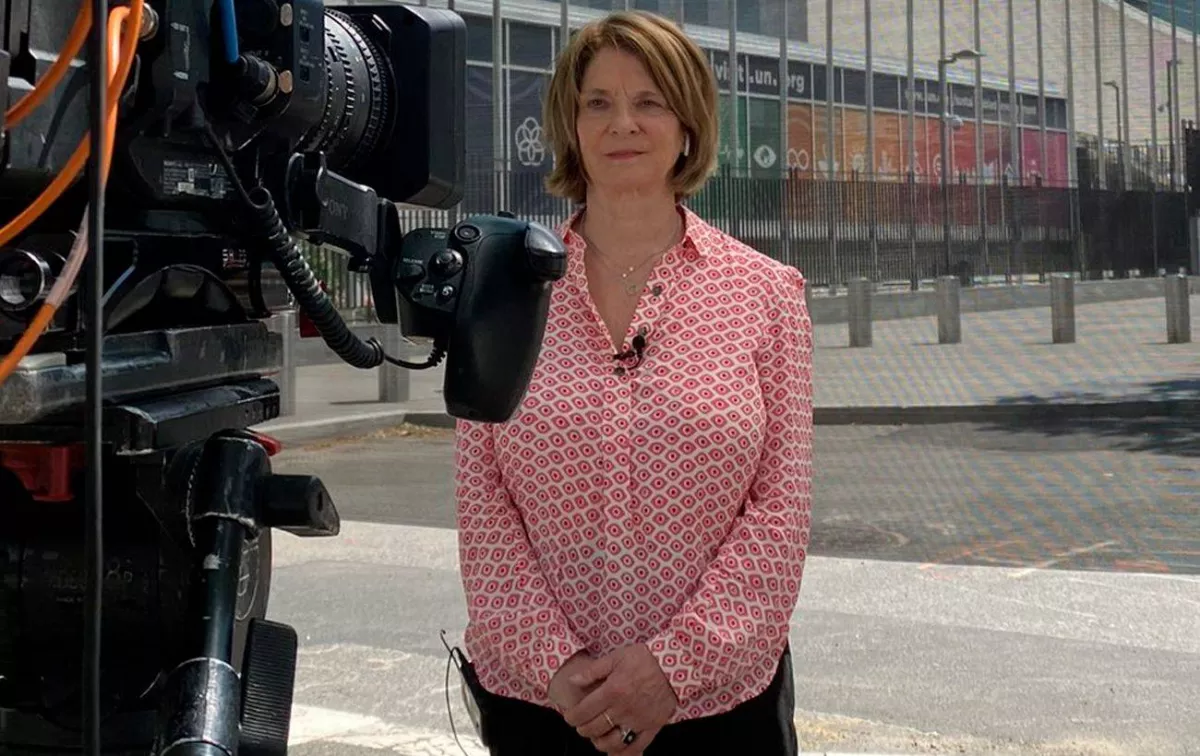
What we found in the Epstein documents forces a reconsideration of this image. No, this is not about a chance acquaintance at some social event, where business cards were exchanged and that was it. The documents reveal a long-standing, sustained relationship that touched the most personal aspects of the Norwegian diplomat’s life and that of her family. Epstein was part of her inner circle; she turned to him for assistance, invited him to family events, and even used his connections to handle career matters for her children.
The timeline of these ties begins long before Epstein made headlines following his arrest in 2019. In the spring of 2011, aides to the Juul family corresponded with his team to arrange a private flight to Bermuda. A letter dated May 2, 2011, details this trip.
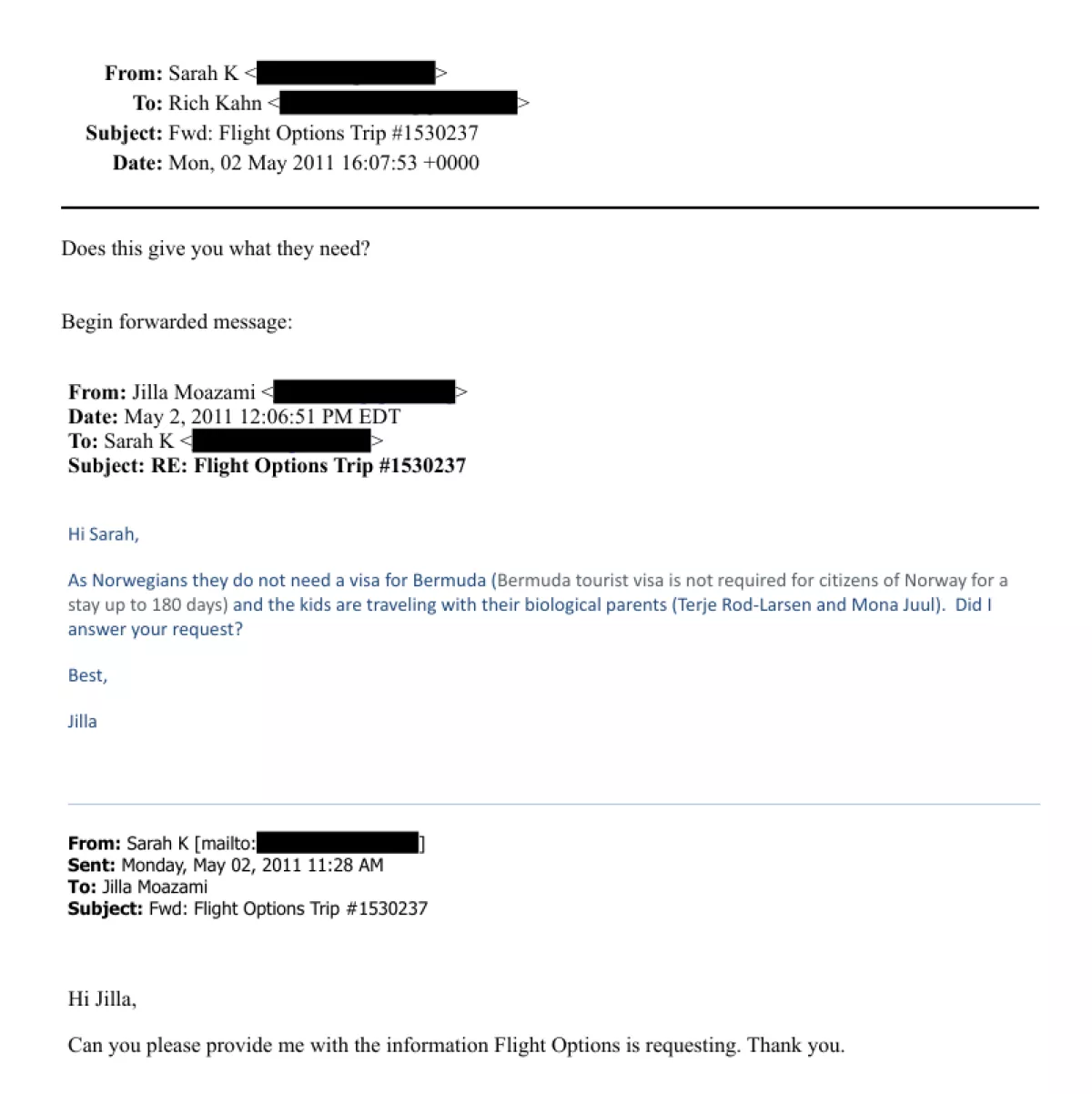
Assistant Jilla Moazami wrote to Epstein's office: “As Norwegians, they do not need a visa for Bermuda… the kids are traveling with their biological parents (Terje Rod-Larsen and Mona Juul).” This email was forwarded to Rich Kahn, Epstein’s manager, which directly indicates the involvement of Epstein’s network in organising—and likely funding—this flight. A month before the departure, scans of the entire family’s passports were sent to Epstein’s pilot, Larry Visoski. Next to Mona Juul’s name was the note: “Passport issued: Oslo, Norway (diplomatic)” — a diplomatic passport.
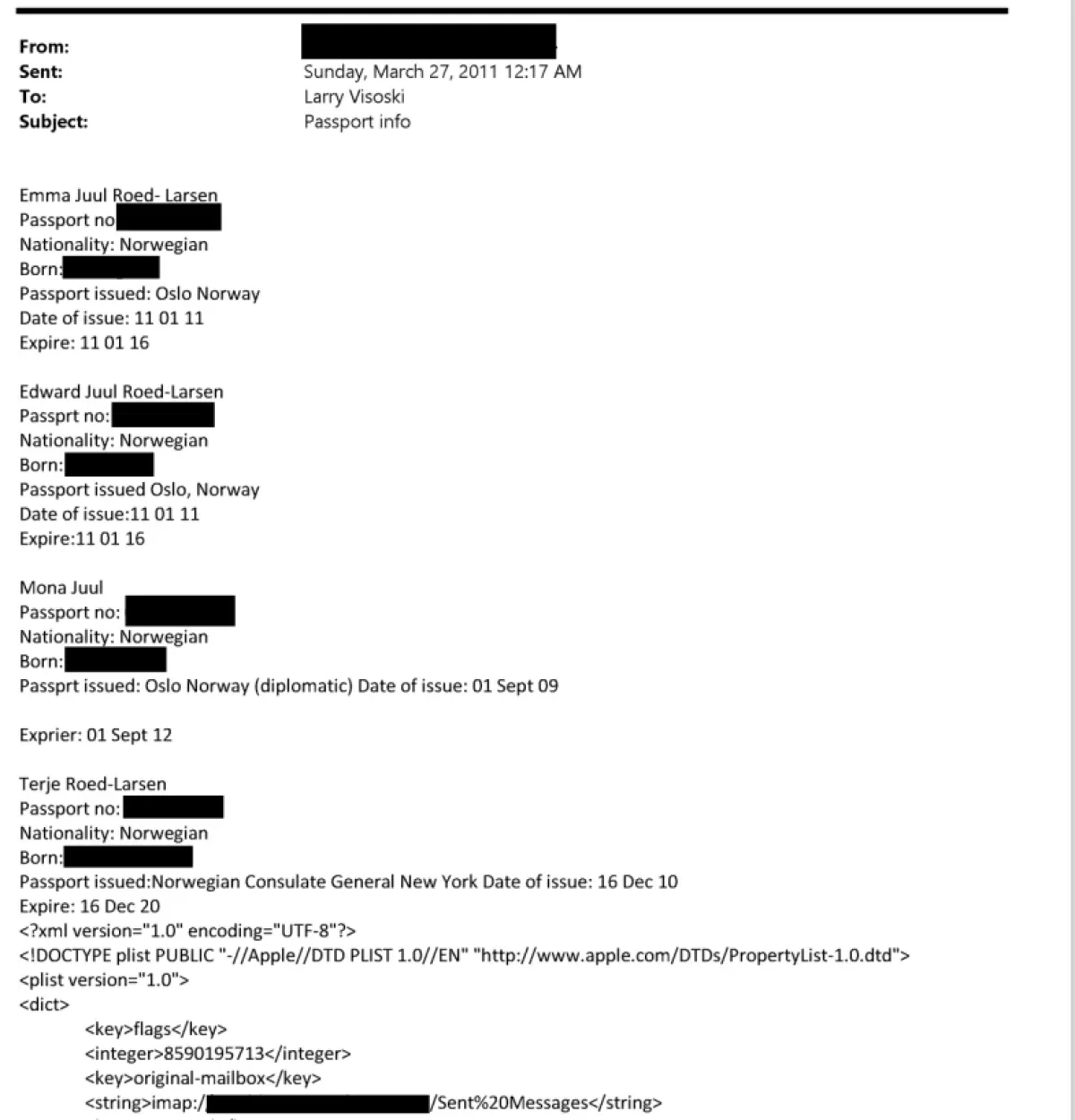
This detail deserves special attention. A diplomatic passport is issued to government officials for the performance of official duties. Its use for private trips organised by Epstein’s network raises questions not only of ethics but also of procedure. At the time, Mona Juul held the post of Norway’s ambassador to Israel—a position that demands an impeccable reputation.
But this was only the first sign. In October 2014, the diplomat’s assistant, Camilla Reksten-Monsen, sent an email to Epstein’s personal account. The subject line read: “Invite for Woody Allen.” The body of the message stated: “Terje asked that I send you the below invitation for Woody Allen and Soon-Yi… We have the pleasure of inviting you to a dinner in honor of … Headmaster of Stowe School… The dinner will take place on Friday, October 24, 7pm at the International Peace Institute, located at 777 UN Plaza. Best regards, Mona Juul and Terje Rod-Larsen.”
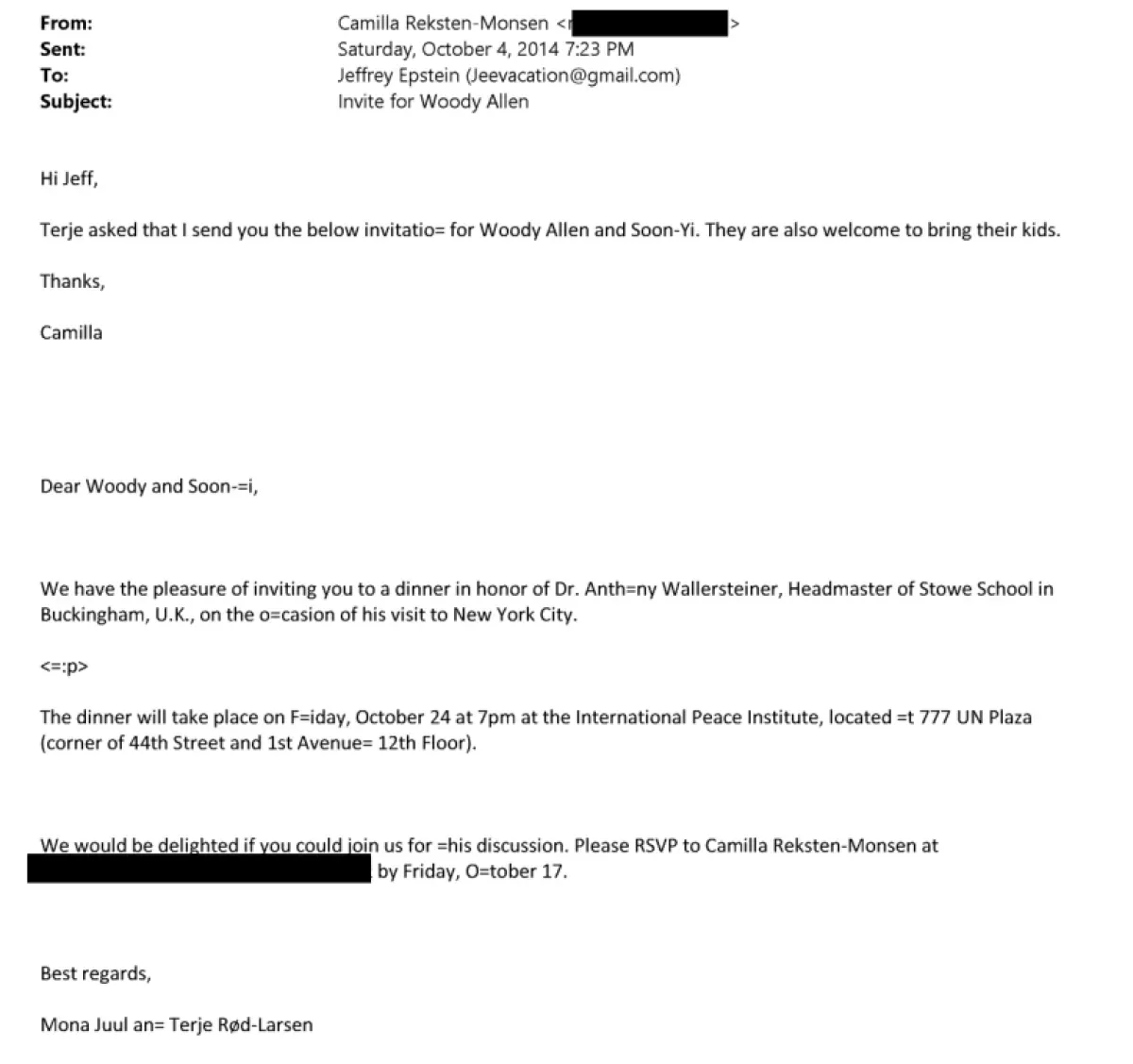
Thus, Epstein acted as an intermediary through whom the Norwegian diplomat and her husband sought to secure high-profile guests for their events in New York. He had an “address book” with the right contacts, and the Juul family made active use of it. The International Peace Institute, where Mona’s husband worked, positioned itself as a serious organisation dealing with global security and diplomacy. And yet its leadership relied on the connections of a man whose reputation already raised serious questions to organise social gatherings.
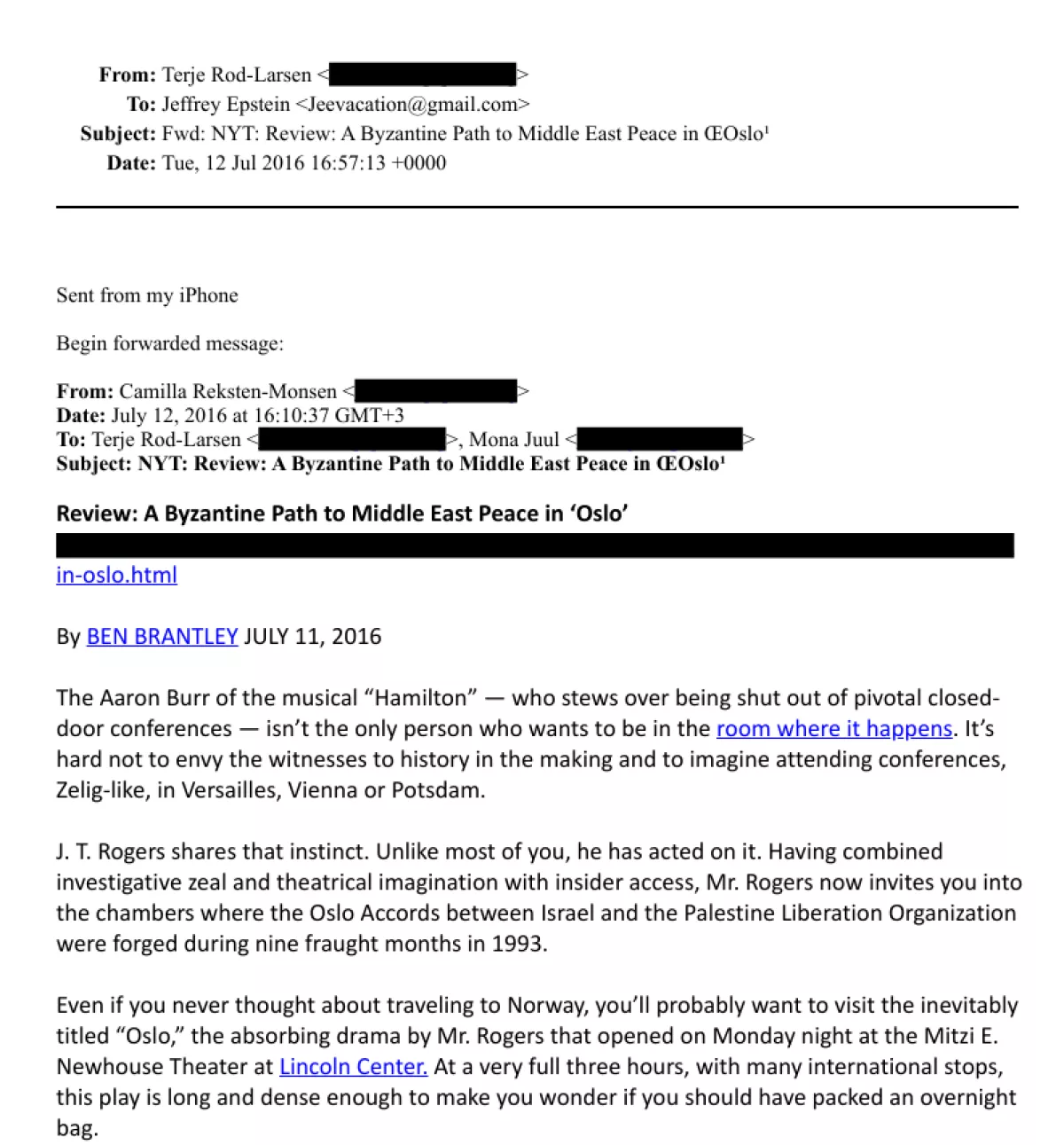
By 2016–2017, the friendship had reached its peak. In the summer of 2016, Mona’s husband forwarded Epstein a review from The New York Times of the play Oslo, which tells the story of Norway’s involvement in the Middle East peace process of the 1990s—a process in which Mona Juul herself was one of the central figures. The review noted: “At the heart of the story is a Norwegian couple… Mona Juul (played by Jennifer Ehle) and her husband, Terje Rod-Larsen.” The play was a success, ran on Broadway, and helped shape the diplomat’s image as a peacemaker. The family shared news of these triumphs with Epstein.
Correspondence from June 2017 illustrates the depth of the closeness. On June 23, Mona’s husband wrote to Epstein via iMessage: “Very well! Am on my way with Mona, Grace and Camilla to Ascot. Will call after.”
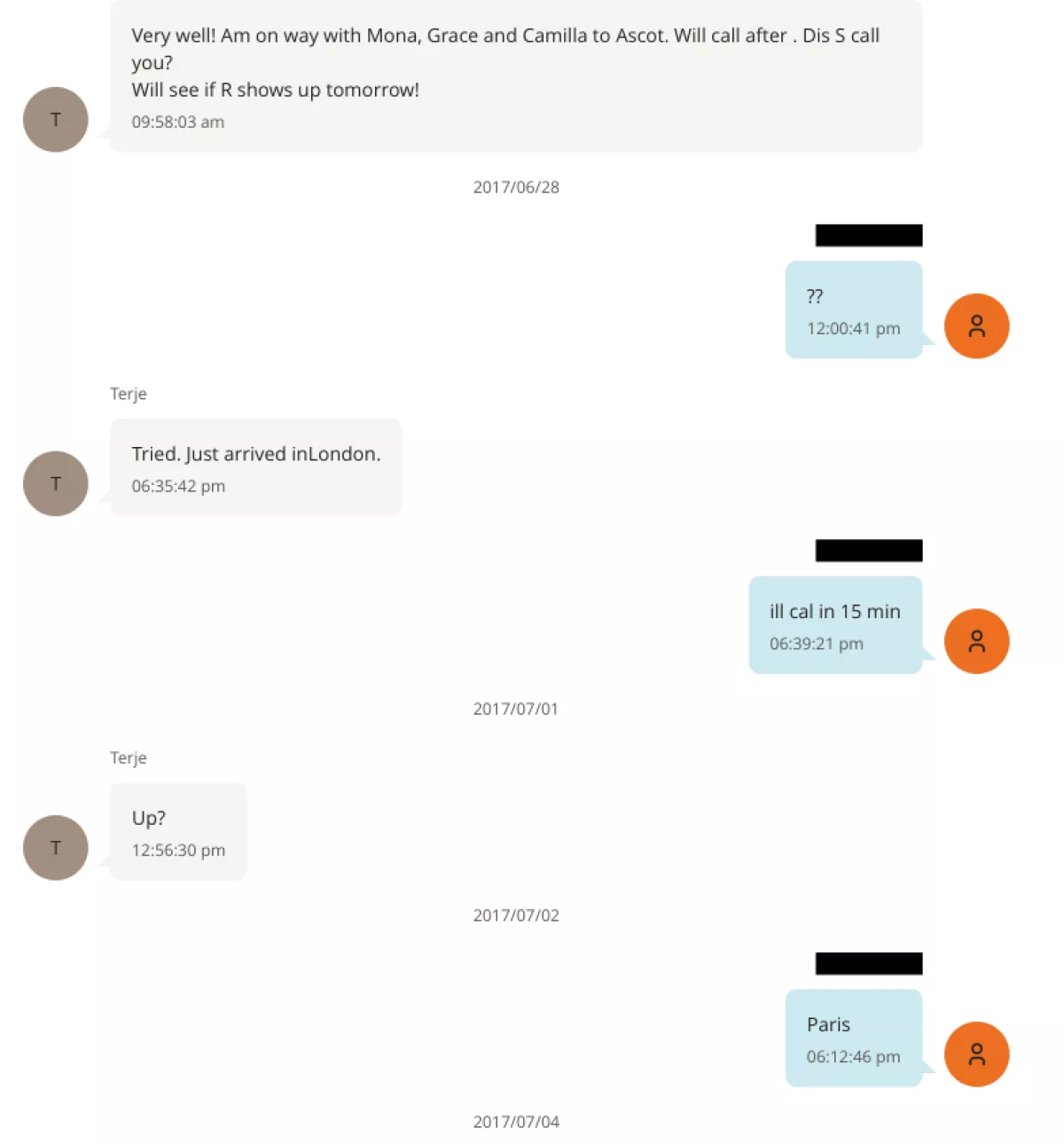
Royal Ascot is not merely horse racing. It is a cornerstone of the British social calendar—an event reserved for the elite, where members of the royal family arrive in carriages and where the dress code is stricter than at diplomatic receptions. And Mona Juul was spending time there together with Epstein. This was 2017, just two years before his arrest. By that point, the financier’s first conviction for sexual offences was already a matter of public record—in 2008, he pleaded guilty in Florida to soliciting prostitution from a minor and served thirteen months in prison.
Moreover, it was in July 2017—barely a month after Ascot—that an episode occurred which went beyond mere friendship. On July 19, Epstein sent an email to David Stern, his contact in the banking sector. In it, he forwarded a CV: “Edward Rod-Larsen. Norwegian, son of diplomats. Grew up in Israel (mother, Mona Juul, Norwegian Ambassador to Israel; father, Head og UN Middle East)… Has to do one week of obligatory work experience.” In other words, Epstein was personally involved in arranging employment for their son.
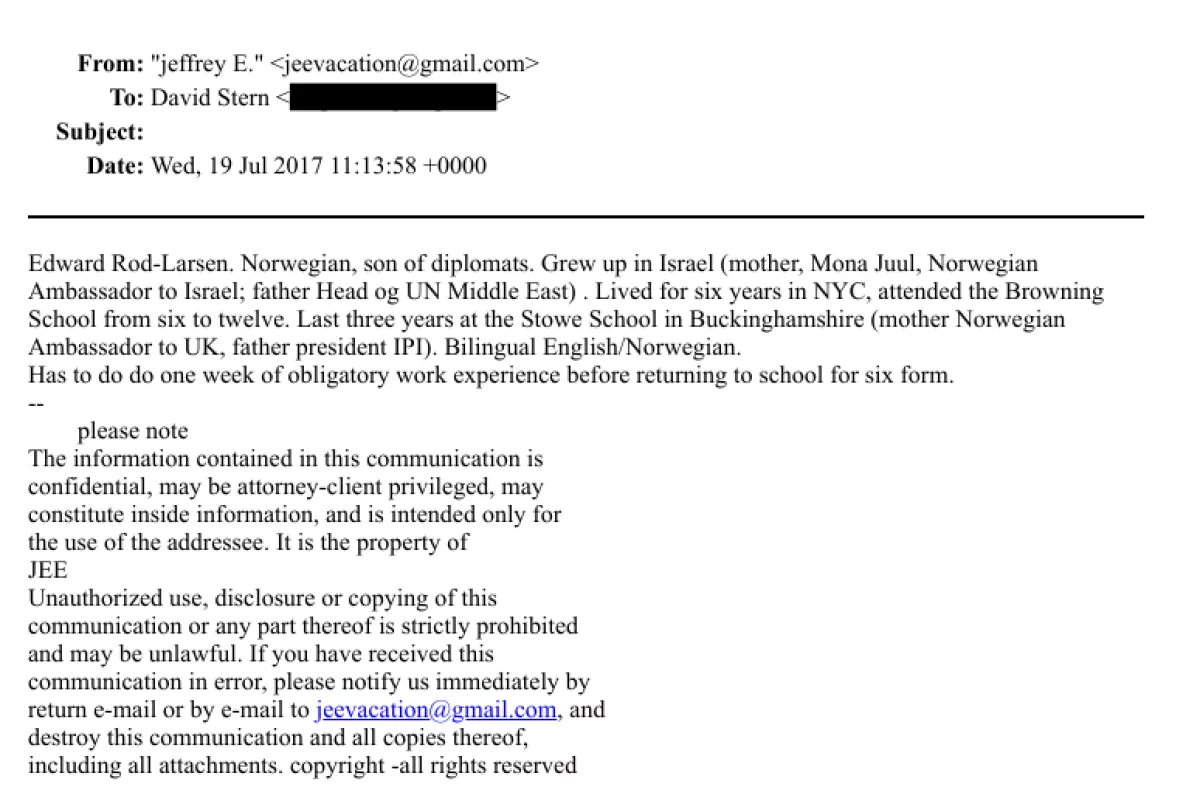
At this point, it is worth pausing to grasp the depth of the moral decay. Mona Juul—at the time Norway’s ambassador to the United Kingdom (she had already moved from Israel to London)—allowed a man convicted of sexual crimes against a minor to involve himself in her son’s career. Moreover, in his email, Epstein explicitly used Mona’s title as leverage with bankers: “mother — Norwegian Ambassador.” He traded on her status, and she was clearly aware of it and did not object.
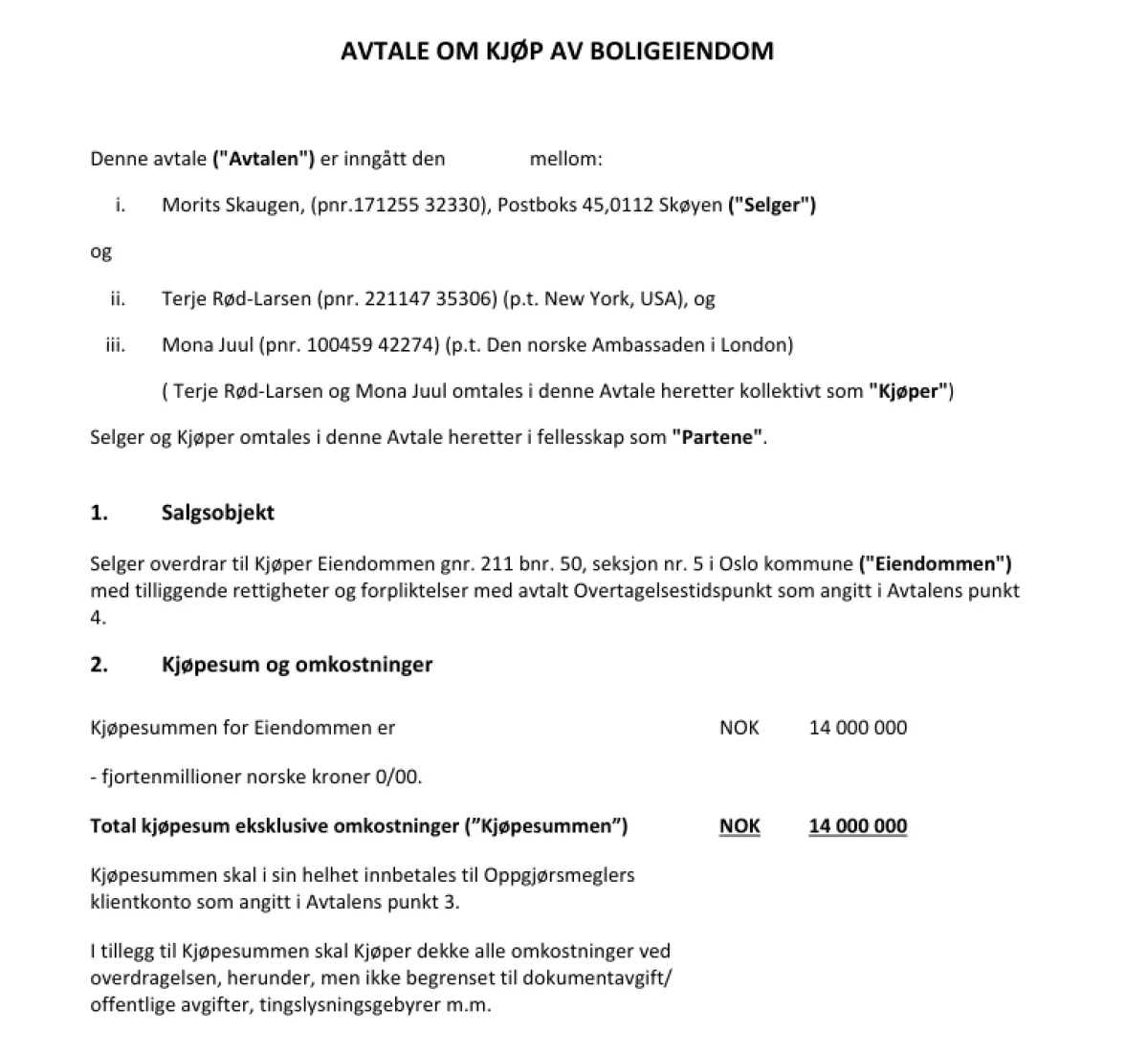
The documents suggest that the extent of these ties may have gone even further. Among Epstein’s files is a contract for the purchase of residential property in Oslo worth 14 million Norwegian kroner, listing Terje Rod-Larsen and Mona Juul as the buyers. Why did documents related to a Norwegian diplomat’s real estate purchase end up in Epstein’s possession? And how deeply was he involved in their financial affairs?
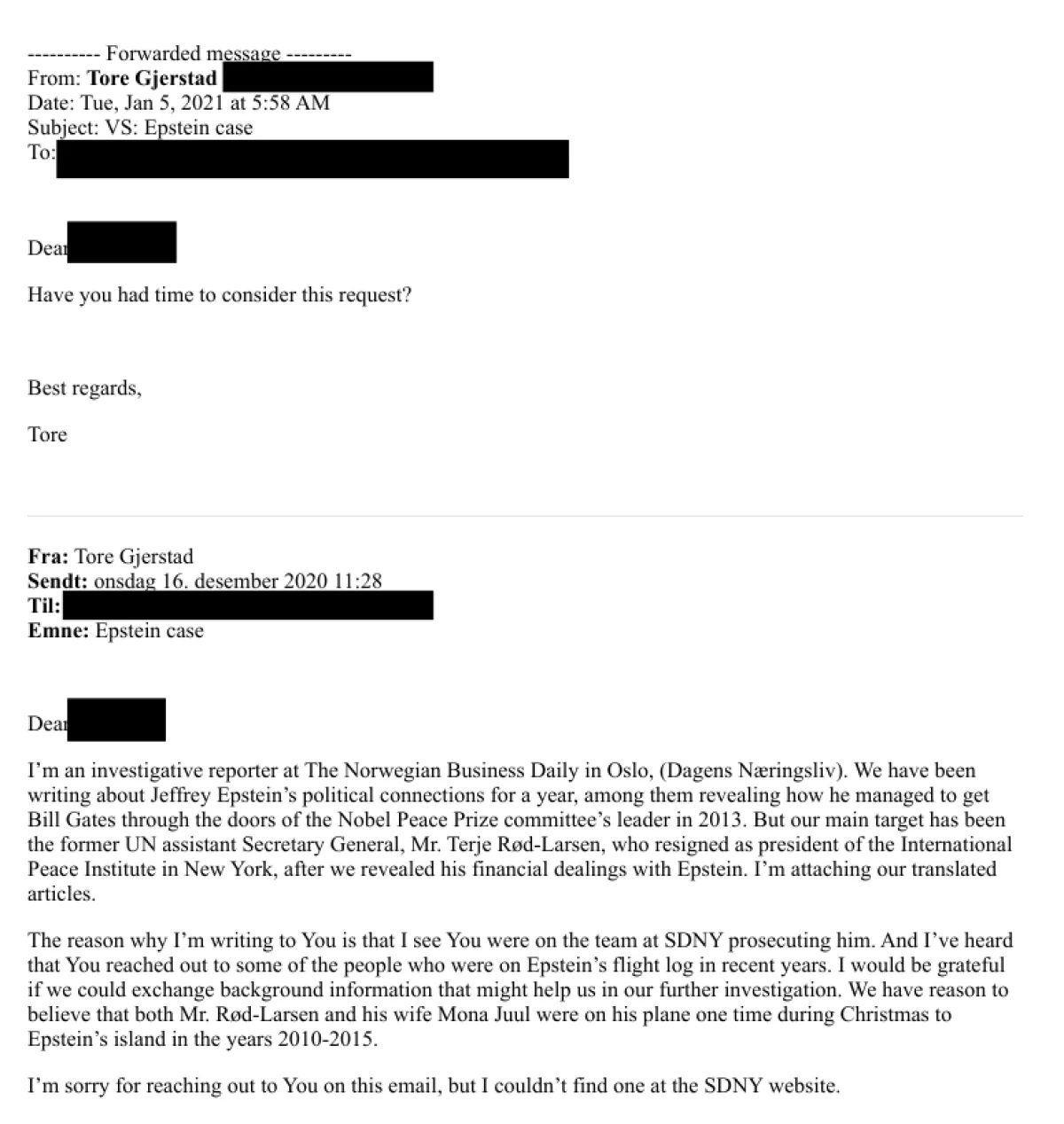
In January 2021, after Epstein’s death in prison, Norwegian journalist Tore Gjerstad from the influential newspaper Dagens Næringsliv sent a letter to US prosecutors stating: “We have reason to believe that both Mr. Rød-Larsen and his wife Mona Juul were on his [Epstein’s] plane one time during the Christmas to Epstein’s island in the years 2010-2015.”
By the time this letter was written, Epstein’s island—known as Little Saint James—had already entered history as the site where the financier’s horrific crimes took place. If the Norwegian journalist’s information is accurate, this would mean that Mona Juul and her husband were at the very epicentre of the world Epstein created for himself and his guests.
It is important to understand this: we are not judges. We are analysts who have examined documents from open sources and are presenting the facts. And facts, as is well known, are stubborn things. What we see before us is not a series of isolated episodes of a chance acquaintance, but a system of stable ties that lasted for years. Family holidays using Epstein’s logistics. Social events where he acted as an intermediary to attract celebrities. Joint trips to elite gatherings such as Royal Ascot. The use of his contacts to advance his son’s career. Personal financial documents kept in Epstein’s archive. And all of this against the backdrop of Mona Juul’s public role as a diplomat of a country that presents itself as a defender of human rights and a moral authority.
Epstein’s first conviction in 2008 should already have raised serious questions for any decent person—especially for an ambassador, whose job requires constant risk assessment and an understanding of how personal relationships can affect professional responsibilities. Yet despite this, the relationship continued until 2017, and possibly beyond.
The answer likely lies in the environment in which, as it turns out, a certain segment of the Western diplomatic elite operates. It is a closed world where being “one of the right people” in certain circles matters, where access to influential figures opens doors that would otherwise remain shut. Epstein was the key to those doors.
And, so to speak, the “cherry on top.” According to Norway’s influential newspaper Dagens Næringsliv (DN), just two days before his death in 2019, Jeffrey Epstein signed a will stipulating that ten million dollars would go to the children of Terje Rod-Larsen and Mona Juul. For what services? That is an intriguing question—one now being examined by the relevant authorities in Norway.
From this point on, every statement by Mona Juul on human rights, every critical remark directed at other countries, will inevitably be read through the prism of these documents. How can one speak about morality when one’s own life demonstrates such a glaring discrepancy between words and deeds? How can transparency be demanded of others when one’s own connections were hidden behind the closed doors of private jets?







 editor@caliber.az
 +994 55 444-88-98
 Азербайджан, Баку, ул. Низами, 203, Af Business House, 5-й этаж