










Kyiv under fire, lawmakers under watch Ukraine’s New Year reality
While in Baku and in capitals around the world people welcomed the night of December 31–January 1 in a spirit of celebration, Kyiv found itself—aptly described by Caolan Robertson, a British journalist with Times Radio and LBC Radio—the only capital ushering in the New Year in silence. “While the world celebrates with fireworks, Ukrainians have to listen for drones. Wherever you are in the world, think of Ukraine and remember who caused this,” the British journalist said.
He voiced an absolute truth. Indeed, on New Year’s Eve Kyiv residents anxiously awaited yet another powerful wave of Russian drone and ballistic strikes.
Why “yet another”? Because such attacks by Russia are, in essence, relentless. This is not a personal observation, but stark statistics. In 2025, Russia carried out drone, missile, or combined strikes against Ukraine on 361 days. Ukrainians experienced only four days without Russian missiles or drones being launched—April 7 and 20, as well as May 9 and 10, when Russia marks its so-called “Victory Day”.
These fears were further fuelled by statements from the Russian side claiming it would inevitably retaliate for the highly dubious—and denied by leading US media—“strike on the residence of the Russian president”. In the local social media space, speculation spread rapidly, even about the possibility of a nuclear strike on Kyiv. The absurdity of such claims is obvious, yet it is equally clear why rumours of this kind do not surprise residents of a country that has lived for almost four years under the constant threat of drone and missile attacks from Russia.
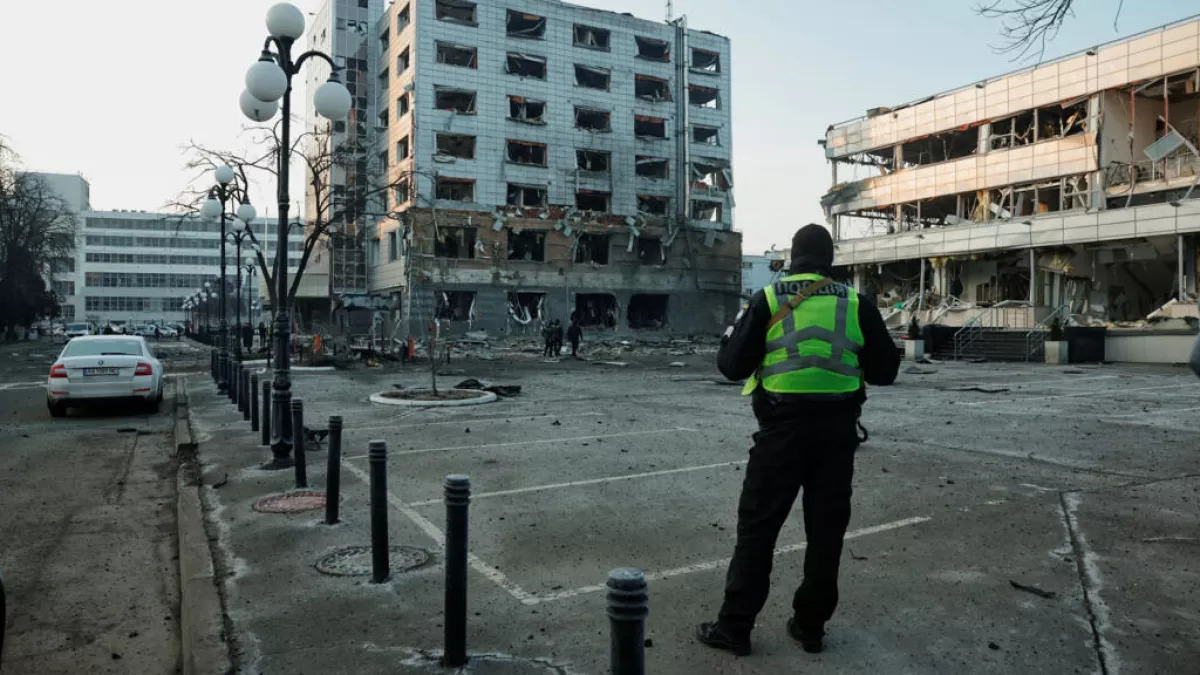
Ultimately, on New Year’s Eve Russia launched more than 200 attack drones against Ukraine. As Ukrainian President Volodymyr Zelenskyy noted, the primary target of these strikes was Ukraine’s energy system. According to him, the attacks hit the Volyn, Rivne, Zaporizhzhia, Odesa, Sumy, Kharkiv, and Chernihiv regions.
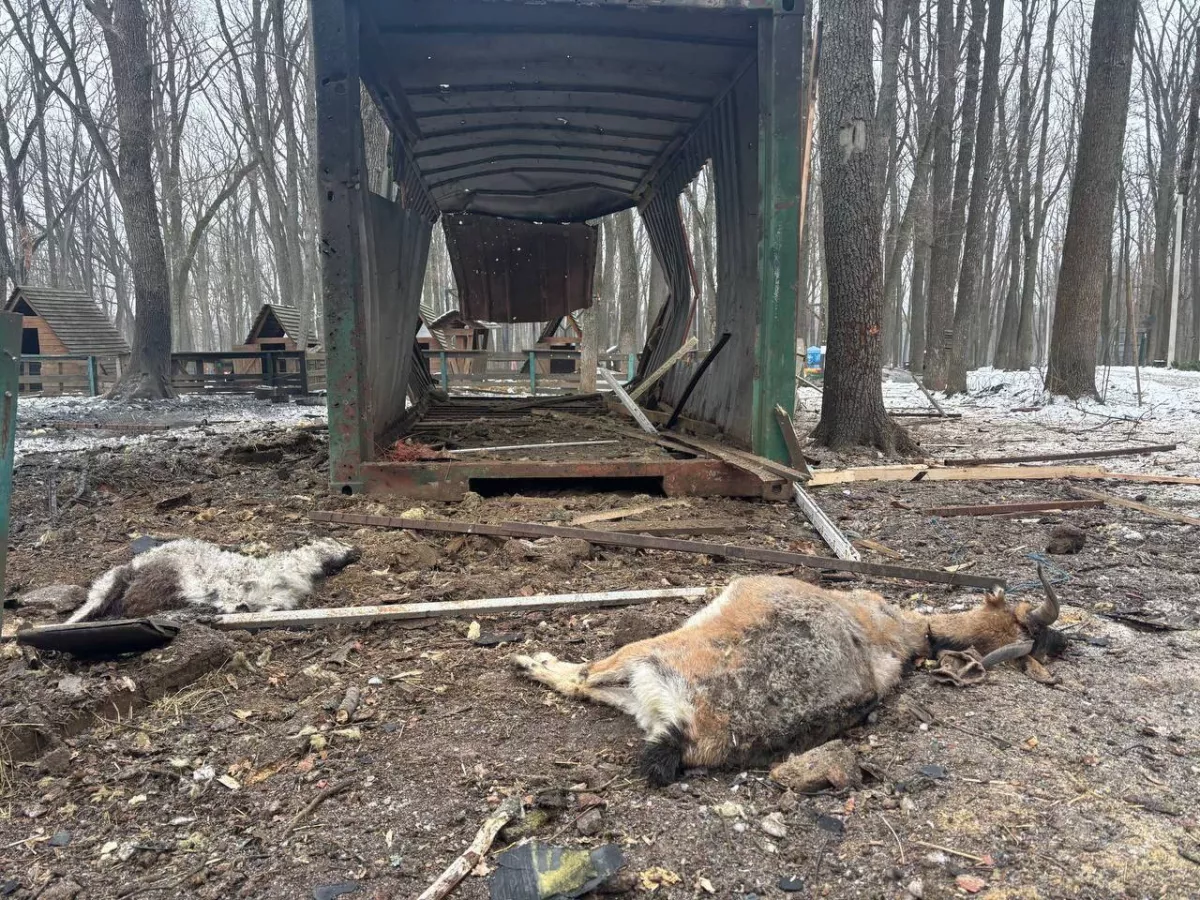
In a suburb of Kharkiv, the Russian army also struck the private zoo Feldman Ecopark with a guided aerial bomb. As the owner of the ecopark, Member of Parliament Oleksandr Feldman, told Suspilne Kharkiv, the winter enclosure for predators and the winter facility for birds were completely destroyed.
Since the start of Russia’s full-scale invasion, the ecopark has repeatedly suffered from shelling. Moreover, because the site is located on the northern outskirts of the city, it fell under Russian control during the first weeks of the war. At that time, two civilian zoo employees were taken captive and executed. Later, after Ukrainian forces managed to liberate the area, a teenage volunteer was killed during another attack on the ecopark.
As we can see, the Russian side always knows exactly where it is striking and for what purpose. And therefore one is forced to acknowledge that any residential building, any school or university, any clinic or hospital in Ukraine can become the target of another drone or missile attack. Just imagine the horror of this situation. You are asleep in your house or apartment, fully aware that at any second a drone or a missile could hit it.
Yes, air-raid alerts are sent to Ukrainians’ phones. Yes, there are bomb shelters, protective facilities, and metro stations that have long been equipped to receive Kyiv residents during yet another Russian attack. But what about, for example, the relatives of those whose children or parents are in hospitals?! How are they supposed to live with the fear that these people may simply not have time to reach a shelter?! And Ukrainians, meanwhile, have been living in this hell for almost four years.

And do you know what shocks one almost more than the sheer monstrosity of the crimes committed by Russia against a country and a people it falsely and cynically called “brotherly”? It is the staggering scale of corruption on the part of those to whom Ukrainians entrusted their present and their future. Yes, I am talking about the deputies of the Verkhovna Rada from the ruling Servant of the People party—the very party that holds a mono-majority in parliament, allowing it to push through the adoption of virtually any decision.
Ukraine’s High Anti-Corruption Court has imposed preventive measures on five members of the Verkhovna Rada suspected of taking bribes in exchange for voting in parliament. The decision was announced on January 1 by the Specialised Anti-Corruption Prosecutor’s Office.
According to local media reports, the case involves Mykhailo Laba, Ihor Nehulevskyi, Yevhenii Pyvovarov, and Olha Savchenko. The court decided not to remand Yurii Kisiel in custody on December 30. All the MPs were allowed to remain at liberty on bail: Kisiel’s bail was set at 40 million hryvnias, Nehulevskyi’s at 30 million, Pyvovarov’s and Laba’s at 20 million each, and Savchenko’s at 16.6 million hryvnias. All suspects were also ordered to wear electronic monitoring bracelets.
According to the investigation, the MPs received unlawful benefits in return for supporting or blocking the passage of draft legislation. Prosecutors say the lawmakers may have acted as part of an organised group since 2021. The size of the bribes ranged from $2,000 to $20,000. “At the same time, from at least September to November 2022 the amount of unlawful benefit was $2,000, while from at least August 2025 it had already increased to $5,000,” the Specialised Anti-Corruption Prosecutor’s Office reported.

Online reports also claimed that the Bureau was searching the home of Servant of the People MP Yurii Koriavchenkov—better known since his days with Kvartal 95 as “Yuzik”—but NABU denied these reports. At the same time, media outlets circulated information suggesting that this figure, known to be very close to Ukrainian President Volodymyr Zelenskyy, had left the country. And we remember how promptly Kvartal 95 co-founder Timur Mindich and Oleksandr Tsukerman departed Ukraine.
As a reminder, they are key figures in a large-scale NABU and SAP operation codenamed “Midas.” The core activity of the criminal organisation was the systematic extraction of unlawful benefits from contractors of Ukraine’s state nuclear energy company, Energoatom, amounting to 10–15% of contract values. NABU and SAP have released portions of audio recordings from the investigation. NABU detectives established that approximately $100 million passed through embezzlement schemes in Ukraine’s energy sector.
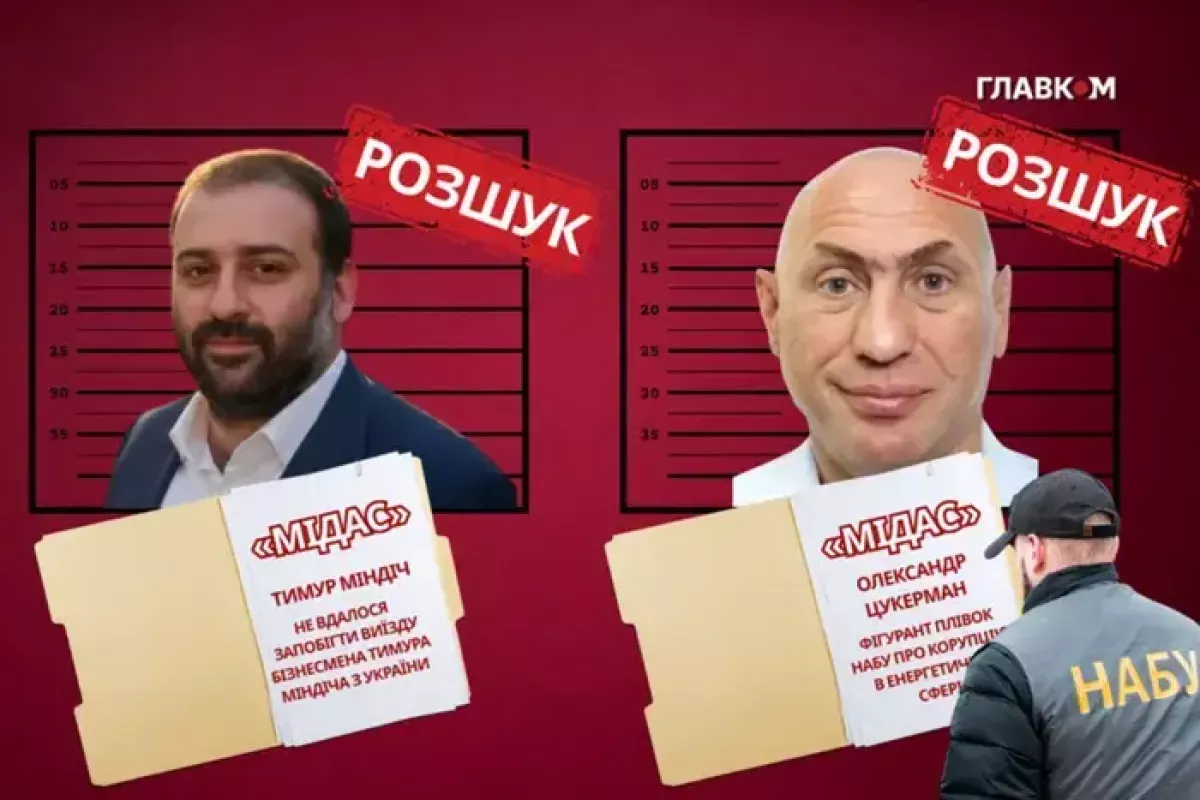
And you know what is interesting? Mindich and Tsukerman were located in Israel by a film crew from Ukrainska Pravda—despite the fact that Ukraine’s law enforcement agencies supposedly cannot find them. Naturally, both men predictably denied all the accusations against them. Particularly ironic was hearing Tsukerman, who is accused of complicity in corruption on such a massive scale, accuse Ukrainska Pravda journalist Mykhailo Tkach of “tracking people down like a thief”. At the same time, on Oleksandr Tsukerman’s wrist—at the very moment of his indignation at Tkach’s appearance—journalists noticed a Swiss Patek Philippe Nautilus 5990 watch worth more than $150,000.
This is how Ukraine lives. In the constant expectation of yet another wave of drone and missile strikes on its cities, raising aid for servicemen through social media and volunteers, while at the same time witnessing grotesque corruption—many of whose key figures have already managed to flee the country.







 editor@caliber.az
 +994 55 444-88-98
 Азербайджан, Баку, ул. Низами, 203, Af Business House, 5-й этаж