










Von der Leyen vs. Kallas: who speaks for Europe? A rift in EU leadership
The Middle East conflict has not only reverberated across almost every country in the world but has also revealed deep political rifts—both between senior officials of various nations and among the leaders of influential international institutions, including within the EU itself.
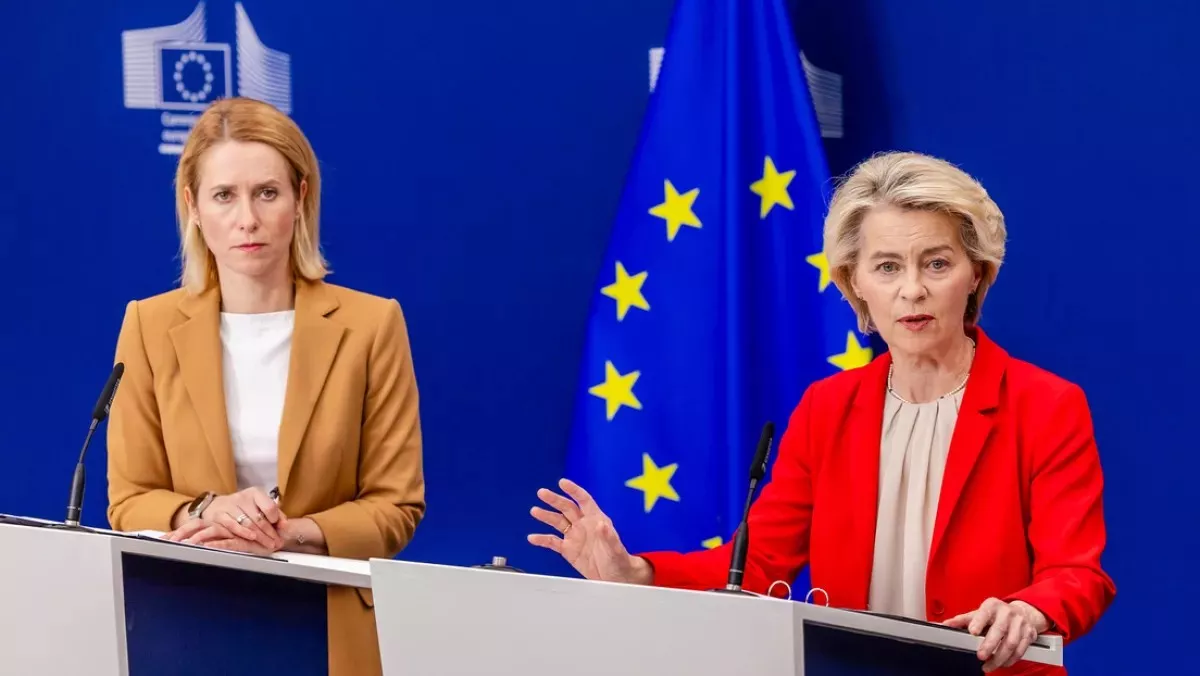
In particular, Politico, citing diplomats and officials familiar with the situation, reported internal competition between European Commission President Ursula von der Leyen and EU High Representative for Foreign Affairs and Security Policy Kaja Kallas over who should coordinate the European Union’s response to the Middle East crisis. The publication notes that, despite active diplomatic efforts and attempts to maintain a unified stance, Kallas and von der Leyen did not communicate directly over the weekend—precisely when the situation in the Middle East escalated into open military conflict.
“The EU’s response to U.S. and Israeli strikes on Iran has laid bare familiar divisions at the top, with two of its most senior officials on a collision course over who coordinates the bloc’s reaction to the crisis,” the newspaper noted, recalling that historically, international relations fell under the remit of the EU’s foreign policy chief. However, as geopolitics increasingly impacts the EU’s core functions, the Commission president and her team are playing an ever more prominent role. Additionally, one source told the paper that “von der Leyen and her team of commissioners are content ‘to sideline Kallas’.”
In this context, it is important to note that, despite the insider information from a reputable publication regarding the personal dynamics between the European Commission president and the EU High Representative for Foreign Affairs, no open confrontation between them has been observed so far. However, there are several issues on which they approach from opposing perspectives.
For example, Kallas has consistently advocated for the toughest possible sanctions against Russia, often taking an uncompromising stance that may, to some extent, reflect the views of the Baltic states. Von der Leyen, in turn, supports the West’s sanctions policy, but as Commission president, she must take into account the positions of all EU member states and maintain a certain balance to preserve consensus within the organisation.
Furthermore, the EU High Representative for Foreign Affairs supports strengthening Europe’s defence capabilities, but in alignment with NATO. She advocates adapting to new security realities, yet remains sceptical about creating an all-European army, viewing it as a potentially dangerous duplication of NATO structures. In February 2026, speaking at a security conference in Oslo, she rejected proposals for such a force, warning that its emergence alongside NATO could have extremely dangerous consequences due to a disruption in the chain of command.
It should be recalled that discussions about forming a unified European army gained momentum amid disagreements within the alliance and statements by NATO Secretary-General Mark Rutte that Europe cannot guarantee its own security without the United States. Kallas follows a similar line of thinking.
Meanwhile, the European Commission president holds a fundamentally opposing view on this issue—von der Leyen openly supports the creation of a common EU army, considering it the right approach. She actively promotes the strengthening of military cooperation and Europe’s defence capabilities, including the EU’s “Strategic Compass” initiative aimed at enhancing the Union’s military readiness by 2030. This position is likely informed by her experience as Germany’s defence minister (2013–2019), during which she supported expanding military collaboration among EU countries.
In addition, von der Leyen strongly advocates for EU strategic autonomy, aimed at reducing economic and defence dependence on the United States. The currently observed reduction of American involvement in European security further strengthens her position within EU institutions. Kallas, as noted earlier, holds a different view, and if transatlantic cooperation with the EU continues to dominate, it may reinforce her influence within the broader European political system.
As can be seen from the above, the approaches of these two senior EU officials on key global issues differ in significant ways, which inevitably affects the European Union’s foreign policy, hampers internal consolidation, and naturally creates tension in their relationship. However, political competition between von der Leyen and Kallas is likely to escalate into personal confrontation only in the context of a struggle for key positions within EU institutions or a redistribution of influence in the fields of foreign policy and defence.







 editor@caliber.az
 +994 55 444-88-98
 Азербайджан, Баку, ул. Низами, 203, Af Business House, 5-й этаж