










Visegrad deadlock Scandal between Hungary and Poland
The Russian-Ukrainian war continues to act as a catalyst for the growing rift in Europe. For instance, Polish President Karol Nawrocki shortened the program of his visit to Hungary, declining a planned meeting with Prime Minister Viktor Orbán and limiting his agenda to participation in the Visegrad Group presidents’ summit, which is taking place on December 3 in Esztergom.
The Polish president’s decision came in response to the recent trip of the Hungarian prime minister to Moscow. To recall, Orbán held four-hour talks with Vladimir Putin, during which the parties discussed oil and gas supplies as well as the situation in Ukraine. The Hungarian prime minister stated that his country is interested in a swift resolution of the conflict and is ready to offer its capital as a venue for potential peace negotiations.
According to Marcin Przydacz, Head of the International Policy Bureau at the Polish Presidential Chancellery, Nawrocki’s decision not to meet with Orbán is not driven by emotion but reflects a pragmatic calculation of Polish interests. In other words, Warsaw seeks to send a signal that dependence on Russian energy resources and rapprochement with Moscow do not align with Poland’s policy, which is focused on transatlantic cooperation and energy independence.
Disagreements between Poland and Hungary have deepened since the start of the war in Ukraine. Warsaw remains one of Kyiv’s main allies, whereas Budapest maintains pragmatic relations with Moscow, citing national interests. The victory of Karol Nawrocki, who in Hungary was seen as politically close to Orbán, did not change the dynamics: despite his conservative rhetoric, the Polish leader maintains a firm anti-Russian stance. According to Przydacz, President Nawrocki follows the line of Lech Kaczyński, who believed that Europe’s security is built on solidarity and unity.
The situation was further inflamed by Polish Prime Minister Donald Tusk. “Orbán visits Putin, Nawrocki Orbán. Chaos in negotiations over Witkoff's plan, and in Kyiv a political crisis. A fatal combination,” Tusk said even before it became known that Nawrocki would not meet with the Hungarian prime minister, thereby creating a negative backdrop for the meeting within Poland.
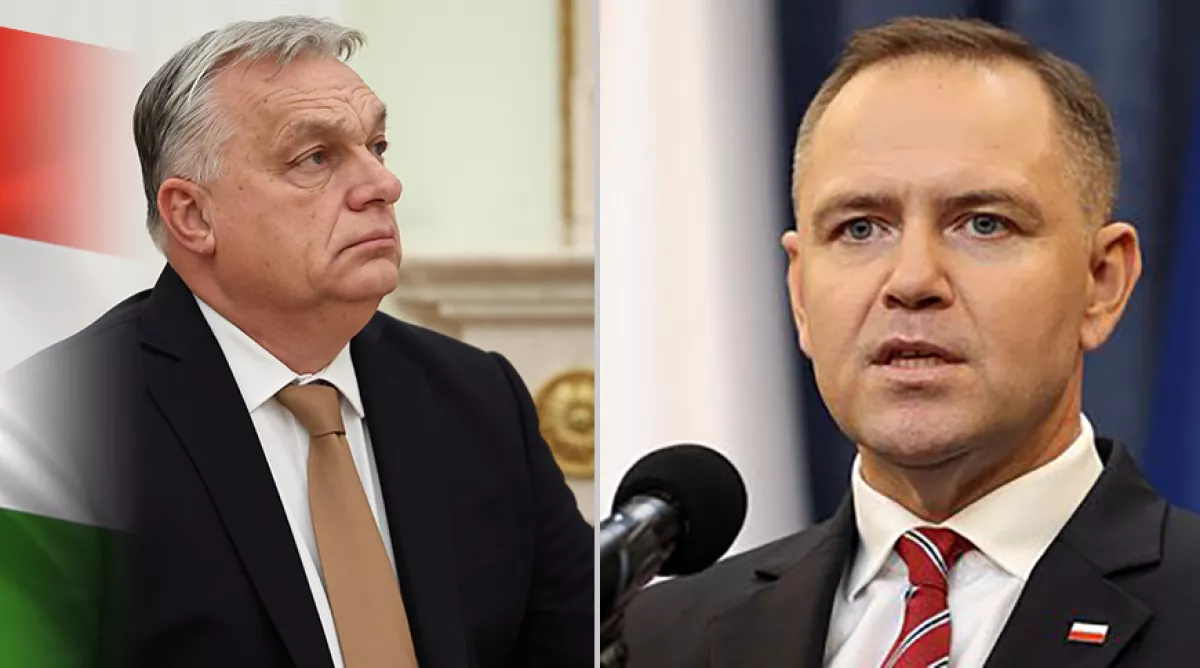
Meanwhile, liberal experts note that the Polish president’s decision was a demonstrative yet restrained gesture. Warsaw, they argue, publicly signalled its distance from Budapest without escalating the matter into a diplomatic conflict. Refusing to meet Orbán deprives the Hungarian prime minister of the symbolic photo-op of a bilateral handshake, but still leaves room for future dialogue if the parties’ positions converge.
However, this interpretation seems somewhat strained. Refusing to meet the head of state hosting an international event can hardly be read as anything other than an act of disrespect.
The Visegrad Group format, in which the leaders of Hungary, Poland, the Czech Republic, and Slovakia gathered in Esztergom, was originally conceived as a platform to strengthen Central Europe’s role within the EU. However, in recent years the alliance has faced a crisis: differences over Moscow, migration, and EU internal policies have increasingly become sources of tension.
Nawrocki’s decision only reinforced this split, creating the impression that, for countries in the region, their stance toward Russia is becoming a key criterion for trust and partnership. Meanwhile, there are signs that Poland’s sharply confrontational approach toward Hungary is driven not only by differing approaches to resolving the Ukrainian crisis but also by Warsaw’s rivalry with Budapest as the driving force behind efforts to strengthen national sovereignty within the EU—and, by extension, its leadership within the Visegrad Four itself.







 editor@caliber.az
 +994 55 444-88-98
 Азербайджан, Баку, ул. Низами, 203, Af Business House, 5-й этаж