










A Californian in Berlin Merz hosts the “Golden State” governor
This year’s Munich Security Conference became the stage for a new round of transatlantic tension. Europe, still reeling from the chastising tone of last year’s speech by J.D. Vance at the same forum, seems to have found the strength to recover from the knockout before the count even reached ten.
The leader who took on the role of reviving the Old Continent was German Chancellor Friedrich Merz. Both practically and symbolically, he did a great deal to offer bewildered Europeans a glimpse of future prospects. Merz’s budget initiatives inspire confidence in Germany’s military resurgence, which other EU countries are expected to follow, and his confident opening speech in Munich restored Europe’s sense of significant weight on the international stage.
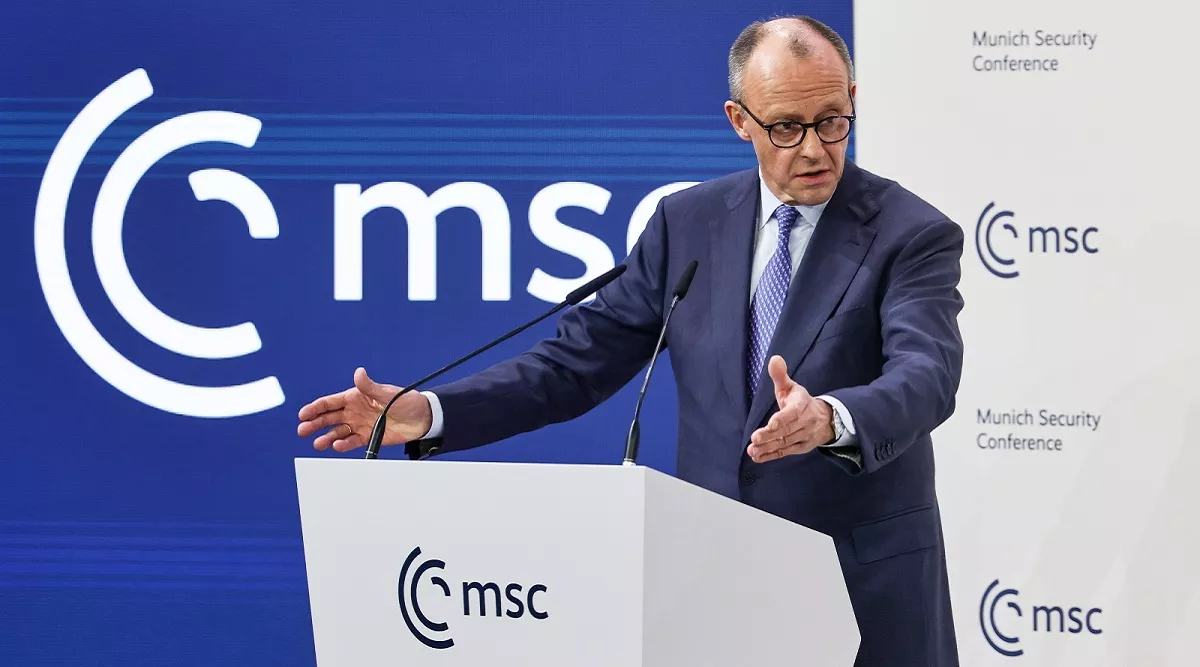
As if sensing that Europeans had spent some time in the gym, the Americans this time sent a less irritating figure to Munich—the Secretary of State, Marco Rubio. His speech, more complimentary toward Europe compared to Vance’s address, nevertheless carried the same essential message: Europe must change in order to survive—and, of course, to please America.
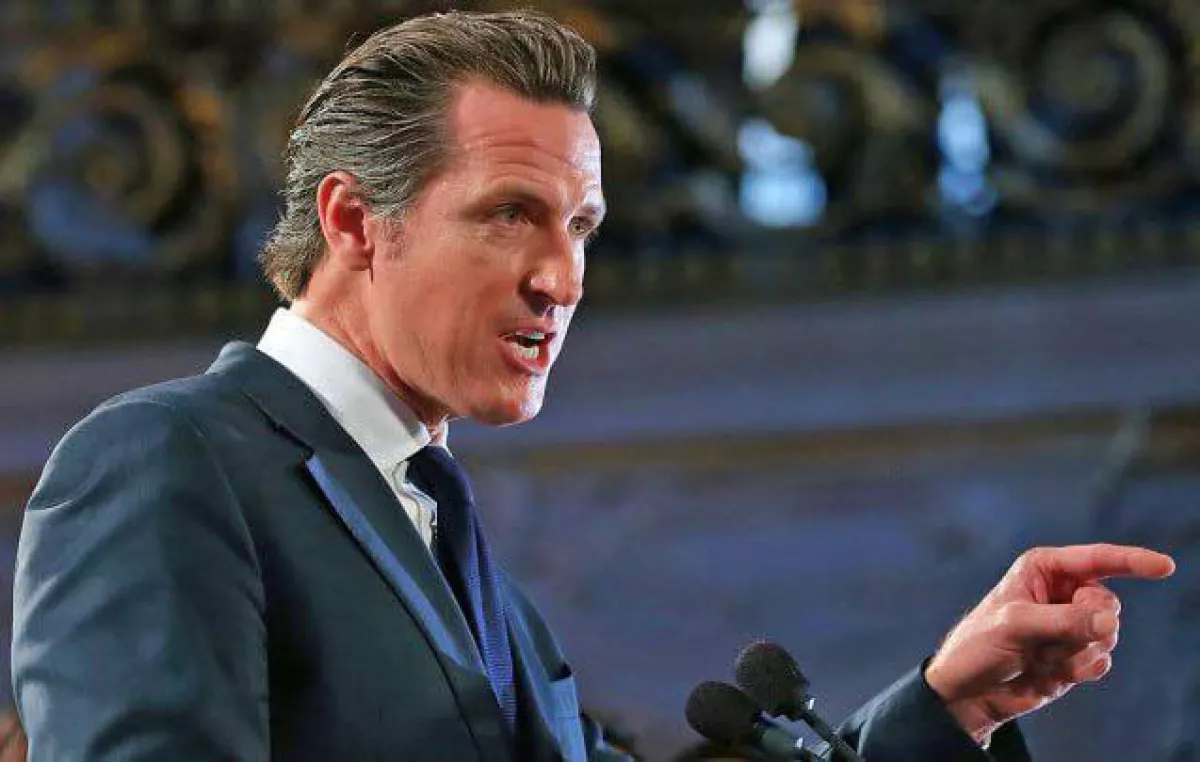
Thus, Rubio’s speech marked not an end but a continuation of the rift between the U.S. and Europe, and even more broadly, between the liberal and conservative camps of the global elite. To support the Europeans, the very embodiment of liberalism—and at the same time, a quintessential American—arrived in Munich: the Governor of California, a leading critic of Trump in the U.S., and a potential Democratic candidate in the next presidential election, Gavin Newsom.
In recent weeks, Newsom has clearly decided to play “grown-up politics.” Before travelling to Munich, he took the floor at another high-profile venue—the World Economic Forum in Davos—where, in a conversation with journalist Ben Smith, he accused the Trump administration of exactly what it accuses Europe of: “That’s what’s happening in the United States of America. Freedom of expression, freedom of assembly, freedom of speech — it’s America in reverse.” He also described Trump as historically unpopular in the U.S., noting that he would be remembered for a few years, not decades.
He repeated a similar point in Munich. In a series of speeches and interviews, Newsom also accused the president of undermining climate norms, weakening international ties, and eroding democratic institutions. His warning about the risks of an “imperial presidency” and his call for Europe to establish direct connections with the U.S. states, bypassing the federal centre, were particularly striking.
Before the White House could properly react to Newsom’s actions, another blow followed. The opposition politician was received in Munich by none other than German Chancellor Friedrich Merz. Merz posted a photo of the meeting on X and spoke of “unity of positions on NATO issues.”
Washington’s response was immediate. A close Trump ally—special presidential envoy for critical missions and U.S. ambassador to Germany during Trump’s first term—Richard Grenell called Merz’s move “the biggest gaffe” by the chancellor. And if Grenell says it, then Trump is clearly furious. Which means the war continues.
Earlier, we noted the struggle between the conservative and liberal camps of the world. Yet even this broad-brush thesis, appealing as it may be, is somewhat simplistic. In reality, the situation is far more complex and multidimensional. For instance, it is difficult to place Newsom and Merz in the same ideological camp. In spirit, they are polar opposites: one a staunch liberal, the other an old-school conservative and opponent of Angela Merkel’s legacy, who was even at one point dubbed the “German Trump.”
In this sense, the antagonism between Merz and Trump does not run along ideological lines, but rather along the defence of national sovereignty—only not at the German, but at the European level. Paradoxically, Merz is thus ideologically closer to Trump than to Newsom, and it seems that the shared realism of the two leaders may ultimately make them irreconcilable opponents. Representing a still-weak Europe, Merz resists its “absorption” by America and is willing to form a situational alliance with the liberal American camp to achieve this. Newsom, on the other hand, is so intent on undermining Trump’s position that any ideological qualms along the way seem like unnecessary fastidiousness.
As we can see, the tangle of contradictions among the world’s elites is extremely intricate.







 editor@caliber.az
 +994 55 444-88-98
 Азербайджан, Баку, ул. Низами, 203, Af Business House, 5-й этаж