










Armenian hardliners defy peace Revanchists protest at UN in Yerevan
Attempts to portray the Armenian-Azerbaijani conflict as "unfinished" are once again being used as a tool for political PR in Armenia. Certain political forces, persistently stoking ideas of revanchism, seize every opportunity to obstruct the process of normalising relations with Azerbaijan. On this front, the chairman of the political council of the Democratic Alternative Party, Suren Surenyants—known for his openly anti-Azerbaijani stance—recently made his mark with yet another provocative action by organising a demonstration in front of the UN office in Yerevan.
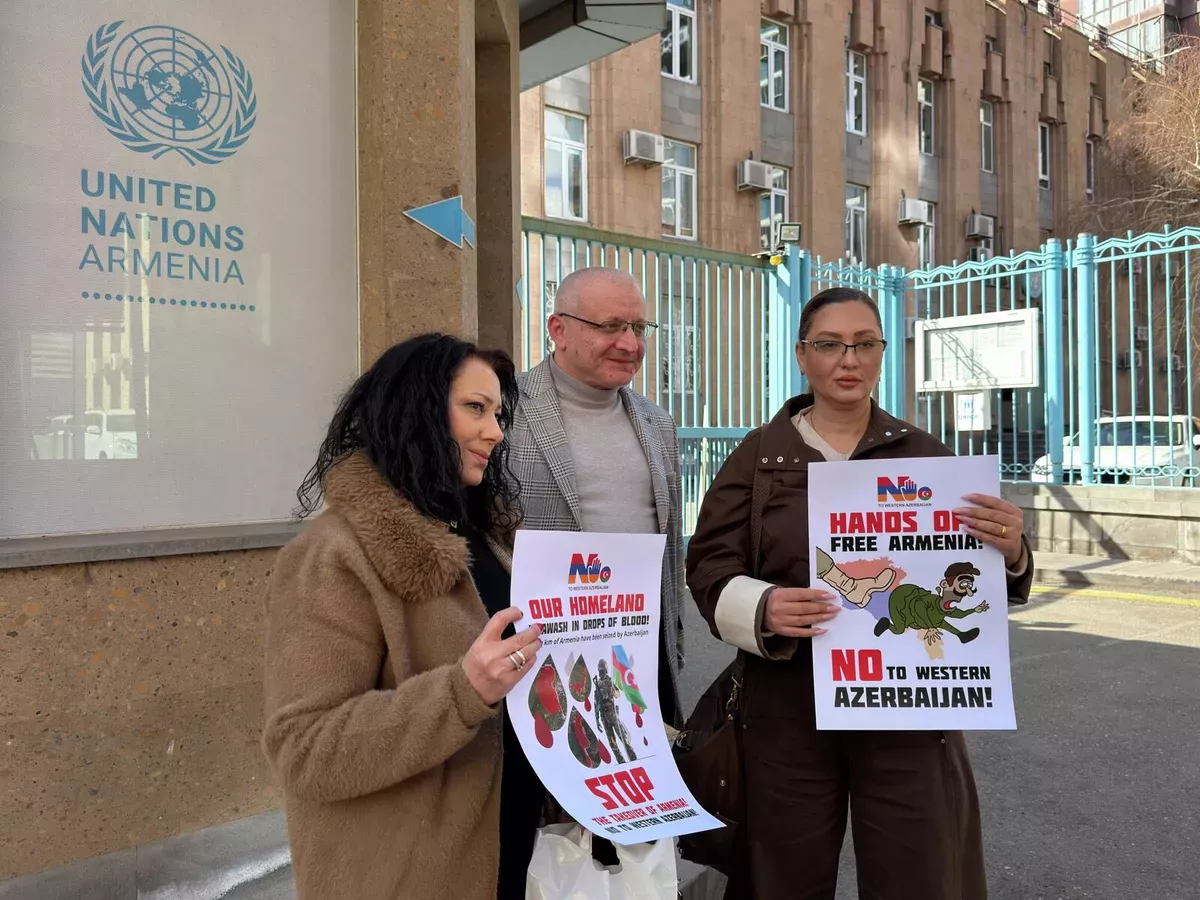
Surenyants told journalists that he had submitted a protest letter to the Armenian office of the organisation, claiming that the Armenian-Azerbaijani conflict cannot be considered resolved. In doing so, he sought to draw the attention of the international community to issues that, in his view, remain unresolved.
Participants in the picket carried placards with provocative slogans such as: “Our homeland awash in drops of blood,” “Stop the takeover of Armenia,” “Hands off free Armenia,” and “No to Western Azerbaijan,” aiming to portray Armenians as victims and Azerbaijan as the aggressor. Such provocative PR moves by Armenian revanchists are actively used to mislead the global public and discredit Baku’s peace agenda. In attempting to convince the international community that official Baku supposedly seeks to impose on Armenia a model of relations comparable to the status of defeated Germany, Surenyants, of course, did not utter a word about the radical nationalist ideology that still persists in parts of Armenian society and political circles.
The Karabakh clan and the Dashnaks continue to feel at ease in Armenia and even intend to participate in this year’s parliamentary elections. Naturally, they actively push the narrative of the vanished separatist project and the so-called “prisoners of war.” Surenyants and his associates refuse to acknowledge that the situation on the Armenian-Azerbaijani border is calm—there are no shootings, no casualties, and no wounded—and that peace has already been achieved.
Clearly, this situation is entirely at odds with the position of those who oppose the settlement, both within Armenia and abroad. In this context, it is unsurprising that, ahead of the parliamentary elections, provocative statements from supporters of a confrontational stance towards Azerbaijan are likely to become increasingly frequent.
Ultimately, the signing of a comprehensive agreement between Armenia and Azerbaijan remains possible if Yerevan meets Baku’s final condition: amending the Armenian Constitution to remove all territorial claims. Whether the Armenian leadership will take this step amid growing opposition to the peace agenda will depend on the political will of Armenian society.







 editor@caliber.az
 +994 55 444-88-98
 Азербайджан, Баку, ул. Низами, 203, Af Business House, 5-й этаж