










Politics of construction and reality Azerbaijan and the US forge a new era of partnership
The year 2025 marked a pivotal moment in the history of independent Azerbaijan—a year in which the country’s transition from war to peace coincided with a deepening of relations with the United States. This was no coincidence. One of the key steps in resolving the Armenian-Azerbaijani conflict took place at the White House: on August 8, Azerbaijani President Ilham Aliyev and Armenian Prime Minister Nikol Pashinyan signed a joint declaration reaffirming their commitment to peace, while the foreign ministers of both countries initialled a draft peace agreement. The peace process gained further momentum with the involvement of the United States, which, as highlighted in the declaration, is participating in the project to open the Zangezur Corridor—ensuring uninterrupted connectivity between mainland Azerbaijan and Nakhchivan.
At the same time, this project also serves as a tool for the region’s economic integration, with Azerbaijan becoming a key hub on the “East–West” and “North–South” routes. Trump, who lent his name to the project, confirmed the U.S. political will for a genuine peaceful settlement—sending an important signal that could act as a trigger not only to accelerate the peace process but also to drive a broader transformation of the region.
On January 5, in an interview with local channels, President Aliyev emphasised that the American administration acted from a position of pragmatism rather than ideological templates. Trump’s decision to support the Zangezur Corridor project—now dubbed the “Trump Route for International Peace and Prosperity”—reflects a new logic in U.S. foreign policy.
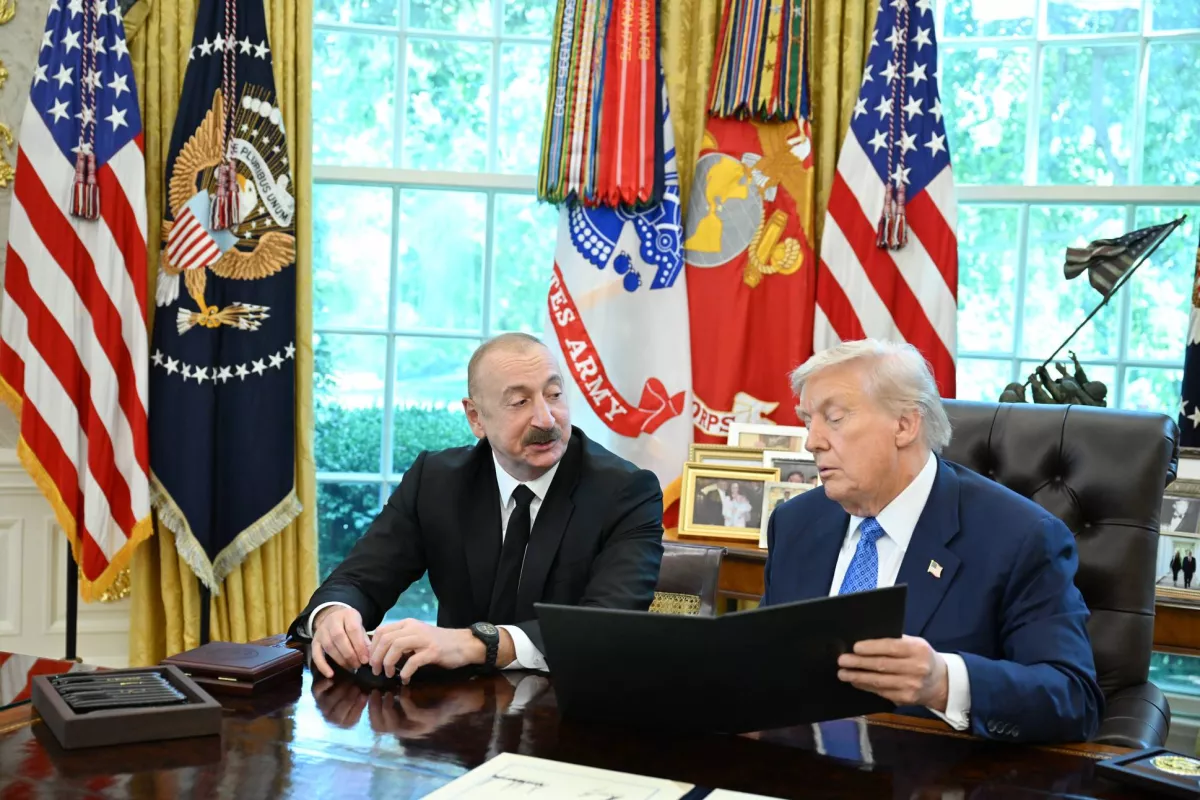
In addition to the Washington Peace Summit, it is also important to highlight the bilateral meeting between President Ilham Aliyev and President Donald Trump on the same day, August 8, 2025, at the White House. This meeting marked not merely a diplomatic rapprochement, but the creation of a new system of strategic partnership based on mutual interests and pragmatism. During the meeting, a memorandum was signed to establish a Strategic Working Group tasked with preparing a Charter on Strategic Partnership. This document lays the foundation for a long-term partnership that goes beyond traditional diplomacy, covering energy, trade, transit, the digital sector, investment, defence, and security.
Thus, it can be concluded that the United States is not merely observing developments in the Caucasus but actively participating in shaping them. The current U.S. administration has also demonstrated a clear understanding that a new perception of America in the region is impossible without removing the remnants of the past era. In this context, it is important to note that the executive order signed by Trump to suspend the application of Section 907 symbolically closed one of the most contentious and unfair periods in U.S.–Azerbaijan relations.
This provision, which prohibited direct U.S. government assistance to Azerbaijan, was passed by the U.S. Congress in October 1992. Prominent political figures such as John Kerry, Wayne Owens, and Joseph Biden were involved in its adoption. Although the provision was temporarily suspended in 2002, when the United States urgently needed Azerbaijan’s support following the September 11, 2001, attacks, it was reactivated during the Biden administration. Enacted under the influence of the Armenian lobby and amid weak diplomatic defence by Azerbaijan’s leadership at the time, this provision remained for many years a tool of pressure on Baku, though a largely ineffective one.
Azerbaijan, through its own efforts, strengthened its statehood, rebuilt its economy, and built a powerful army that liberated the occupied territories. In other words, after three decades, reality itself has disproved even the most pragmatic logic behind Section 907. Azerbaijan is not a country in need of oversight, but a reliable U.S. partner in the region, ensuring stability, transit, and Europe’s energy security. The suspension of the provision by President Trump was a recognition not only of the new political situation in the South Caucasus but also of Azerbaijan’s military victory, firmly consolidated on the international stage.
However, the question of formally repealing the provision will now be discussed in Congress, where, as is well known, the Armenian lobby has traditionally wielded significant influence. If American lawmakers wish to keep pace with the times and act in the interests of their country, they must finally consign this provision to the dustbin of history.
Azerbaijan demonstrates that stability can be built not on external oversight, but on its own strength, pragmatism, and partnerships. This is precisely what makes it a valuable U.S. partner—a country that does not seek support, but offers mutually beneficial cooperation.
The year 2025 marked a moment when historical justice was restored not only on the ground, but also in diplomacy. The Washington summit and the signing of the U.S.–Azerbaijan memorandum opened a new chapter in relations, leaving no room for old stereotypes or one-sided approaches. Azerbaijan, having affirmed its strength and independence, has become for the United States not an object of policy, but a full-fledged partner—a partner with whom a balance of peace and stability in Eurasia can be built.







 editor@caliber.az
 +994 55 444-88-98
 Азербайджан, Баку, ул. Низами, 203, Af Business House, 5-й этаж