










Fake news in “royal style” Russian Tsargrad TV fabricates anti-Azerbaijan story
The Russian propaganda outlet Tsargrad TV has once again demonstrated a striking example of open Azerbaijani-phobia, this time through an outright fake story about an allegedly established “Centre for Support of Ukraine” in Baku, which, according to the report, was supposedly opened under the orders of the country’s leadership. This information has nothing to do with reality, but its purpose is obvious: to incite hatred.
In fact, a Ukrainian Centre was opened in Baku in 2021—but it was initiated and supported by the Ukrainian Embassy in Azerbaijan and is focused solely on promoting Ukrainian culture to those interested. The difference is obvious: the real Ukrainian Centre and the fictional “Centre for Support of Ukraine” invented by Tsargrad are worlds apart.
The text goes on to claim that the Azerbaijani diaspora in Russia allegedly “pumps money out of the Russian economy,” which is then supposedly channelled “to support the enemy.” This is followed by a rhetorical—and extremely dangerous—pirouette questioning whether such “friendship” is not too costly for Russia, accompanied by a thinly veiled call for pressure—not with tanks and missiles, but through handcuffs, criminal cases, and repression against the diaspora.
Thus, this is no longer a matter of journalism, but a case of direct incitement to discrimination on ethnic grounds. Moreover, such statements fall squarely under Article 282 of the Criminal Code of the Russian Federation (“Incitement of hatred or enmity, as well as humiliation of human dignity”), including when committed through mass media or information and telecommunications networks, including the Internet. Yet, judging by their behaviour, neither the authors nor the editorial board of Tsargrad appear concerned about these potential legal consequences.
What is particularly telling is that immediately after the story’s publication, comment sections are flooded with identical, coordinated accounts pushing long‑familiar xenophobic slogans like: “Suitcase—train station,” “Lock them all up,” “Seize their businesses,” and “Tighten inspections.” This is a textbook example of a classic manipulation scheme: first, an information provocation is launched, and then a managed wave of hatred follows, creating the illusion of a “public demand” for repression.
Meanwhile, no one seems concerned that the basic thesis of this publication is an outright lie from the first letter to the last comma. Azerbaijan has never acted secretly or underhandedly. The official position of Baku is to express support for the territorial integrity of any state, including Ukraine, openly and consistently. This is a principled stance of the country, dictated by its own history, and given this, expecting Azerbaijan to take any other approach to questions of sovereignty and international law is, at best, naive—and, in reality, simply foolish.
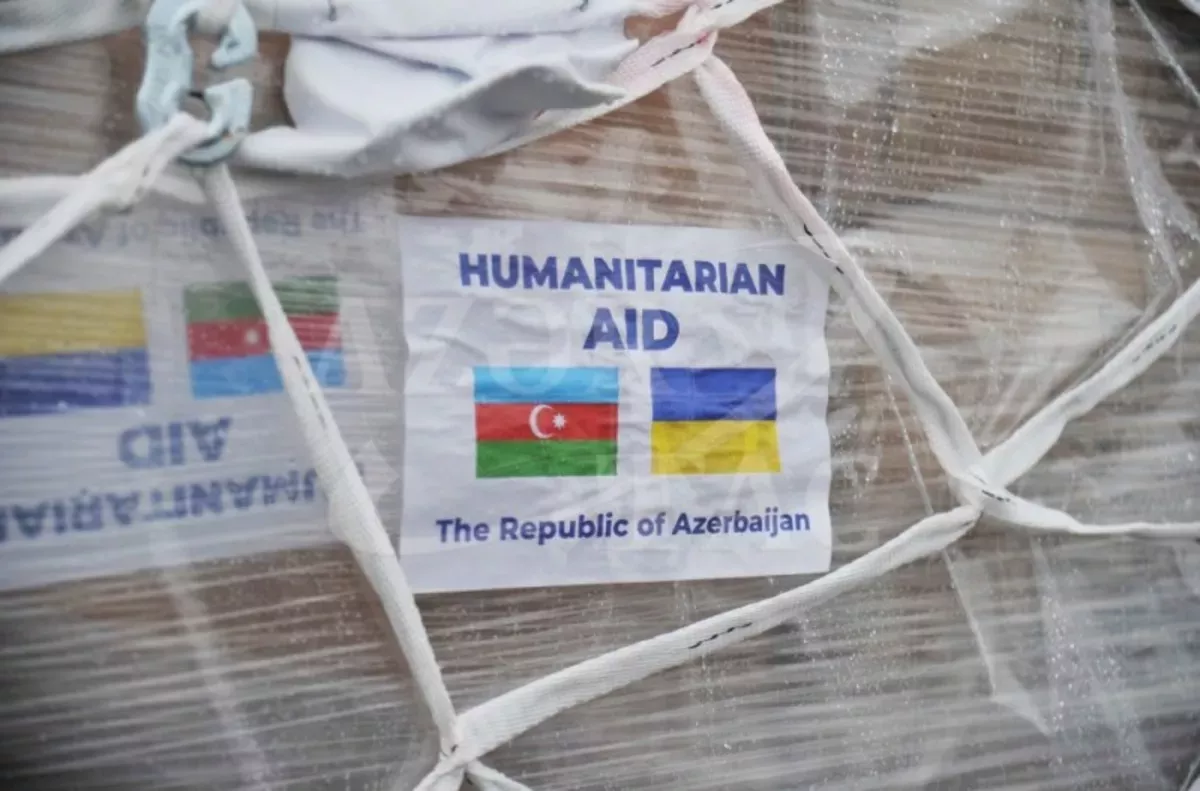
Regarding aid to Ukraine, everything is equally transparent. Azerbaijan does provide humanitarian assistance, officially and without any “secret centres,” and also hosts Ukrainian children for rehabilitation, without turning it into a conspiracy‑theory spectacle. In this context, Baku’s motives are clear: as a country that has endured the horrors of occupation, Azerbaijan fully understands the pain and suffering of the Ukrainian people, who have now lived under daily Russian missile and drone attacks for four years. The Russian army deliberately targets energy infrastructure, plunging Ukrainian cities into darkness and cold. All of this constitutes a gross violation of international humanitarian law and basic moral norms.
If the situation were reversed—if Ukraine had attacked Russia, occupied its territories, and destroyed its cities—Azerbaijan’s position would be different, and humanitarian assistance would be directed to Russian citizens.

It is also important to understand the nature of the source itself. Tsargrad TV is a Russian online news channel founded in 2015 by businessman Konstantin Malofeev, known for his ultra‑right and nationalist views. It is therefore unsurprising that on April 20, 2022, against the backdrop of Russia’s full-scale invasion of Ukraine, the channel was added to the U.S. sanctions list as a disseminator of disinformation, with the United Kingdom, Ukraine, Canada, and the European Union later imposing similar sanctions.
Thus, we are dealing with a classic means of mass disinformation—a media outlet with minimal accountability, where journalism is replaced by propaganda and the promotion of hatred. Symbolically, the very name “Tsargrad” is used in certain Russian circles as an archaic and chauvinistic designation for the largest city of fraternal Turkey—Istanbul. This outlet has long served as an outlet for those trapped in xenophobia, envy, and rejection of a changing world. By spreading lies, promoting territorial claims, and perpetuating nationalist myths, such media present both themselves and the country they purport to represent in a highly unflattering light.
The particular cynicism here lies in the fact that calls to exert pressure on the Azerbaijani, Armenian, Uzbek, Kazakh, Tajik, and other diasporas objectively amount to proposals to weaken the Russian economy. After all, members of these communities earn and spend money in Russia, supporting domestic demand, businesses, and the tax base. And given that the Russian economy has already been severely undermined by the war against Ukraine and Western sanctions, such a blow could simply be unsustainable. It is also worth noting that in recent years, a significant number of migrant workers from India have arrived in Russia, suggesting that they may soon become the targets of xenophobic campaigns as well. There is little doubt that Tsargrad TV will be at the forefront of this new wave of hatred.
Meanwhile, Baku has observed a sharp increase in Azerbaijani-phobic statements in Russia, including provocative remarks by Vladimir Solovyov, radical claims by Alexander Dugin, and outright insinuations from other media figures. The conclusions are clear: a segment of the Russian establishment reacts painfully to its inability to influence Azerbaijan, which consistently pursues an independent foreign policy guided by its national interests. Once again, the same old cards of nationalism, chauvinism, and xenophobia are being played—confirming the worst perceptions of the reality prevailing in the neighbouring country.







 editor@caliber.az
 +994 55 444-88-98
 Азербайджан, Баку, ул. Низами, 203, Af Business House, 5-й этаж