










Polish farmers rise against MERCOSUR Tractors vs. Brussels
Could Poland leave the EU over Latin American beef? In Warsaw, farmers’ protests have received backing from the opposition-aligned president, while the home of the minister of agriculture was attacked. The mass demonstrations erupted in response to the EU agreement signed on January 9 with the MERCOSUR bloc, which Polish farmers fear could devastate Europe’s agricultural sector.
Uprising from the fields
The agreement aims to create the world’s largest free trade zone, encompassing around 700 million people. Under the deal, a range of agricultural products from MERCOSUR countries—Brazil, Argentina, Paraguay, and Uruguay—will enjoy significant advantages in the European market. South American goods will be substantially cheaper, as they are not bound by the EU’s strict environmental and technical standards. European farmers’ associations warn that this could deal a severe blow to their farms and overall competitiveness.
In 2025, mass protests by farmers in France, Poland, Germany, and other countries forced the European Commission to postpone signing the controversial agreement until the following year. But barely had 2026 begun when the MERCOSUR deal was officially approved in Brussels.
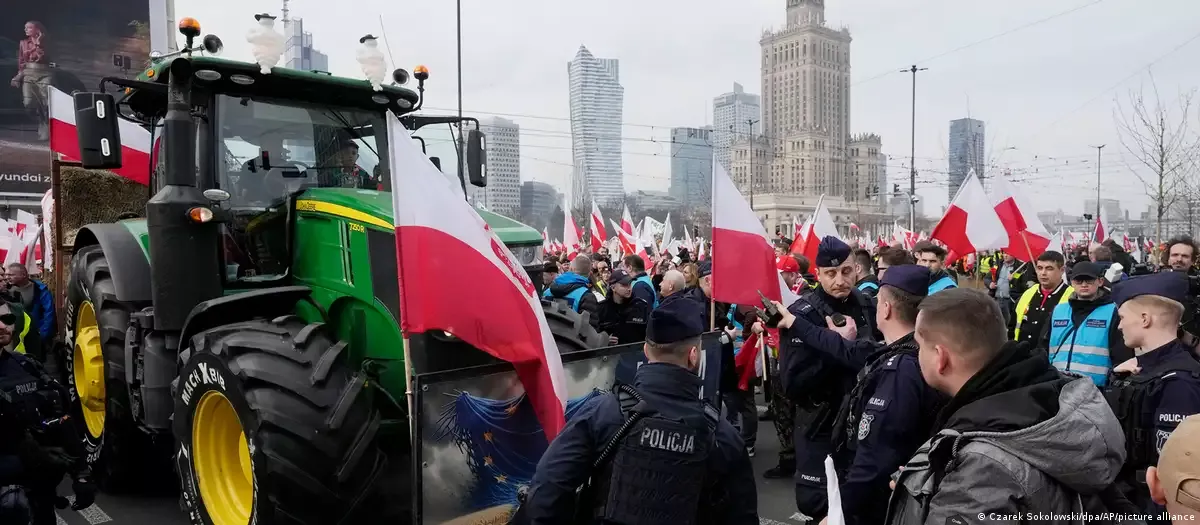
On the very morning of its ratification, Polish farmers drove their tractors to Warsaw. In Poland, the English word “farmers” is rarely used; instead, rural workers are called rolniki—“role-niks.” Even temperatures as low as minus ten degrees Celsius did not deter thousands of people hardened by the very nature of their work.
As columns of heavy machinery approached the capital, Warsaw Mayor Rafał Trzaskowski declared that the rolniki were allowed to protest—but tractors would be banned from entering the city centre, citing regulations that, supposedly, do not allow large vehicles on the streets. Police began stopping the columns on the outskirts of the city. Notably, there had been no official ban on entry beforehand, and authorities had even negotiated routes with the protesters. By comparison, in Paris, Brussels, and Berlin, protesters were not blocked from the streets.
However, a delegation of farmers was still allowed into the presidential Belweder Palace. Polish President Karol Nawrocki told the protesters that he, too, opposed the MERCOSUR agreement.
The stance of Prime Minister Donald Tusk was quite different. Protesters marched through central Warsaw to the Prime Minister’s Chancellery and requested a meeting—but talks with the head of government never took place.
Manure for the minister
In the Podlaskie Voivodeship, the home of Agriculture Minister Stefan Krajewski was attacked. One of the protesters drove up in a cargo van and dumped about half a ton of liquid manure in front of the building. He then attempted to knock down the fence by pulling on it with a rope. The attacker also directed threats toward the minister’s wife, Krajewski himself, Donald Tusk, two other ministers, and the mayor of Warsaw. He later posted a video of the incident online.
A sign was left at the gate reading: “Krajewski — Traitor of the Village.”
The 35-year-old suspect from the Lublin Voivodeship was arrested. He has been charged, including under the article concerning insults against state authorities. If found guilty, he faces up to five years in prison. The District Prosecutor’s Office in Zambrów is conducting the investigation.
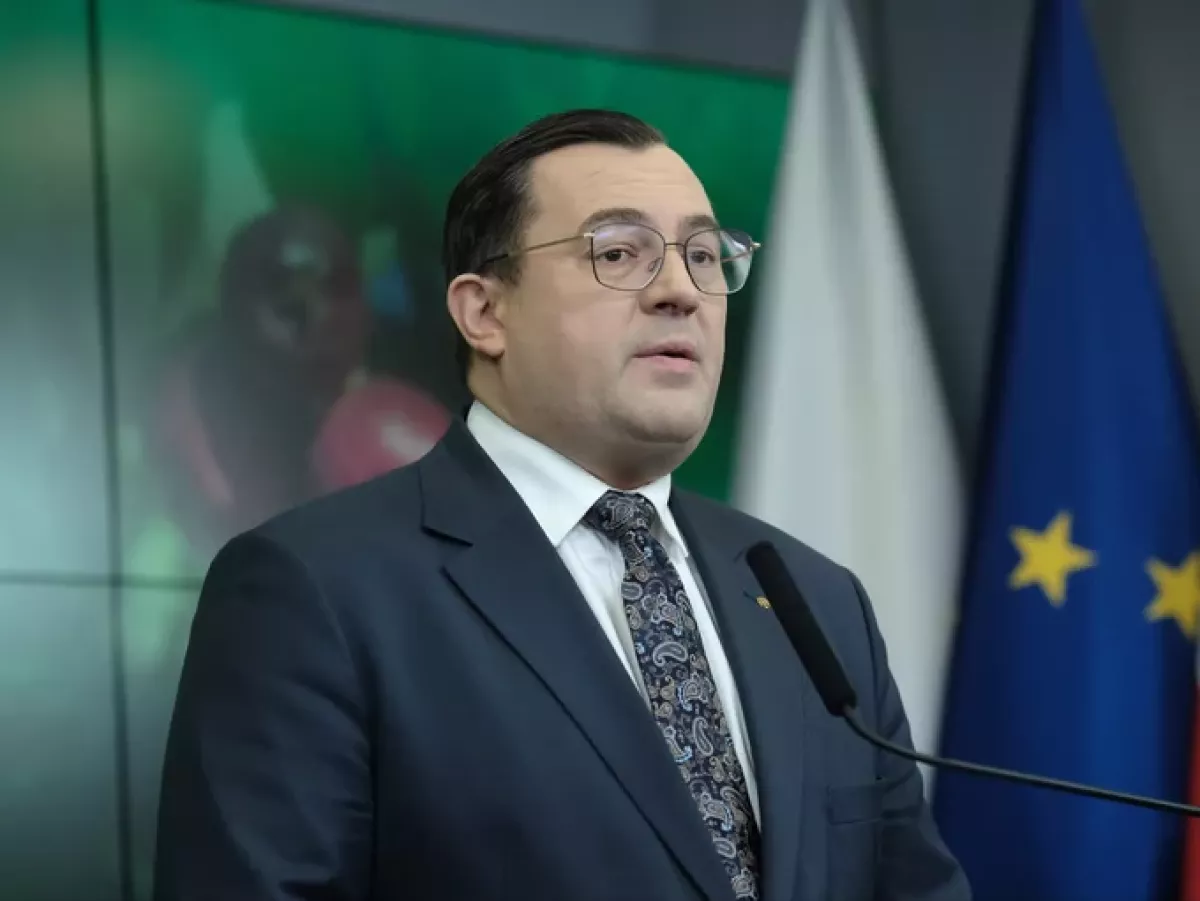
“This cannot happen. The peace of my family has been shattered — my wife and children were attacked. My address has been made public, and this is not a public space, this is my home. I do not conduct political activities there,” said Krajewski at a press conference on Monday, January 12.
According to him, the suspect may be connected to the circle of Grzegorz Braun, leader of the far-right organisation Confederation of the Polish Crown. The minister warned that such actions could lead to a tragedy similar to the murder of the mayor of Gdańsk.
In January 2019, during a charity event, Gdańsk Mayor Paweł Adamowicz was fatally stabbed. The attacker was a young Polish man with a criminal record and mental health issues. He later explained the attack as “revenge” against the liberal Civic Platform party, which he blamed for his “unjust conviction.”
Is Macron against it, too?
Farmers’ protests have erupted not only in Poland but also in Belgium, Ireland, France, and Greece. In the latter two countries, hundreds of tractors brought highways to a standstill.
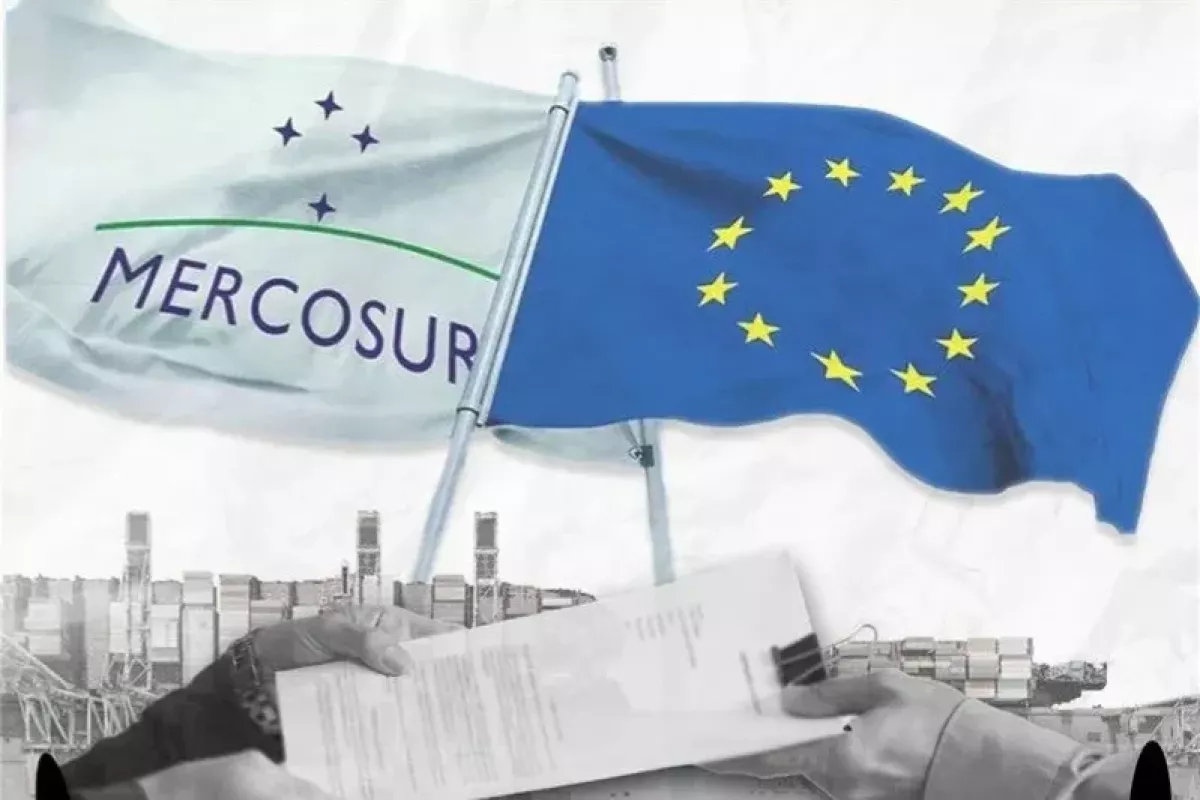
The European Commission faced serious resistance during the vote on the MERCOSUR agreement: Poland, France, Hungary, and Ireland opposed it, while Belgium abstained. Italy initially resisted the deal but ultimately gave its support at the last moment. In the end, 21 countries approved the agreement, and the votes of four states were insufficient to block it.
Interestingly, the deal was passed using the EU’s “double majority” system, which requires 55 per cent of member states representing 65 per cent of the EU population. This somewhat intricate procedure suggests that even those pushing the agreement within the Commission were unsure of its support.
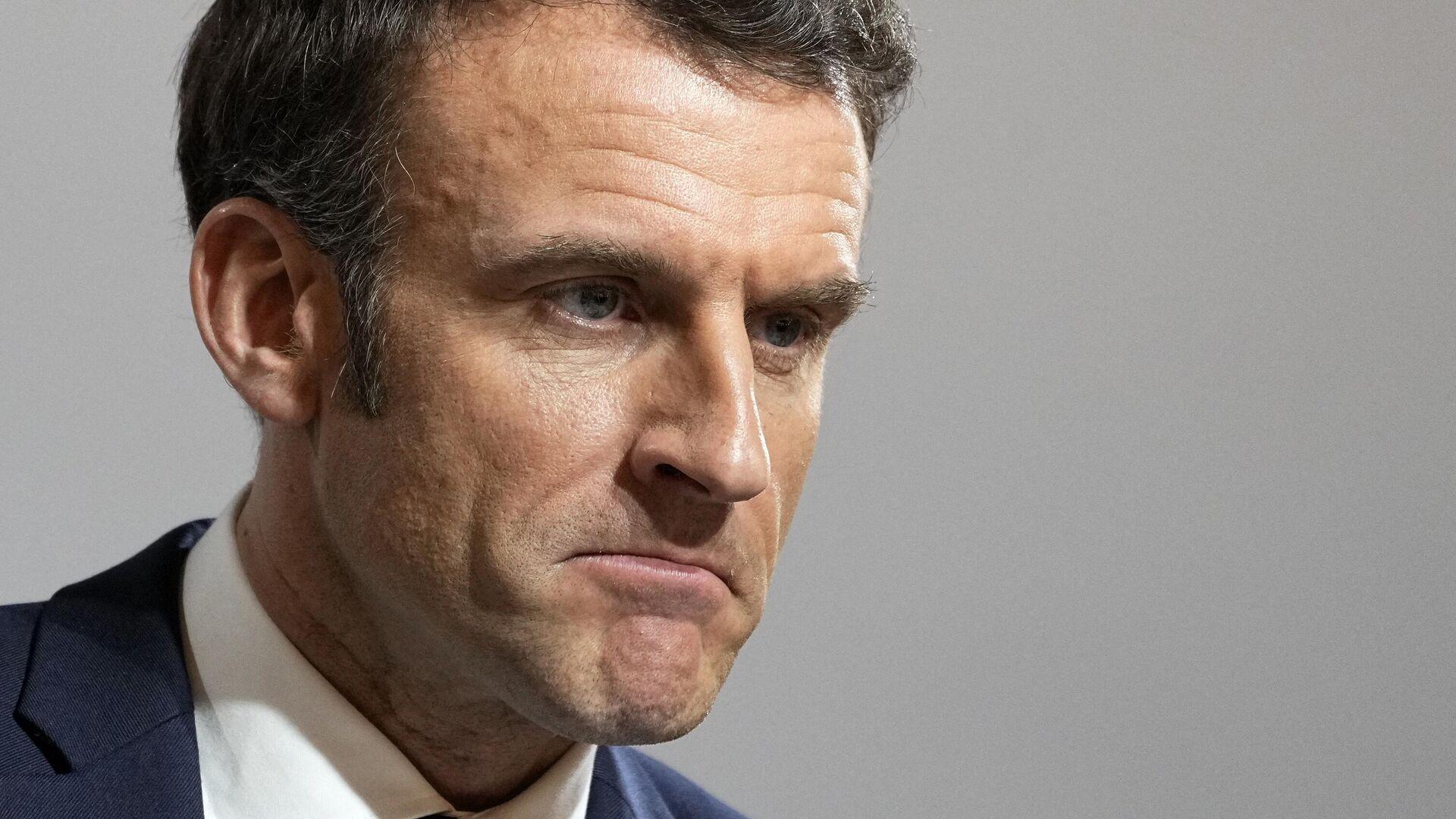
Alongside Poland, France has taken an equally hardline stance against the agreement. Both the far-left and far-right opposition now accuse President Emmanuel Macron of failing to prevent MERCOSUR. Officially, Macron voted “against,” but critics argue that his decision was driven less by principle and more by the intense pressure of farmers’ protests that shook France in 2025.
The opposition also claims that Macron’s government made no meaningful effort to build a “blocking minority” within the EU. In fact, just a few years ago, the Élysée Palace had actively participated in negotiating the deal. Macron himself has admitted that his vote against the agreement was motivated more by political calculation than conviction.
For this reason, both France Unbowed (LFI) and the National Rally (RN) dismiss Macron’s stance as little more than a symbolic gesture. The left has already submitted a no-confidence resolution against the government, while the RN threatens to bring a similar motion against the European Commission, headed by Ursula von der Leyen.
While Macron could face real trouble in the French Parliament, von der Leyen—the so-called “European Chancellor”—is, according to Parisian observers, effectively untouchable for now.
“This protest was triggered by government inaction …”
In Poland, opposition to the agreement comes not only from the ruling centre-left coalition but also from the conservative, right-populist opposition.
The Polish opposition has called the approval of the MERCOSUR deal the greatest foreign policy failure of Donald Tusk’s government. Farmers have also expressed sharp criticism of the premier, who did not meet with protesters on January 9. Beyond blaming the “globalists in Brussels,” activists point to successive liberal and conservative cabinets in Warsaw as responsible for the crisis in Polish agriculture.
“The Prime Minister has once again shown that he despises farmers and has no interest in agricultural issues,” said Marcin Wroński of the Self-Defence movement.
“If the prime minister and the minister of agriculture showed the same determination in defending Polish agriculture as the thousands of farmers who took to the streets in freezing weather, we wouldn’t be facing problems with Ukraine, MERCOSUR, the Green Deal, or the prices and sales of grain and vegetables… For more than 20 years, Poland has been governed by the Civic Platform (PO) and Law and Justice (PiS) parties, and as a result, the number of farms—especially livestock operations—has dropped significantly. It must be emphasised clearly: this protest was triggered by government inaction on the issues facing Polish agriculture,” said Wroński in a statement.
Rural self-defence
Within the ruling Civic Platform party, the farmers’ protests were seen as highly politicised, framed as an “extreme-right narrative with a Braun syndrome” — a reference to Grzegorz Braun, leader of the right-populist Confederation. At the same time, the coalition blamed the farmers themselves for the failure to block the agreement.
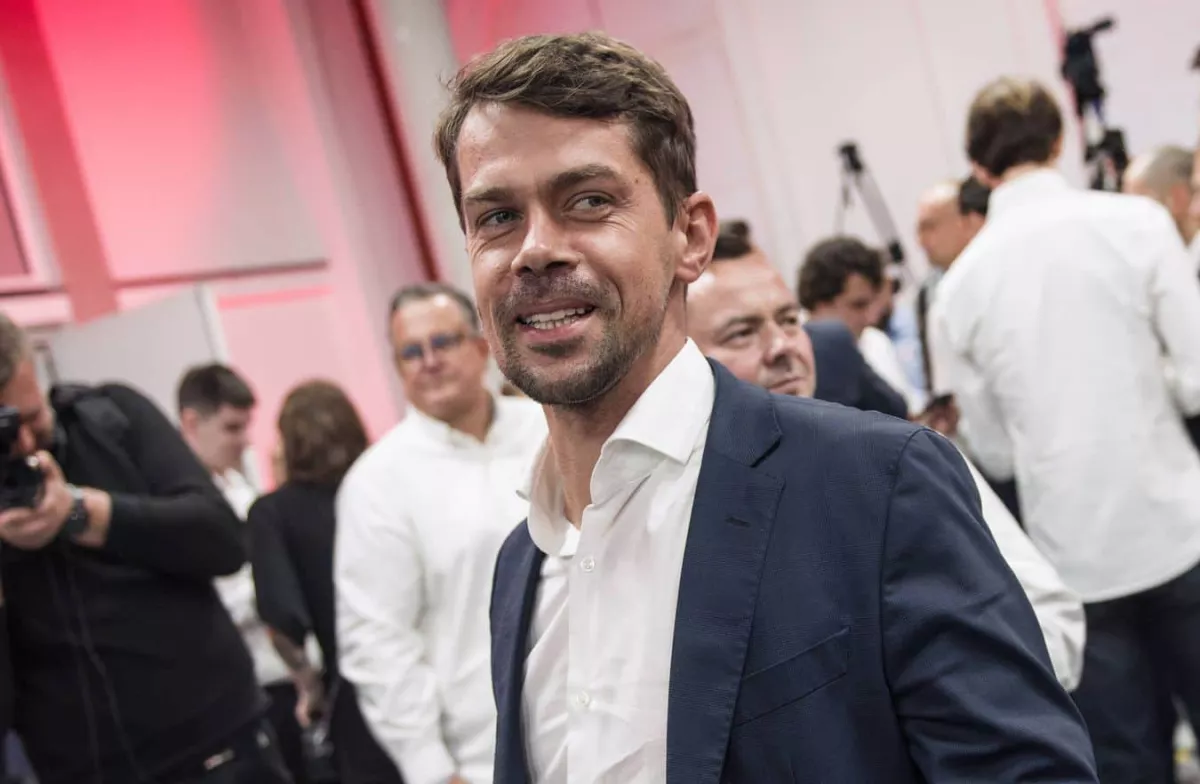
“If the farmers’ actions had been better planned and there had been real international cooperation, this matter could have been won,” said Civic Platform deputy and former Deputy Agriculture Minister Michał Kołodziejczak.
As if Polish farmers are sitting in committees, building alliances, and voting in the European Parliament and European Commission! Moreover, the liberals fear that yet another “globalist agreement” imposed on Poland will only strengthen anti-Brussels sentiment.
“This fits into the narrative of the far-right PiS and Grzegorz Braun’s Confederation, who will seek to turn the protests into a debate about Poland leaving the European Union,” Kołodziejczak said in an interview with RMF FM.
However, despite attempts by right-wing populists to “hijack” the protest, the movement against the MERCOSUR agreement is clearly not under their control. Even during preparations for the January 9 action, activists emphasised that they did not represent any political party.
“We farmers do not support PiS, PSL, the Civic Platform, or any other party—neither left nor right. Above all, we support sensible agricultural policy. And don’t try to drag us into your games,” said Janusz Terka, a rolnik from Piotrków County and one of the organisers of the march on Warsaw, on January 13.
Terka stressed that both major parties bear responsibility for the crisis: the agreement threatening Polish agriculture was first drafted under the conservative PiS, now in opposition. He also noted that MERCOSUR is far from the only challenge facing Poland’s agricultural sector.
Brussels bureaucracy
The MERCOSUR agreement still needs approval from the European Parliament, but given the current balance of power, no major surprises are expected there. The real challenge will come with ratification by national parliaments—particularly in Poland and Hungary.
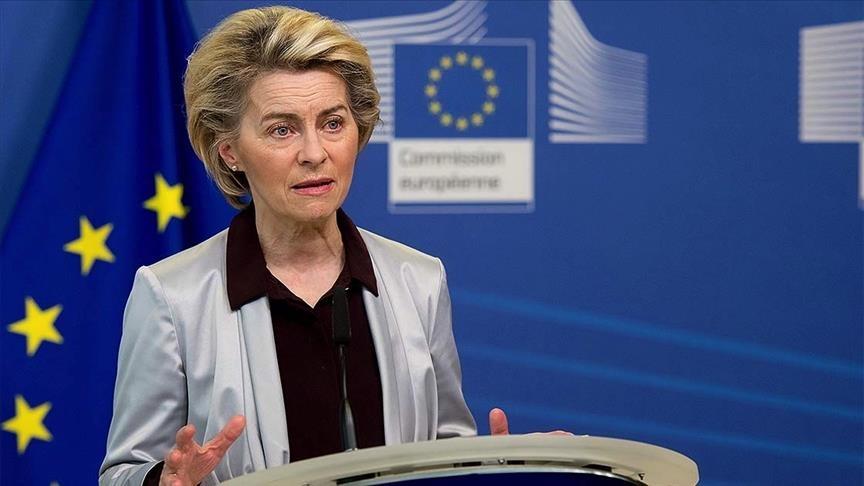
Even so, Ursula von der Leyen is pushing a “backup” mechanism: the parts of the agreement that fall under the European Commission’s authority will take effect immediately, while the remaining sections will later be implemented independently by national parliaments.
Supporters of the deal in the European Commission, Germany, and Spain argue that it will offset losses from American tariffs and reduce the EU’s dependence on China. In reality, however, a free trade zone with MERCOSUR will allow the European Union to build its economic influence in Latin America—in competition with both the US and China. This is particularly important for Brussels in light of Donald Trump’s policy of radical independence from European allies. For example, German automakers, struggling to compete with China, will be able to sell their Mercedes and Volkswagen vehicles to the vast South American market with fewer obstacles.
In the foreseeable future, Poland—regardless of the volume of Argentine beef—will remain an EU member. But hostility toward Brussels among the population is clearly on the rise. An increasing number of Poles, even without any influence from right-wing populists, are realising whose interests the European bureaucracy truly serves: multinational corporations, not their own national producers.







 editor@caliber.az
 +994 55 444-88-98
 Азербайджан, Баку, ул. Низами, 203, Af Business House, 5-й этаж