










Uzbekistan’s economic surge increases Georgia’s strategic importance Article by Vladimir Tskhvediani
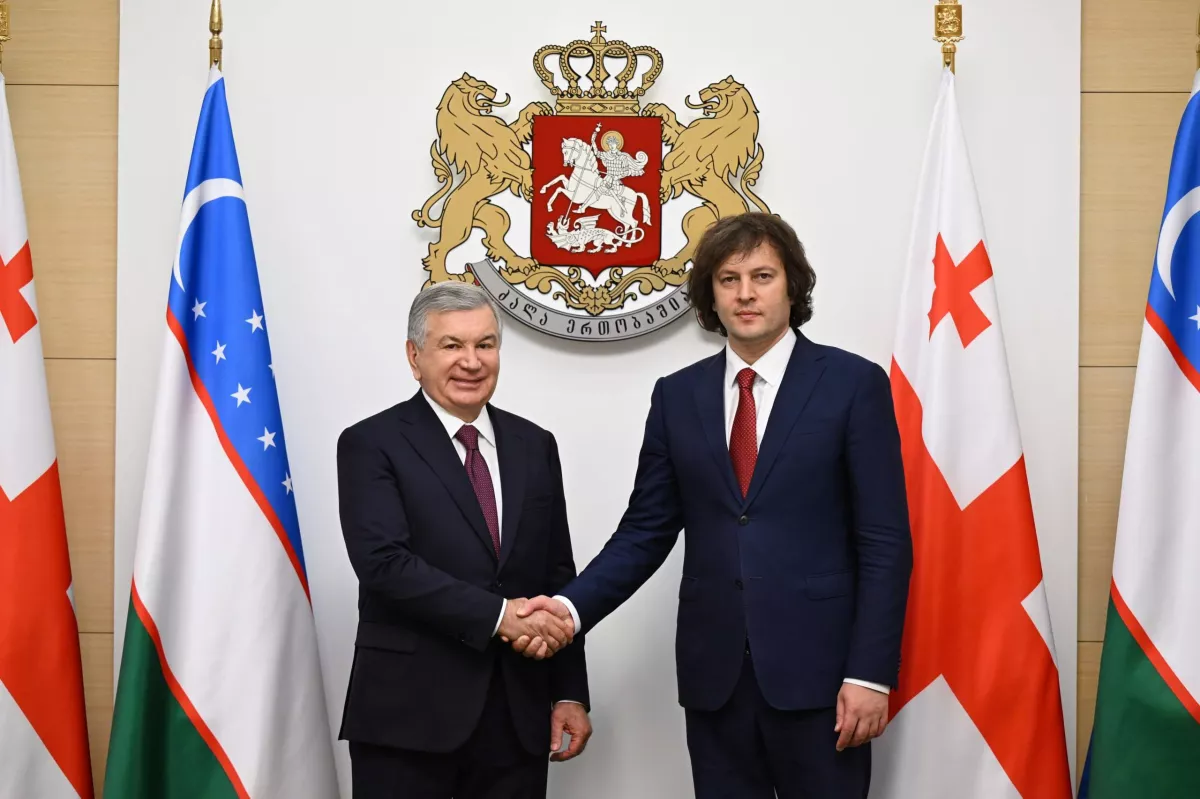
On July 2–3, 2026, President of Uzbekistan Shavkat Mirziyoyev paid a state visit to Georgia. Following the visit, the two sides signed a Declaration on the Establishment of Strategic Partnership Relations. Even before the visit began, on July 1, a Georgian-Uzbek business forum was held in Tbilisi, where particular attention was paid to the development of Uzbekistan’s economy and the prospects for bilateral cooperation.
Uzbekistan’s economic performance in recent years has been impressive. Since 2017, the country’s economy has doubled, and in 2025 GDP growth reached 7.7%. The oil and gas, mining and chemical industries, mechanical engineering, and automotive sectors are all developing rapidly. Significant further growth potential is also provided by the demographic factor, the lack of which is currently a challenge for many European and Asian countries.
According to preliminary census data announced by the head of the National Statistics Committee, as of January 15, 2026, Uzbekistan’s population exceeded 39 million — 810,617 more than previous estimates had indicated. By this measure, the country is not only the most populous in Central Asia but has also risen to second place in the post-Soviet space, overtaking Ukraine, which has suffered significant demographic losses as a result of the war, and ranking behind only the Russian Federation. Uzbekistan’s population remains relatively young and continues to grow rapidly. If current trends continue, in the coming years the country may reach population levels comparable to major European states such as France or Italy.

With its growing demographic potential, Uzbekistan has every prerequisite to become the economic core of Central Asia. The country is attracting significant investment flows from China as well as from other industrially developed states. For instance, South Korean corporations are increasingly considering relocating part of their production capacities from South Korea—one of the countries facing one of the most severe demographic crises in the world—to Uzbekistan. The presence of a sizeable Korean diaspora in the country further facilitates the development of such cooperation.
At the same time, Uzbekistan faces an objective geographical limitation. It not only lacks direct access to the sea but is also surrounded by other landlocked countries. In the context of the development of the Middle Corridor, Georgia is emerging as the most convenient and natural gateway to maritime communications for Uzbekistan.
According to Uzbekistan’s Minister of Economy and Finance Jamshid Kuchkarov, the share of the Middle Corridor in the country’s total freight transportation increased from 12% in 2021 to 28% in 2025. This growth has been driven by investments in railway electrification, the development of road infrastructure, and multimodal logistics. The importance of the Middle Corridor for Uzbek freight transport and transit is expected to increase further after the commissioning of the under-construction China–Kyrgyzstan–Uzbekistan railway.
For Georgia, cooperation with Uzbekistan opens additional opportunities for the development of trade relations with Central Asia, China, and South Asia. Tbilisi’s interest in becoming a maritime gateway for the countries of the South Caucasus and Central Asia was explicitly stated by Georgia’s Minister of Economy and Sustainable Development Mariam Kvrivishvili, speaking at the Georgian-Uzbek business forum.

“We must be prepared for the fact that Uzbekistan, Kazakhstan, and Azerbaijan are growing, and we are developing together with our partners. That is why it is extremely important to invest today in basic infrastructure so that businesses can transport more cargo. This will make the Middle Corridor not only one of the most competitive routes, but also the main and most reliable transport route,” stated Mariam Kvrivishvili.
For many years, transit through the territory of the Russian Federation and Russian ports was a priority for Uzbekistan. However, the situation is gradually changing today due to increasing risks associated with the Russian-Ukrainian war. The reliability of the northern route is increasingly being questioned, and Georgia, with its Black Sea ports, as well as the Baku–Tbilisi–Kars railway passing through the South Caucasus, is becoming one of Uzbekistan’s key gateways to European markets.
A free trade regime operates between Georgia and Uzbekistan, contributing to steady growth in bilateral trade turnover. Over the past five years, its volume has increased 2.5 times. This figure could grow even more significantly if part of the Uzbek cargo currently transiting through the territory of the Russian Federation is redirected to the route via Georgia.
By Vladimir Tskhvediani, Georgia, specially for Caliber.Az







 editor@caliber.az
 +994 55 444-88-98
 Азербайджан, Баку, ул. Низами, 203, Af Business House, 5-й этаж