










Armenian agenda under a European label Baku never invited the EU as an arbitrator
Recently, Armenia and the European Union approved a new cooperation agenda at the level of strategic partnership. The signing took place in Brussels following the 6th meeting of the Armenia-EU Partnership Council. Ararat Mirzoyan, Armenia’s Minister of Foreign Affairs, signed on behalf of Armenia, while European High Representative for Foreign Affairs and Security Policy Kaja Kallas signed on behalf of the EU.
The document essentially appears as a programme of intentions: several dozen pages covering political interaction, the economy, democratic institutions, reform assessments, and plans for future projects. In essence, it is a catalogue of what is already being done and what Brussels is ready to support moving forward. At the same time, the document does not even hint at discussing Armenia’s prospects for EU membership. However, it clearly reflects Brussels’ desire to anchor Armenia within its geopolitical sphere. This raises a question that European officials tend to avoid — why, in an agenda designed to develop bilateral Armenia-EU cooperation, is Azerbaijan mentioned in an overtly politicised context?
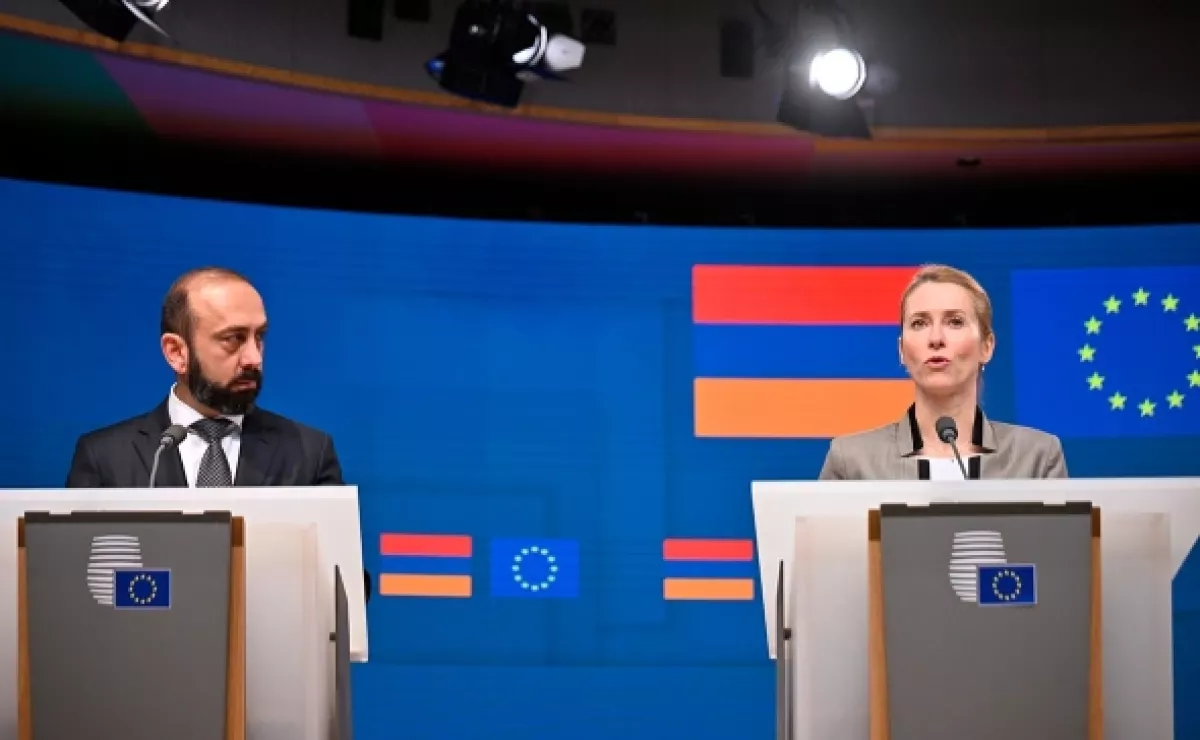
Azerbaijan appears in the document several times. Twice it is mentioned in connection with peace negotiations, which is logical and expected. However, two other references appear in the most programmatic sections of the text — in the introduction and conclusion. Here, the EU assumes the role of commentator on events in Karabakh, using language that introduces political assessments under the guise of humanitarian concerns. On the fourth page, it refers to the “socio-economic inclusion of Karabakh Armenians displaced following Azerbaijan’s military operation.” On the last page, the document returns to the same topic, again using terminology that Europe apparently has yet to settle on — whether “displaced persons” or “refugees.”
The problem is not that Brussels shows concern for people. The problem is that the text completely omits the key factor that led to these events — the 30-year-long occupation of Azerbaijani territories. The EU knows Baku’s official position. It knows that the issue of disarmament and withdrawal of Armenian Armed Forces from the Karabakh region was a fundamental concern for Azerbaijan. Yet the document leaves this aside, as if the cause of the events no longer matters when it is more convenient to describe them in a one-sided manner, even under a “humanitarian” framing. This approach looks like an attempt to record in European archives its own interpretation of history, regardless of the facts.
Another inconsistency is that the EU speaks of the “displacement” of people as if it occurred due to unilateral pressure from Azerbaijan. In reality, the departure of Armenians from the region was organised by Armenian structures that had governed the Karabakh Armenians for many years and were funded by the Armenian state budget. The document does not devote a single line to this. Instead, Brussels continues to refer to Armenian “detainees and prisoners,” calling for their release, without specifying who these individuals are or why the EU considers it appropriate to take on a role in the legal affairs of another state.
Particularly striking is the reference to the International Court. In the section on normalising relations in the region, it proposes to “support the full, immediate and effective implementation of all relevant International Court of Justice orders.” The phrase sounds bold, but it is unsupported. The text does not specify which rulings are meant, nor what obligations are expected of the parties. If it refers to rulings concerning Armenians who voluntarily left Azerbaijani territory, it gives the impression that the document applies international law selectively. And if this approach were applied consistently, Brussels would need to explain why the rights of Western Azerbaijanis, who were expelled from Armenia with particular brutality, are not addressed — even though the same humanitarian principles that the EU declares for Armenians would logically apply to them.
All of this creates the impression that, in shaping a strategic agenda with Armenia, the European Union is attempting to expand the scope of cooperation by addressing issues that fall outside its immediate jurisdiction. Brussels assumes the role of arbitrator in a region that has long been developing its own security architecture. The language used in the document is presented as neutral, but in reality it introduces political interpretation into matters directly related to bilateral relations between Azerbaijan and Armenia. This does not help build trust; on the contrary, it drags the region back into the kind of rhetoric it has been trying to move away from in pursuit of long-term peace.
The EU has every right to develop relations with any partners. But when it includes assessments of events concerning Azerbaijan without taking its position into account, it ceases to appear as an observer and starts acting as a participant in a process to which it was not invited. If Europe seeks stability in the South Caucasus, this approach is unlikely to advance that goal. Instead, it reinforces the perception that Brussels aims to cement a version of events convenient for itself, even if it does not reflect reality and undermines the peace agenda that the region has long sought to achieve.







 editor@caliber.az
 +994 55 444-88-98
 Азербайджан, Баку, ул. Низами, 203, Af Business House, 5-й этаж