










French military contingent lands in Armenia Just 40 minutes from Russian base
Although Azerbaijan and Armenia effectively reached the final stages of conflict resolution after August 2025, France’s military-political leadership has continued to act deliberately against the advancement of peace in the South Caucasus. A stable resolution threatens one of France’s key foreign policy tools in the region: managed instability. The Fifth Republic long sought to expand its influence in the South Caucasus, relying on Armenia as a political and military outpost. To this end, it systematically armed Yerevan while exploring the deployment of a French military contingent—a plan that has now partially succeeded.
Under President Macron, France’s policy of militarising Armenia intensified and became institutionalised. The framework of Armenian-French military cooperation steadily expanded, encompassing officer training and retraining programmes as well as arms supply agreements. France expressed its readiness to provide Armenia with missiles of various ranges for air defence systems—specifically short- and medium-range Mistral missiles, to be delivered if necessary. Additionally, an agreement was reached for the retraining of Armenian officers in France.
At the same time, the close intertwining of the French political establishment with Armenian lobbying structures has long taken on the character of direct political complicity. For years, a significant number of French politicians and parliamentarians have worked closely with Armenian organisations in France. The effective overseer of this network is Mourad Papazian, co-chair of the Coordination Council of Armenian organisations in France, who is linked to Dashnak ideology—the same radical tradition that has historically rejected compromise and fuelled confrontation.
A telling example of this influence was the annual CCAF dinner held on 28 January in Paris, which brought together over 400 guests, including Senate President Gérard Larcher, ministers, Paris Mayor Anne Hidalgo, former President François Hollande, and former Prime Ministers Bernard Cazeneuve and Édouard Philippe. This clearly demonstrates that the Armenian lobby is far from marginal—it is an embedded element of French political power.
The key moment of the evening, however, was the speech by current French Prime Minister Sébastien Lecornu, which stripped away all pretence. While verbally welcoming the peace process, he confirmed in practice that Paris is deliberately “muddying the waters” by supplying weapons to Armenia and deploying military infrastructure, thereby undermining progress toward regional stability.
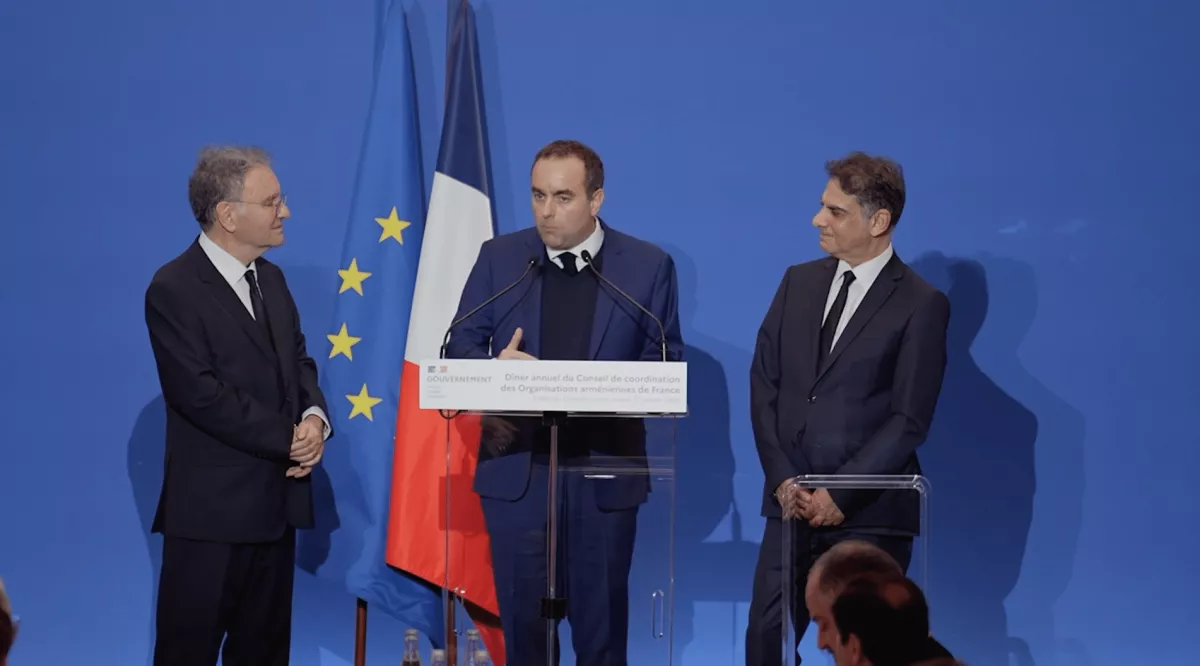
“You have already heard many speeches, and I don’t want to be too long-winded. The sovereignty of a friendly country is not negotiable. Respect for the borders of a friendly country is not negotiable. And ultimately, one can have any peaceful intentions, but at a certain point there is reality: in a defence system, one must be capable of deterrence, which means possessing means commensurate with one’s ambitions. No Minister of Defence of the French Republic had previously visited Armenia, and for obvious reasons.
Indeed, the transition to the stage of selling weapons to Armenia — initially, as was said, defensive, then individual, then collective (this was less discussed), and eventually offensive, up to the most advanced systems developed by our industry — undoubtedly marked an absolutely decisive turning point. But it does not end there. The sale or provision of weapons would have had absolutely no meaning if we were not able to create strategic proximity between the armies and, above all, train Armenian military personnel to operate and use this equipment.
I will recount one episode — I really don’t want to be too long — but it speaks to everything we represent: our doubts, but also our strength when we decide to be united. It should be understood that at that time, Armenia was still a member of the CSTO, and we deployed almost forty French military personnel just forty minutes from a Russian base. These French soldiers trained Armenian troops for several weeks. It went relatively unnoticed, but one must realise the reaction within NATO. When a NATO ministerial meeting was held in Brussels, the Italians and Americans said to us: ‘But do you realise what you are doing? You, a NATO country, are deploying French soldiers on the territory of a state that is still a CSTO member?’ We replied: ‘Yes.’ They looked at us and asked: ‘But why?’ And we said: ‘Because we are France!’” said Lecornu, among other things.
As we can see, in his speech Lecornu, with barely concealed self-satisfaction, effectively admitted that France had progressed from supplying Armenia with “defensive” systems to providing offensive weapons, including the most advanced models of French military industry, and then to creating “strategic proximity” between the armies — that is, training Armenian military personnel and establishing an actual military presence.
Moreover, he openly spoke about the deployment of around forty French soldiers in Armenia, just forty minutes from a Russian military base, emphasising that this caused irritation and bewilderment within NATO. But, according to him, France’s response was simple: “Because we are France.” This phrase, presented as an argument, in reality amounted to an admission of political arrogance and a willingness to disregard both alliance obligations and regional risks in order to demonstrate a semblance of grandeur.

In light of Lecornu’s admission, all of Paris’s statements about supporting the peace process between Azerbaijan and Armenia appear hypocritical and openly cynical. For many years, France nurtured hopes of expanding its sphere of influence in the South Caucasus, and within expert circles in both countries, the possibility of establishing a French military base in Armenia was discussed.
Questions also arise for Yerevan, since Article VII of the peace agreement, initialled in Washington, explicitly obliges the parties not to deploy third-country armed forces along the shared border — an obligation that is effectively being undermined.
Undoubtedly, questions will also arise for Russia, still formally an ally of Armenia, given that French troops are positioned in close proximity to Russia’s 102nd base. However, these are aspects of Armenian-Russian relations, the discussion of which is beyond the scope of this publication.
The irony of the situation is that Lecornu, boasting to his NATO colleagues about his audacity, is in fact illustrating the very decline of European political culture that U.S. President Donald Trump spoke of — a decline rooted in complacency, double standards, and a loss of accountability. Under Macron, France likes to portray itself as a “great power,” but in practice it increasingly acts not as a stabiliser, but as a catalyst for crises, becoming one of the drivers of the very European decline it prefers to ignore, viewing the world through the lens of its own illusions of former grandeur.







 editor@caliber.az
 +994 55 444-88-98
 Азербайджан, Баку, ул. Низами, 203, Af Business House, 5-й этаж