










Le Pen on road to Élysée Palace: Will France turn right? Expert opinions on Caliber.Az
The leader of the parliamentary faction of France's National Rally party, Marine Le Pen, has confirmed her intention to run in the 2027 French presidential election in an interview with the TF1 television channel.
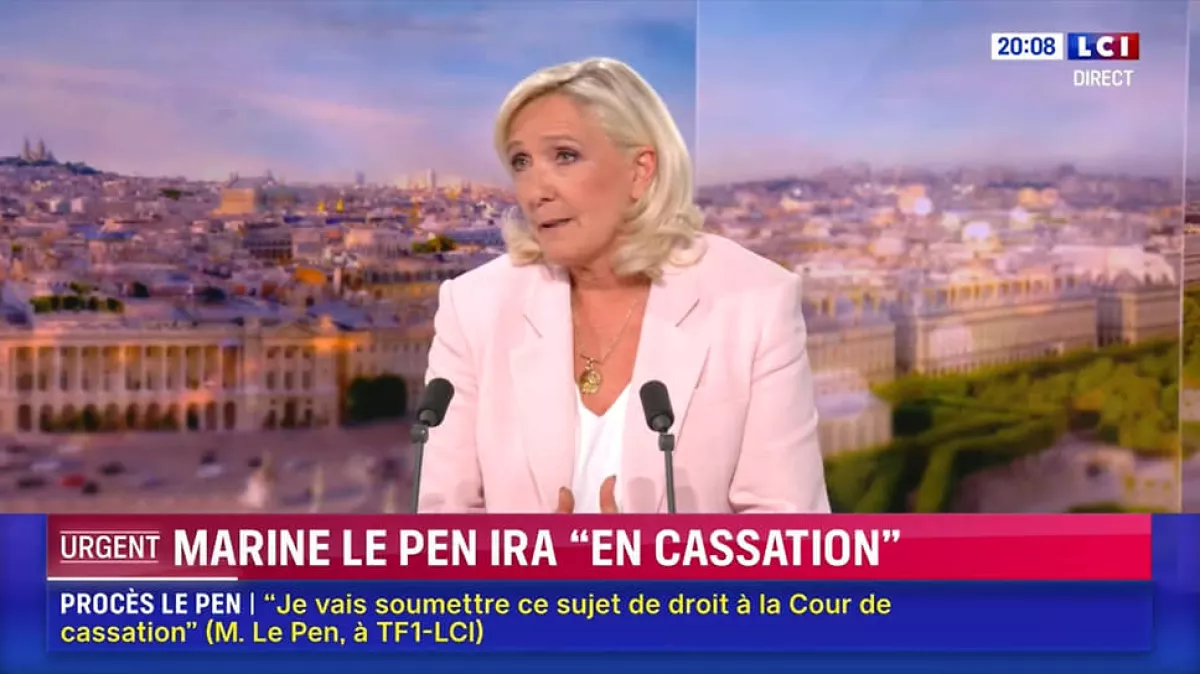
“Yes, as of this evening, I am officially a candidate in the presidential election,” Le Pen emphasised.
The politician also announced that she and National Rally leader Jordan Bardella would soon launch their election campaign. In addition, Marine Le Pen said she would file a cassation appeal against the court ruling in the European Parliament embezzlement case, stressing that she had no hesitation in making that decision.
France’s presidential election will be held in two rounds, on April 18 and May 2, 2027.
On July 7, the Paris Court of Appeal upheld Marine Le Pen’s right to run for the French presidency. The ruling effectively shaped the framework of the 2027 presidential race. A court that had pledged to stay out of politics nevertheless resolved two politically significant issues simultaneously—the future of the presidential contest and the internal situation within the National Rally.
Marine Le Pen has once again emerged at the centre of the political stage as the undisputed leader of France’s right-wing camp. According to data by social institutes Ifop, Elabe, and Ipsos, she continues to command the most stable electoral base among all potential opposition candidates.
In most scenarios, Le Pen consistently advances to the second round, and in several projections, she even outperforms centrist candidates in the first round.
Under these circumstances, the first round once again becomes a stage of structural advantage for the National Rally, while the outcome of the runoff will depend primarily on the ability of anti-Le Pen voters to unite behind a single candidate.
The architecture of the presidential campaign has thus returned to the familiar pattern of recent decades: a highly personalised contest centred on the leader of the National Rally and a fragmented camp of opponents.
Analysts note that Le Pen’s candidacy will allow the party to avoid a difficult leadership transition while maintaining maximum mobilisation of its core electorate.
The party’s internal structure has once again been consolidated entirely around her leadership.
The 2027 presidential campaign is therefore unfolding according to the same pattern seen in the previous two electoral cycles: Le Pen is expected to finish first in the opening round, only to face the risk of defeat in the runoff due to the consolidation of centrist and left-wing forces.
Whether the much-discussed "cordon sanitaire" against the far right will prove effective this time remains uncertain. Many centrist politicians are already showing signs of hesitation. One thing, however, is clear: the campaign is once again shaping up as "Marine Le Pen versus everyone else."
Le Pen’s chances of winning remain significant. What would her victory mean for France and for Europe? France is one of the European Union’s and NATO’s leading powers and a nuclear-armed state. In the past, Le Pen has criticised the European Union for what she described as its "constant preparation for war in Eastern Europe," advocated reforming the bloc under right-wing leadership, and her party has repeatedly faced allegations of receiving financing linked to the Russian leadership.
Well-known Western experts shared their assessments of these developments with Caliber.Az.

French historian and researcher Maxime Gauin noted that opinion polls conducted nine months before a presidential election have very limited predictive value.
“In 2011, 2016, and 2021, polls predicted that Marine Le Pen would finish first in the first round. In reality, she came third in 2012 and then second in both 2017 and 2022. This is not a problem with the quality of French polling in general, but rather with the specific nature of this type of election.
As for the current polls, one of them shows that 59 per cent of respondents believe it was a mistake for Marine Le Pen to maintain her candidacy after the Court of Appeal upheld her conviction, [including a €100,000 fine and a one-year sentence requiring her to wear an electronic monitoring bracelet.]
The Court of Appeal's ruling is not the end of the story. Marine Le Pen has appealed to the Court of Cassation, maintaining her innocence. However, the court has already announced that it could issue its decision before the first round of the presidential election, and a final conviction would inevitably become a serious political burden for her. The Paris Prosecutor General has stated that if the appeal is rejected, she will immediately request that the electronic monitoring bracelet be enforced.
As for the consequences of Le Pen coming to power, the risks are undoubtedly very high. Nuclear weapons have already been mentioned. Unlike the United Kingdom, France has retained the airborne component of its nuclear deterrent forces. Since 2025—and especially throughout 2026—Emmanuel Macron has been promoting the concept of 'extended deterrence': deploying Rafale fighter jets equipped with nuclear air-to-surface missiles in EU and NATO member states in exchange for the host countries' participation in the detection of incoming enemy missiles.
France's nuclear deterrent remains fully autonomous, with the exception of intercontinental missile detection, which still depends in part on the United States. France possesses over-the-horizon radar systems, but their capabilities are not yet sufficient. Marine Le Pen initially portrayed this initiative as a form of 'sharing nuclear deterrence,' before acknowledging that the President of France would nevertheless retain the exclusive authority to decide on the use of nuclear weapons. However, there is no guarantee that she would continue negotiations on establishing the necessary facilities in Poland, Sweden, Denmark, the United Kingdom, Germany, and other countries,” the historian said.
According to him, Marine Le Pen spent many years advocating France's withdrawal from the European Union and the eurozone, until realising in 2017 that this position represented an insurmountable obstacle to winning the presidency.
“What she is proposing now would undermine the functioning of the European Union. As for NATO, her current position is virtually identical to the one she held in the past. In 2022, there were a number of disagreements between Emmanuel Macron on the one hand and the countries of Northern and Eastern Europe on the other. However, he has since become extremely popular in those countries thanks to his concept of 'extended deterrence' and the strengthening of support for Ukraine through the supply of SCALP cruise missiles, AASM precision-guided bombs, Mirage 2000-5 fighter aircraft, and guidance systems for Flamingo missiles. It is clear that these countries would view a Marine Le Pen victory as a catastrophe.
Furthermore, there have indeed been repeated allegations that her party received financing linked to the Russian leadership. That is true. In 2014, the party obtained two loans from Russian sources totalling €11 million. Correspondence later published by Russian hackers indicated that these loans were a reward for the party's support of the annexation of Crimea. That annexation violated, among other agreements, the 1991 Alma-Ata Declaration, the 1994 Budapest Memorandum [reaffirmed in 2009], the 1997 Treaty on Friendship, Cooperation and Partnership between Ukraine and the Russian Federation, and the 2003 Treaty on the Ukrainian-Russian State border.
The foundation established by former Member of the European Parliament Jean-Luc Schaffhauser, who negotiated the loan agreement, also received €256,000 from Moscow in return for its chairman’s pro-Russian stance.
On November 30, 2022, the French National Assembly adopted a resolution in support of Ukraine. Deputies from the National Rally abstained, rightly fearing that voting against it would prove politically costly in subsequent elections. Nevertheless, in May 2023, Marine Le Pen once again defended the annexation of Crimea, and there were evidently reasons behind that position,” Gauin concluded.
Stefan Meister, Head of the Center for Order and Governance at the German Council on Foreign Relations (DGAP), said that, as both a German citizen and an analyst, he expects Marine Le Pen to move closer to the political line pursued by Giorgia Meloni.
“France needs Brussels’ financial support, and it is not going to prepare its own exit from the European Union.
If Le Pen wins the election, she will have to make significant compromises. I am also not convinced that cooperation with Russia is currently a realistic option for any European politician, given that Russia remains interested in prolonging the war, including its confrontation with NATO. I believe France, too, will continue to distance itself from Russia, and I do not expect any substantial cooperation between the two countries,” the expert said.
Additionally, he believes that a Le Pen presidency could lead to stronger anti-German sentiment in France and further complicate decision-making within the European Union.
“At the same time, France will have to deepen its security cooperation with its European partners as the United States gradually scales back its role in Europe's security architecture. The broader geopolitical changes make it impossible for France to 'turn away from Europe'. Instead, we are likely to see a more pragmatic approach to European cooperation.
As for migration, a great deal has already been done in this area, so I do not believe Le Pen would be able to bring about a fundamental transformation. Nevertheless, Europe is likely to become more restrictive on migration, more right-leaning, more focused on traditional values, and more nationalistic and driven by national interests, which will make cooperation on many issues increasingly difficult,” Meister concluded.







 editor@caliber.az
 +994 55 444-88-98
 Азербайджан, Баку, ул. Низами, 203, Af Business House, 5-й этаж