










Orchestrated outrage Imperial pretensions of the Z-community
On April 25 in Gabala, the leaders of Azerbaijan and Ukraine, Ilham Aliyev and Volodymyr Zelenskyy, held one-on-one talks as well as an expanded meeting. As a result, six documents were signed. The meeting was strictly bilateral in nature and was not directed against any third countries, as Caliber.Az reported in detail in its coverage earlier today.
However, in the Z-segment of Russian-language Telegram, this news caused an explosive reaction. Not just from a single author, but from an entire layer simultaneously.
Roman Antonovsky, whose channel “Sons of Monarchy” has 86,000 subscribers, published a post after the news of the visit that began with the words “Two fierce Russophobes met” and ended with outright obscenity — receiving hundreds of positive reactions within just a few hours.
A few hours later, the same author rolled out an entire programme. A four-point programme: to ban the Azerbaijani national-cultural autonomy by legally equating it with an organised criminal group; to introduce a visa regime with Azerbaijan; to support so-called “national liberation movements of the Talysh and Lezgin peoples”; and to bomb all Azerbaijani oil refineries located on the territory of Ukraine. The post gathered eight hundred positive reactions.
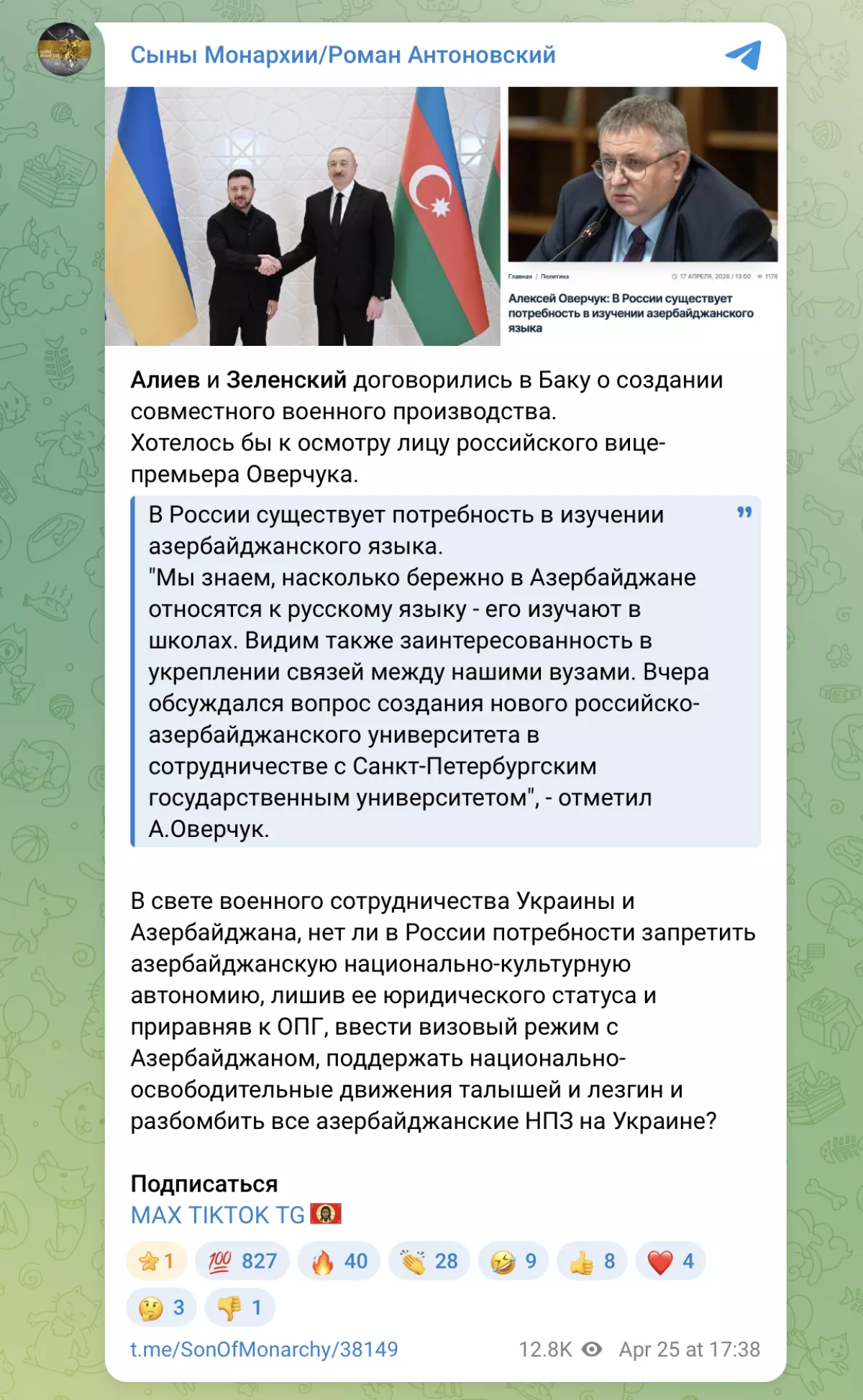
That same evening, the Telegram channel "Besposhchadnaya Rossiya" (Merciless Russia) published a post describing Zelenskyy’s visit in the following terms: “de facto, [Azerbaijan — ed.], on a par with Europe, is a participant in a proxy war against us. This means that legitimate targets may appear on its territory, i.e. Azerbaijan.”
At the same time, the Russian channel “Turan Express” was publishing insulting posts directed at the Azerbaijani leadership. Dozens of smaller channels echoed the same messaging hour after hour, repeating identical talking points.
The tone was openly abusive. The channels act in sync, reference one another, and replicate the same narratives. We would normally not respond to this, but it is clear to us that this is not a collection of isolated opinions, but a coordinated effort — and its orchestrators are not difficult for us to identify.
But before threatening Baku, Russian bloggers should recall whom their own country armed for thirty years and to whom it provided assistance. In the mid-1990s, according to various estimates, weapons and ammunition worth up to $1.5 billion were transferred to Armenia from Russian arsenals. This fact gained wide public attention following an investigation by a State Duma parliamentary commission headed by General Lev Rokhlin. Tanks, missile systems, artillery, and communications equipment were supplied to a country that had occupied the sovereign territories of Azerbaijan. Not as a loan — but as a gratuitous transfer.
And later, the essence did not change. Azerbaijan regularly paid export prices for each air defence system. Armenia received the same equipment free of charge. Several S-300 batteries were handed over to Yerevan at no cost. Armenia also received the Iskander-M operational-tactical missile system — the only export case of this system in its entire history, an exception to all established rules. To this day, the question remains open as to whose crew and from which system the Iskander missile was launched that struck Shusha in the autumn of 2020.
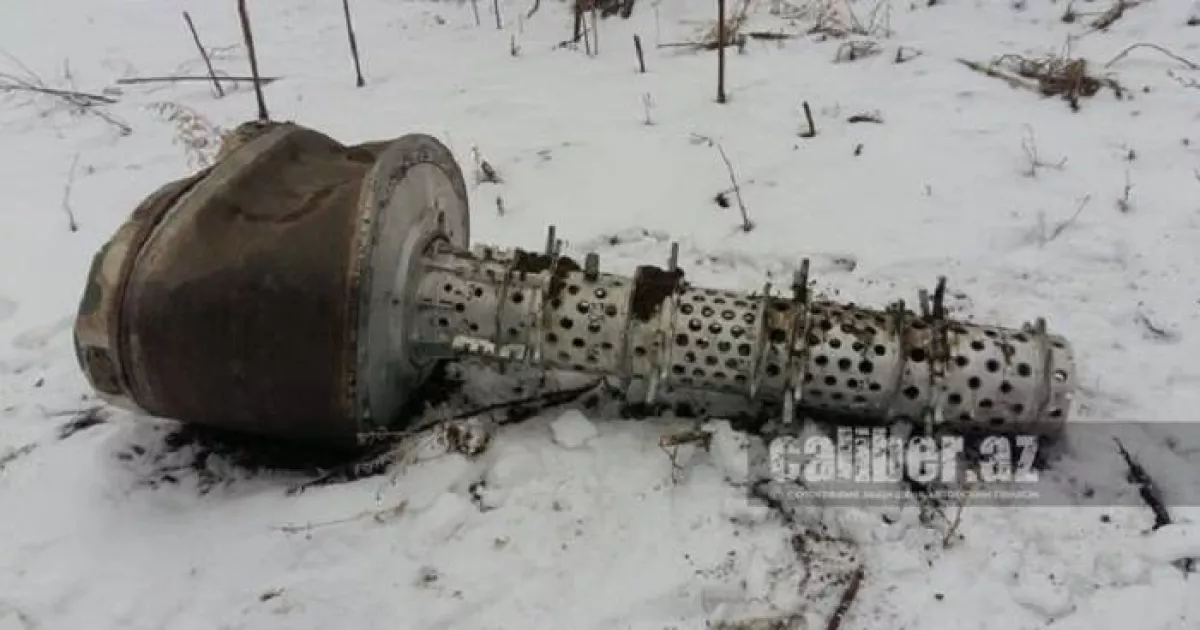
In parallel, Tor-M2KM air defence systems, electronic warfare stations, and reconnaissance equipment were also supplied to Armenia. This equipment was used against Azerbaijani cities and Azerbaijani soldiers.
The political infrastructure functioned along the same logic. Robert Kocharyan and Serzh Sargsyan — two former presidents who emerged from the Karabakh separatist movement and were shaped as political figures with the support of certain circles in the northern neighbour. Kocharyan remains a welcome guest in Moscow, and his ties to its political establishment have spanned decades. Figures from the separatist leadership such as Arkadi Ghukasyan, Bako Sahakyan, and Arayik Harutyunyan maintained representative offices in the Russian capital for years. Russian media platforms routinely presented separatist supporters in studio discussions as “defenders of a Christian outpost.” The occupation was supported in a systematic manner.
In the autumn of 2020, when Azerbaijan was restoring its territorial integrity, this system responded with panic — both on air and in behind-the-scenes meetings, about which we are well aware. It did not work. After 2023, the region ceased to be a space where the former empire set the rules. The peacekeepers withdrew a year and a half ahead of schedule.
It is clear to us that the threats made by Russian bloggers against Baku are an attempt to whitewash their own disreputable record. At the same time, they seem to long for a return to the past — Kocharyan, Sargsyan, controlled chaos, and separatism. What a sovereign state does on its own territory is its own decision. We are honest with all our partners. Are you?
When you have an answer to that, then we can talk about who has the right to issue threats over Zelenskyy’s visit to Gabala. Until then, the outbursts of fabricators are just that — outbursts. A score without an audience.







 editor@caliber.az
 +994 55 444-88-98
 Азербайджан, Баку, ул. Низами, 203, Af Business House, 5-й этаж