










Shadows of a mythical Armenia Is the Pashinyan government powerless?
Recently, in Armenia—despite the government’s declared commitment to the peace process with Azerbaijan—developments have emerged that cast doubt on Yerevan’s sincerity in eradicating revanchist sentiments within society. In this context, three cases are of particular interest.
The so-called “president” of the now-defunct self-proclaimed regime, Samvel Shahramanyan, filed a lawsuit against Armenia’s Ministry of Education and Science. The reason was a reference in a school history textbook to Shahramanyan’s decision to dissolve the entity he headed. In his civil claim, he demanded the “protection of honour and dignity, as well as a retraction of the stated facts.”
The court, rejecting the claim, stated the following: “The court concludes that even if the claimant’s arguments could be considered well-founded, they cannot serve as grounds for satisfying the claim, since no document has legal force if it is signed under coercion or under a direct threat of the use of force, and from the moment of signing is deemed invalid. This follows from universally recognised principles of both domestic and international law.”
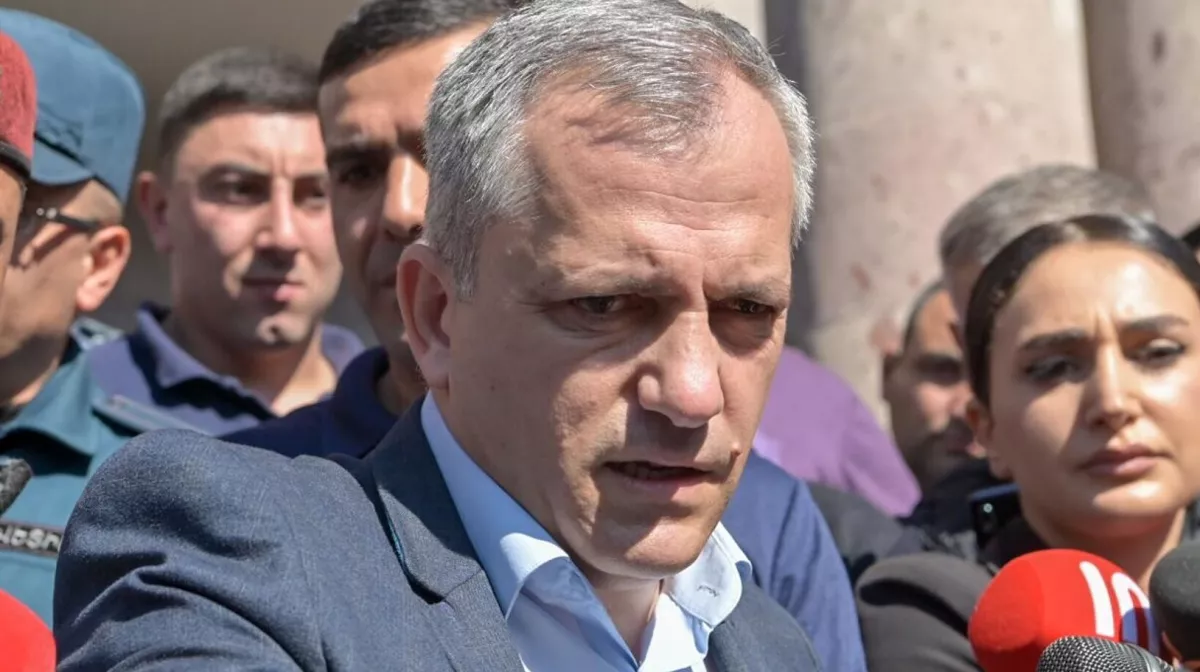
Shahramanyan’s lawyer, referring to this clarification by the court, claims that the Armenian judicial system is in effect recognising the decision to dissolve the self-proclaimed regime as illegitimate.
We will not delve into the intricacies of this case at this stage. What interests us more is the conceptual framework employed by Armenian justice. In this respect, one is compelled to agree with the revanchists’ lawyer: the Armenian court does indeed regard the decision to dissolve the self-proclaimed regime as illegitimate—arguing that the “decree” was allegedly signed under the use or threat of force.
Since such “use of force” is understood to refer to the Azerbaijani Armed Forces’ anti-terrorist operation in the “grey zone” of Karabakh on September 19–20, 2023, the Armenian court is thus casting doubt on the legitimacy of that operation. By extension, it denies Azerbaijan’s sovereign right to the territory of Karabakh and fails to recognise the territorial integrity of the country.
Meanwhile, the court could have referred to Armenia’s recognition of Karabakh as part of Azerbaijan (including the 2022 Prague Statement, Pashinyan’s oral statements, and, most importantly, the joint Washington Declaration, which contains a reference to the Almaty Declaration and the draft peace agreement initialled there in Washington). Overall, the court could have avoided addressing the legality of the dissolution of the self-proclaimed regime altogether, as the claim itself did not require such an assessment.
Thus, the Armenian court, on the one hand, relies on Armenia’s Constitution, in which “Nagorno-Karabakh” is effectively designated as part of Armenia, and, on the other hand—and this is no less important—uses every opportunity to demonstrate its adherence to this provision of the Basic Law.
What is happening once again underscores the necessity of amending Armenia’s Constitution. A situation has emerged in which the executive branch speaks of peace and territorial integrity, while the judicial branch, citing domestic legislation, offers interpretations that run counter to peace and the norms of international law.
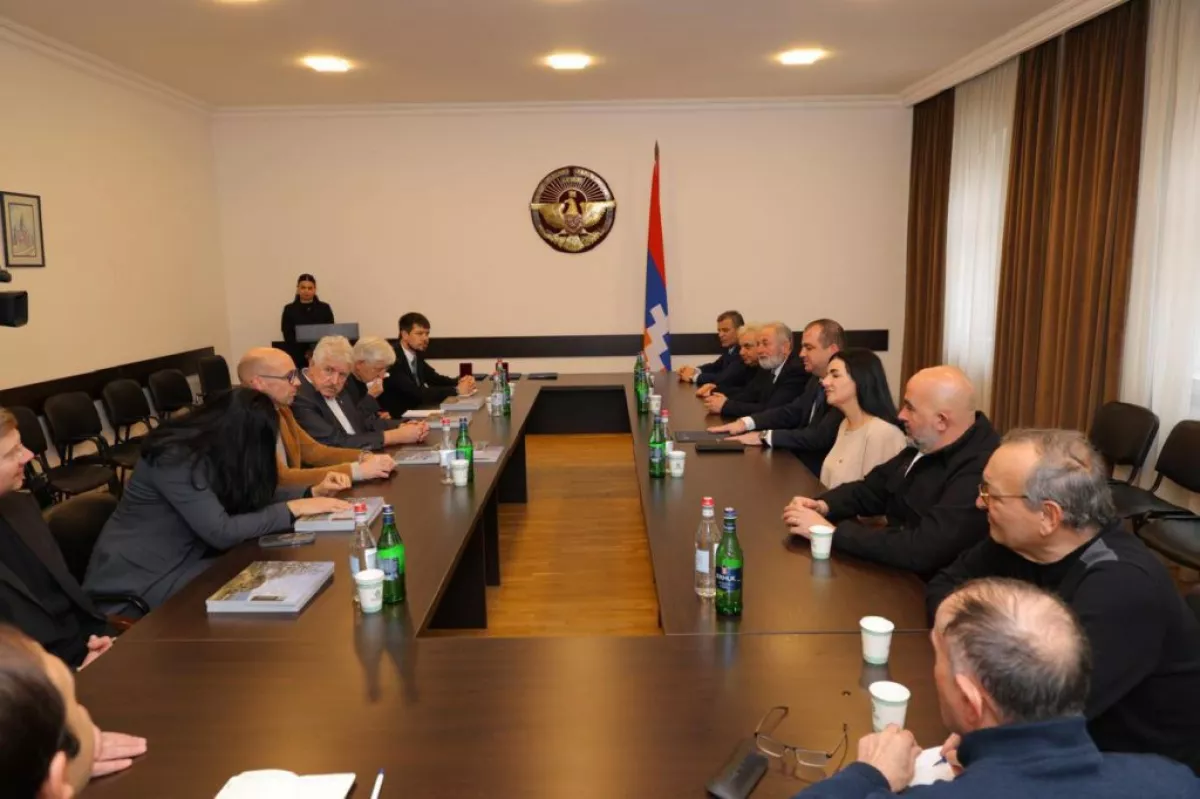
The second case concerns an event that took place on February 4 in Yerevan, at the office of the self-proclaimed regime, where the “acting president” of the dissolved pseudo-entity, Ashot Danielyan, met with members of Switzerland’s National Council, Erich Vontobel and Stefan Altermatt, as well as with the head of the organisation International Christian Solidarity, John Eibner. During the meeting, issues related to steps being taken to “recognise the right of Karabakh Armenians to return” were discussed. As a token of appreciation, Vontobel was awarded a medal of the self-proclaimed regime.
A fair question arises: why has the Armenian government, if it truly adheres to a course of peace, still not shut down the office of the self-proclaimed regime and allowed such a meeting to take place?
Armenian officials explain this state of affairs by invoking “freedom of speech” and “democratic principles.” However, this argument appears unconvincing, since in its struggle against the domestic opposition and church structures, the Armenian leadership shows little regard for democracy or human rights. Moreover, the issue here is primarily about the public expression of an official stance on these matters. If the Armenian authorities, ostensibly following the letter of the law, are unable to intervene directly in the two cases described above, they are nonetheless obliged—given the context of the peace settlement—to offer their own assessment of these developments. Otherwise, their silence, according to an old popular saying, is perceived as a sign of consent.
The Armenian government should clearly and openly state its position: does it support such initiatives, or does it, on the contrary, regard them as incompatible with the course towards a peaceful settlement? Failing this, the impression is created that the Armenian leadership is pursuing a hidden agenda.
By contrast, inaction with regard to the following, third phenomenon already provides grounds to directly accuse the Armenian authorities of acquiescing in actions that call into question the territorial integrity of other states. This concerns initiatives by certain Western countries aimed at supporting revanchist sentiments in Armenia. Thus, on February 4, the French Senate adopted a resolution calling for the release of Armenians detained in Azerbaijan. In addition, in Switzerland, lawmakers (including those mentioned above) have on several occasions in recent months spoken out in favour of keeping the issue of the “return of Karabakh Armenians” on the agenda. These initiatives, which completely disregard the legal and historical context of events over the past more than 35 years, are directed against Azerbaijan’s sovereignty and constitute a gross interference in the internal affairs of the country.
However, neither Armenia’s Ministry of Foreign Affairs, nor the National Assembly of Armenia—where the ruling party holds a majority—nor the prime minister himself have taken any steps to counter these initiatives or to voice their unacceptability in light of Yerevan’s declared commitment to the peace process, even though doing so falls squarely within their direct responsibility.
The impression is thus created that the Armenian government is exploiting every possible opportunity to preserve, as it sees them, various loopholes for reviving the Karabakh issue in the future—when, so to speak, more favourable times arrive.
One could, of course, attribute this behaviour to pre-election politics aimed at avoiding sharp confrontations with revanchists where they do not pose a direct threat of overthrowing the authorities. However, such a policy is utterly irresponsible, as inaction and the absence of a clearly articulated position on issues that put peace at risk undermine the very foundation of trust on the Azerbaijani side.
After all, a peaceful settlement is, as is well known, a reciprocal process. Azerbaijan wants to see a partner that openly demonstrates the absence of hostile intentions. Otherwise, any adjustment of Baku’s position on the peace process is unlikely to benefit Yerevan.
Beyond all other negative consequences, pandering to revanchists by Pashinyan and his team carries the risk of losing the trust of that segment of the electorate which supports the government precisely because of its commitment to a peace agenda with Azerbaijan.
In conclusion, it is necessary once again to underscore the need for Armenia’s ruling circles to provide a principled assessment of manifestations of revanchism within society and to take action in those cases that fall squarely within their remit. Indulging the ideas of a “mythical Armenia” may ultimately push the country to the margins of the real world.







 editor@caliber.az
 +994 55 444-88-98
 Азербайджан, Баку, ул. Низами, 203, Af Business House, 5-й этаж