










Tehran’s rhetoric and Yerevan’s dilemma Experts on Iran-Armenia tensions
Recent events in Iran have also resonated in Armenian-Iranian relations. In particular, the Ambassador of the Islamic Republic to Yerevan, Khalil Shirgholami, recently remarked that Tehran is beginning to view Armenia as a hub for activities by forces hostile to Iran.
According to the diplomat, a group of individuals has been given the green light to approach the Iranian Embassy and make disrespectful and offensive statements.
“For six days now, from 18:00 to 21:00, they have been making disrespectful and offensive statements in front of the Iranian embassy building. And despite the fact that we express our protest, this process continues.
We [i.e. the Iranian embassy] have repeatedly conveyed our protest to the relevant bodies of Armenia. We have stood with the Armenian government in the most difficult moments, there are many examples. We are in a difficult situation today, and what is happening near the building of the Iranian embassy in Armenia will remain in the historical recollection of the Iranian people,” Shirgholami emphasised.
In response to the Iranian ambassador’s accusations, Prime Minister Pashinyan assured that Yerevan would take all necessary steps to dispel Tehran’s concerns regarding Armenia’s position.
“We will closely monitor Iran’s concerns and, within the framework of democratic principles, will take all measures to ensure that no problems arise in the activities of the embassy [in Armenia] of the friendly and brotherly Islamic Republic of Iran,” he said, noting that since 2018, protests have not been banned anywhere in the country, and the authorities cannot act differently in a single, specific case.
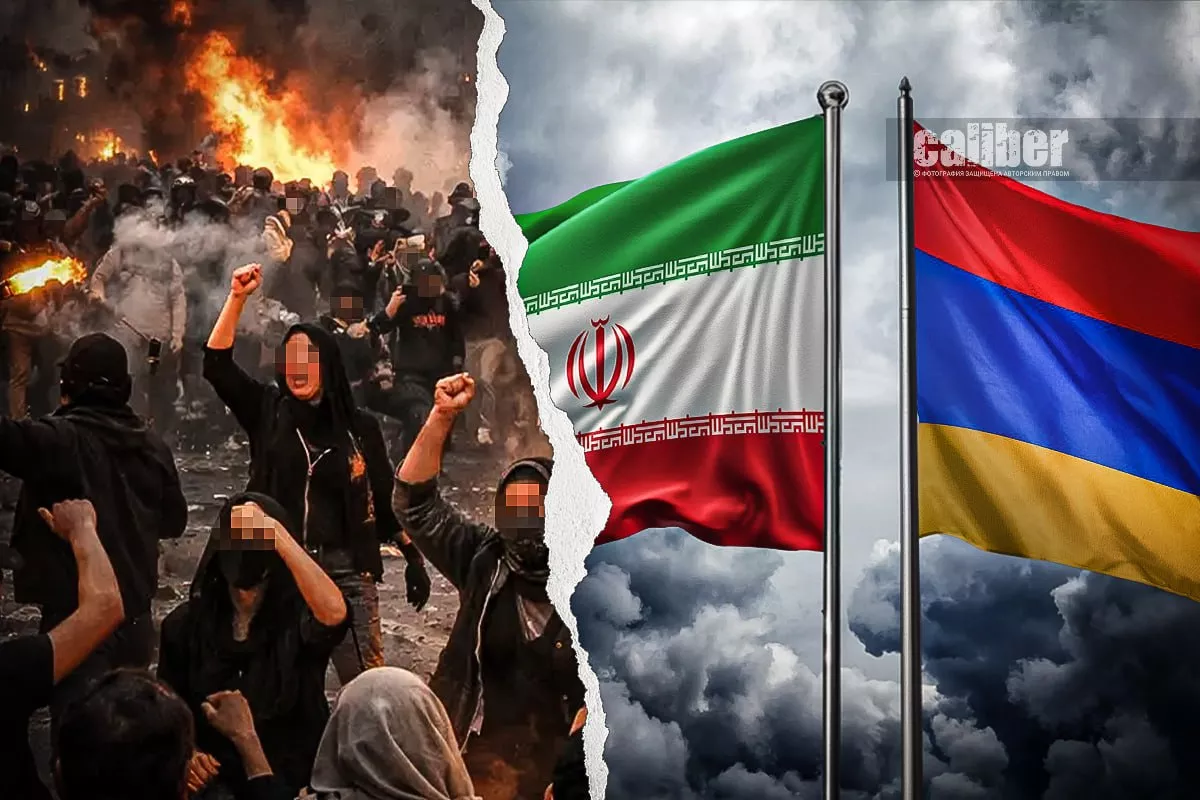
However, the emerging tension between Tehran and Yerevan cannot be viewed as a purely local episode—limited, in this case, to protests outside the Iranian embassy in Armenia. In this context, a quite reasonable question arises: How can one determine where, at any given moment—whether within specific borders or amid internal turbulence—the external sources of irritation or dissatisfaction for the Islamic Republic of Iran actually lie?
Experts on Iranian affairs from Russia and Israel offer their perspectives on this issue to Caliber.Az.

Thus, Lana Ravandi-Fadai, Associate Professor at the Department of the Modern East and Africa at the Russian State University for the Humanities and Senior Research Fellow at the Institute of Oriental Studies of the Russian Academy of Sciences, believes that Iran’s anxiety and harsh rhetoric are driven by several key triggers. These include the country’s complex domestic political situation, the imposition of new Western sanctions, and the perceived threat of a strike against the very core of the Iranian regime. Tehran views the actions and stance of the United States and Israel as a direct threat unfolding according to a 1953-style scenario, as well as an attempt by external forces to destabilise the country—something that, by and large, is already taking place.
“So, the rhetoric of official Tehran and its representatives abroad serves as a means for the regime to maintain national and governmental mobilisation. Within this logic, the harshest measures are employed, which, according to the authorities, are fully justified. The threat framework operates on the principle: ‘We are being attacked from within and from outside’—meaning that any activity near the border, especially in sensitive areas such as communications, corridors, or security zones, is perceived as a potential part of this attack. This explains why the events at the embassy in Yerevan are framed in terms of security. In other words, it’s not merely people shouting at the gates; from Tehran’s perspective, the situation creates a platform for hostile actions, since for the Iranian regime, an embassy is always symbolic.
The second strategic point is that Iran reacts very sensitively to any scenarios that could alter the balance along its northern border—which includes southern Armenia, particularly regarding transport corridors. For the Islamic Republic of Iran, this is always a red line. Additionally, as we can see, Iranian official messages in recent years have followed a consistent formula: support for Armenia’s territorial integrity, rejection of extraterritorial corridors, and so on,” the expert said.
In her view, Pashinyan’s response to the Iranian ambassador is explained by the fact that the situation in Armenia is entirely different from that in Iran.
“In the republic, since 2018, a stable understanding has developed that street protests are not prohibited as long as they do not violate the law. On the other hand, Armenia cannot afford to quarrel with Iran, as it is an important neighbour and a regional balancing factor. For this reason, the Armenian prime minister gave a typical dual-track response: it is necessary to reduce tensions with Iran while not setting a precedent for selectively banning protests at home, because tomorrow this could backfire on Pashinyan himself.
Addressing the central question of whether there are any guarantees that Iran will not raise claims again tomorrow, I would say that there are no such guarantees. Almost no one in the region has them, because the Islamic Republic’s claims depend on what Tehran, at any given moment, perceives as a threat to its security and to the stability of the regime.
Here it is important to take into account a key point: while the rhetoric of the Islamic Republic may be softer or harsher, the underlying principle hardly changes. Even when the Iranian authorities attempt to sound more moderate—for example, when the foreign minister publicly states that there are no plans to hang protesters—this does not mean that the regime’s basic mindset and all its narratives disappear. Under the pressure of sanctions, it is primarily the tone and tactics that change.
For this reason, I can say that Iran may once again put forward claims tomorrow if the triggers I have already mentioned coincide,” Lana Ravandi-Fadai stated.

Meanwhile, Israeli journalist and researcher, Iran expert Michael Borodkin, notes that the Iranian demarche coincided with a statement by Vladimir Solovyov claiming that the “loss of Armenia” would be catastrophic for Russia and that, to prevent this, another “special military operation” could be launched.
“Or is this not a coincidence at all, but rather a sign that Armenia’s two main strategic partners have grown concerned that Yerevan is reorienting itself toward the West—thereby threatening to undermine the Russia–Iran link through the loss of its central intermediary? As for Tehran, the key point to remember is that as long as there is no change of regime in Iran, the country’s foreign policy will remain unchanged. There may be minor variations in rhetoric, but the fundamental course will stay the same. Claims and accusations will continue to surface regularly, yet decisive action is unlikely. Armenia and Iran remain closely connected, including through economic interests. Therefore, Tehran will seek to minimise potential losses and preserve whatever influence it can in Armenia, which requires avoiding overt pressure.
As for this particular statement by the Iranian ambassador, it is linked to the large-scale protests currently gripping the Islamic Republic. The Iranian regime views these developments very seriously, which explains the diplomat’s harsh rhetoric,” Borodkin concluded.







 editor@caliber.az
 +994 55 444-88-98
 Азербайджан, Баку, ул. Низами, 203, Af Business House, 5-й этаж