










Baku–Ankara–Tbilisi dialogue: Middle Corridor as geoeconomic platform Expert opinions on Caliber.Az
Energy security, transport and communication projects—including the development of the Middle Corridor—and regional economic integration remain high on the agenda for both countries in the region and neighbouring allied states, particularly fraternal Türkiye.
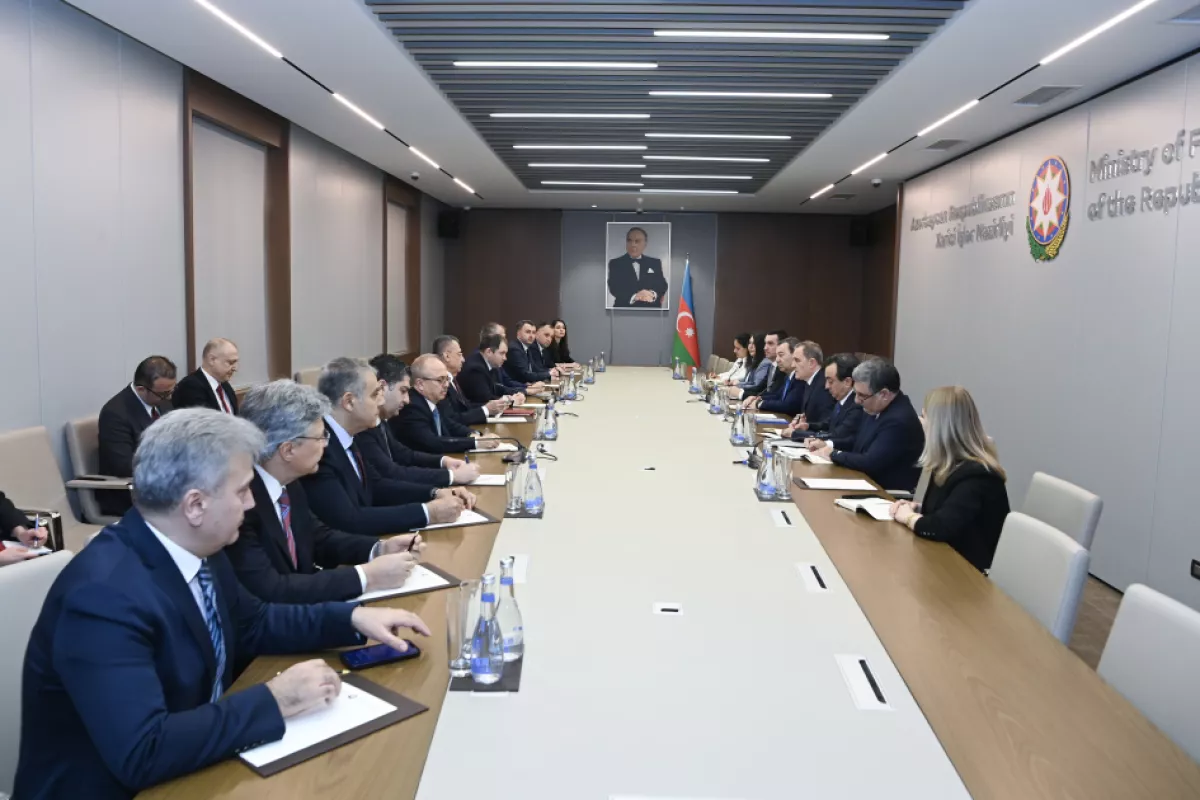
The issue was underscored during the February 24 meeting between Azerbaijani Foreign Minister Jeyhun Bayramov and delegations led by Fuat Oktay, Chairman of the Foreign Affairs Commission of the Grand National Assembly of Türkiye, and Nikoloz Samkharadze, Chairman of the Foreign Relations Committee at the Parliament of Georgia. During the talks, the parties also emphasised that trilateral cooperation among foreign and defence ministers contributes to enhancing peace, stability, security, and prosperity in the region.
What makes this trilateral format particularly noteworthy, and why do the topics discussed carry such significance? Turkish and Georgian experts provide answers for Caliber.Az.

Turkish-Kazakh politician and founder of the Great Turan Union Foundation, Serikzhan Mambetalin, highlighted that the meeting between Azerbaijan’s Foreign Minister and the parliamentary delegations from Türkiye and Georgia focused primarily on coordinating legislative measures to ensure the successful transport and logistics integration of the Middle Corridor. He emphasised that success depends not only on technical logistics but also on political support and strategic alignment among legislators from the South Caucasus and Türkiye.
“Jeyhun Bayramov provided a detailed briefing on the peace settlement process, which directly affects the potential of transport links—particularly in light of Azerbaijan lifting its ban on transit of goods to Armenia and the delivery of Azerbaijani fuel to that country.
Another key topic was the risks for Georgia if some cargo shifts away from the traditional Baku–Tbilisi–Kars route. In addition, potential buyers are already showing interest in the Armenian railways, currently owned by Russian Railways, with Kazakhstan, Qatar, and the UAE among the contenders. Overall, the trend suggests that Russia is losing control over South Caucasus logistics and its influence in Armenia, making it crucial for our countries to agree on the configuration of transport routes under these new conditions,” said Mambetalin.

Meanwhile, Georgian political scientist and international relations expert Giorgi Gogua suggested that the February 24 meeting can be seen as part of ongoing efforts to institutionalise the South Caucasus as a strategic transport hub. In this context, discussions on communications and the Middle Corridor likely addressed several interrelated aspects.
“The development of the Middle Corridor—a trans-Caspian route connecting Central Asia and China with Europe via Azerbaijan, Georgia, and Türkiye—requires coordinated infrastructure, modernisation of railway networks, increased capacity at Caspian and Black Sea ports, and better integration of multimodal transport. The Baku–Tbilisi–Kars railway remains the backbone of this transit network, ensuring the smooth and uninterrupted delivery of cargo from the Caspian basin to European markets,” he noted.
According to the analyst, the competitiveness of the corridor largely depends on the harmonisation of regulations and procedures. “Policymakers are likely exploring the possibility of implementing unified customs documentation, digital customs clearance systems, and coordinated tariff regimes to minimise border delays and transaction costs. In comparative analyses of corridors, administrative efficiency often proves just as critical as physical infrastructure,” he said.

He also noted that communications should be considered not only in the context of transport but also in relation to digital connectivity and logistics management. Integrated information systems, real-time cargo tracking, and fibre-optic infrastructure laid alongside transport routes enhance transparency, predictability, and operational efficiency—factors that play a decisive role in attracting global cargo flows.
“Moreover, the discussions likely also touched on issues of infrastructure resilience and security, particularly given the corridor’s intersection with major energy transit routes. Protecting pipelines, network interconnections, and transport hubs—while ensuring redundancy and mitigating risks—is crucial for maintaining uninterrupted flows and sustaining investor confidence.
Overall, the Middle Corridor functions as a platform for geoeconomic integration rather than merely a transport route. By deepening interdependence between Azerbaijan, Georgia, and Türkiye, this transport artery strengthens regional economic integration, diversifies trade routes beyond traditional northern corridors, and more closely links the region to Eurasian supply chains. In this context, the trilateral dialogue reflects a broader strategic logic: interconnectivity is leveraged as a tool for economic modernisation, geopolitical relevance, and regional stability,” concluded Gogua.







 editor@caliber.az
 +994 55 444-88-98
 Азербайджан, Баку, ул. Низами, 203, Af Business House, 5-й этаж