










The red line of peace Baku’s demand is not open to negotiation
Everything carries memory — including pressure. Those who exert pressure usually remember only their own intentions; those subjected to it remember how such attempts have ended before. This is precisely the difference between Baku and those now preparing to stage a new round of political manoeuvring around the Armenian constitution.
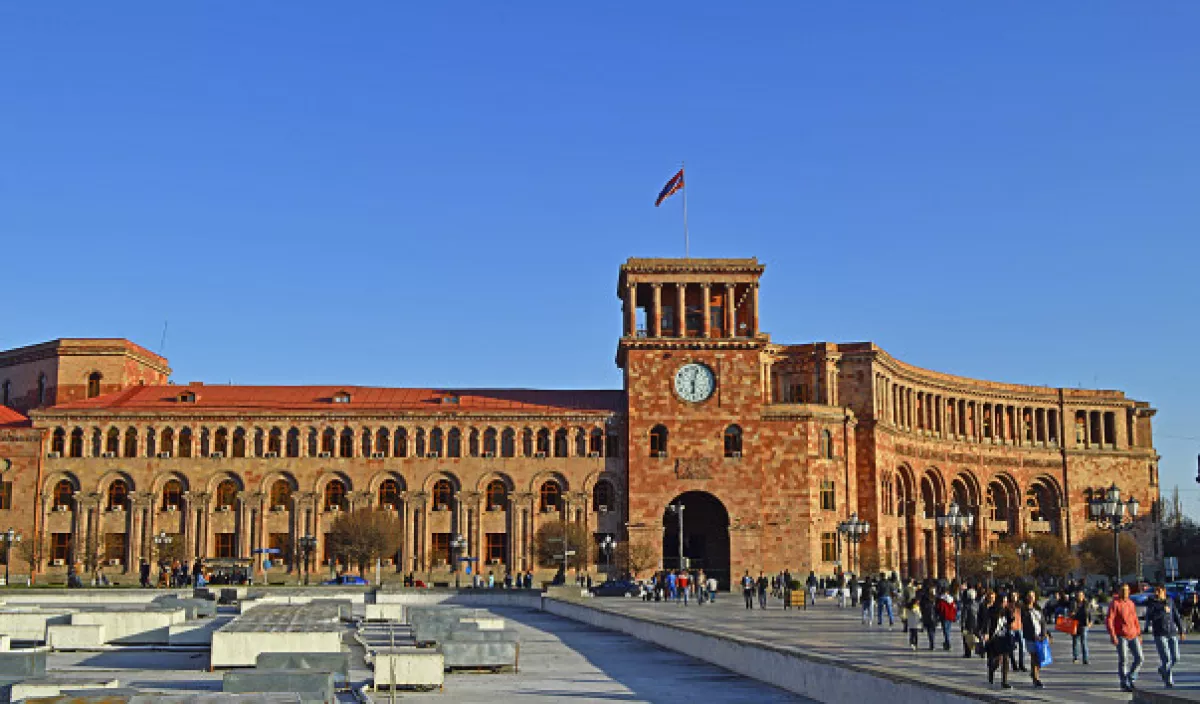
Once again, in Yerevan and beyond, there is talk that Azerbaijan’s requirement regarding Armenia’s Basic Law is “too rigid”, that it can be persuaded to abandon it or at least postpone it, and that international media can create the appropriate background which will gradually turn into concession. Sounds familiar, doesn't it? It has already been attempted before — on the Lachin road, during the environmental protest, when it seemed that a properly framed media narrative would be enough to make Baku back down. It did not. Today, the logic is the same, only the scenery has changed.
The essence of Azerbaijan’s demand is no longer a secret, although in the West it is often described as a kind of “caprice.” The preamble of Armenia’s Constitution contains a reference to the Declaration of Independence, which in turn refers to the decision of the Supreme Council of the Armenian SSR “On the Reunification of the Armenian SSR and Nagorno-Karabakh.” In other words, territorial claims against a neighbouring state are embedded, as a legally referenced norm, in the foundation of Armenian statehood, and can, if desired, be invoked tomorrow, the day after, or a generation from now. Baku is seeking to have this removed from the text prior to the signing of a peace treaty.
This is precisely where the dividing line lies — a line that Baku has clearly and explicitly drawn: the option of “sign first, resolve later” is rejected not out of stubbornness or a desire to demonstrate strength, but because it overturns the very architecture of peace. A treaty signed on top of an existing territorial claim is not peace; it is a postponed conflict. It does not eliminate claims to Azerbaijani territories, but rather freezes them temporarily. A change of government in Armenia, or a shift in internal political circumstances, could reactivate that constitutional provision as a functioning legal basis.
Baku has already seen how such deferred commitments dissolve in practice, and is not prepared to step into the same river twice. A change to the Armenian Constitution must precede the signing of a peace agreement, because only in this way is the claim eliminated — not preserved in suspended form.

Against this backdrop, something that can hardly be described as anything other than groundwork has begun to emerge in the foreign press. The Financial Times explicitly argues that the United States and the European Union should try to persuade Baku to abandon its constitutional demand or, at the very least, postpone its implementation. The wording is telling: not to “help the parties find a solution,” but to persuade one side to step back — precisely the side that emerged victorious from the war.
RAND formulates the same idea from another angle, calling on Western policymakers to “increase engagement.” The Hudson Institute insists that without sustained international pressure on both sides, 2026 will not become the year of peace.
What is striking is the very lens through which these narratives are constructed. In them, Baku is consistently portrayed as the party imposing “maximalist” preconditions, while the existence of a territorial claim embedded in another state’s constitution is presented as an inconvenient detail that an “intransigent” Azerbaijan is allegedly exaggerating into a matter of principle. The logic is inverted: the claim itself is treated as an internal matter into which it is improper to interfere, while the demand to remove it is framed as unacceptable pressure.
The expectation that international media can be used as an instrument of coercion reveals a fundamental misunderstanding of the situation. It is based on the assumption that Azerbaijan is sensitive to pressure through headlines — that by constructing an image of an uncompromising Baku in global media, the “bastion” will eventually give way. Recent history has demonstrated the fallacy of this assumption with sufficient clarity. If someone wishes to repeat the mistake, that is their choice — and their cost. The outcome, however, will remain unchanged, because the nature of Azerbaijan’s position does not shift in response to the volume of publications.
The game, meanwhile, is already underway, and in Baku there is a clear understanding of the scenario that is being attempted from outside. It is transparent: to force Azerbaijan either to drop the constitutional requirement — in which case peace would remain incomplete, containing a built-in time bomb — or to postpone it indefinitely, which in practice amounts to the same outcome, since a deferred condition is easily turned into a forgotten one. In both cases, the side that benefits is the one seeking to sign now and deal with the consequences later.
But this is precisely what Baku will not allow. Understanding the logic of the opposing strategy means that responses to it are already in place — courses of action have been calculated, and a one-sided game is not possible here. Those who expected to play it into an open goal will have to temper their expectations. The line that Azerbaijan will not cross is drawn not on paper or in headlines. It runs where the willingness to accept someone else’s mistake as one’s own obligation ends.







 editor@caliber.az
 +994 55 444-88-98
 Азербайджан, Баку, ул. Низами, 203, Af Business House, 5-й этаж