










The wine of discord Alcohol-fuelled speculation in Armenia
In Armenia, certain political and media circles seem destined to “live forever”—for them, chasing “sensational” stories with nationalist or pseudo-patriotic overtones isn’t a lapse in judgment, but a consistent form of political behaviour. This reality must be kept in mind when analysing the country’s ongoing information campaigns. So it’s no surprise that a new wave—rapidly swelling into a veritable tsunami—has once again swept through Armenia’s social media and media landscape.
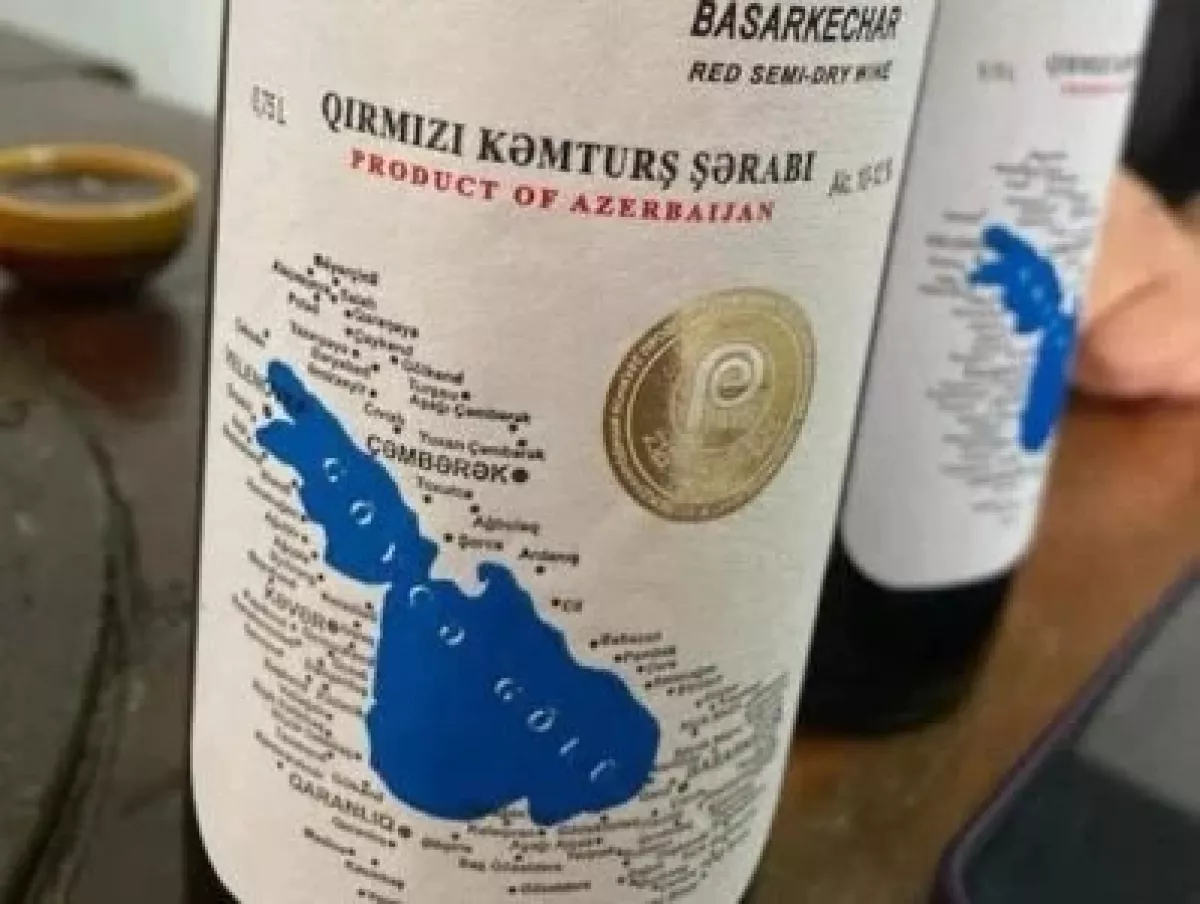
This time, the trigger was Azerbaijani wine labelled “Basarkechar” and featuring an image of Lake Goycha—known to Armenians as Sevan. A number of Armenian commentators portrayed this as “evidence of an attempt to undermine the peace agenda” and even as “proof of the impossibility of dialogue” between Baku and Yerevan.
It is crucial to note that this is a product neither sold in Armenia nor intended for Armenian consumers, and it violates no international laws whatsoever. Yet, according to Armenian radicals, even Azerbaijani wine is supposedly capable of “derailing the peace process.” Taken to its extreme, this logic could turn virtually anything into a “threat to peace”—from a label to a geographical name. The argument becomes outright absurd when pushed further: for example, claims that Azerbaijani gasoline supplied to Armenia “smells… like gasoline.” After all, in the eyes of revanchist circles, even the historical significance of Azerbaijan’s oil industry could trigger a “sense of inferiority” or “painful memories” among certain segments of Armenian society.
This hysteria was eagerly fuelled by figures in the media and so-called expert circles. Television host Grisha Sandalyan, for example, posted a photo of the wine—essentially giving it free publicity—and claimed that it is widely available on the… Chinese market. Meanwhile, lawyer Raffi Aslanyan clarified that the wine in question is actually sold in Asian and American markets.
This raises an obvious question: what relevance do the Chinese and American markets have to Armenia? Neither Sandalyan nor Aslanyan offered any explanation. Nor did they explain why a sovereign Azerbaijani state should be denied the right to use historical toponyms on products intended for third countries. In this context, it is almost surprising that these figures stopped short of calling on the entire Armenian diaspora in the United States—or Kim Kardashian personally—to heroically block Azerbaijani wine from reaching American supermarket shelves.
The hysteria surrounding this issue is so fundamentally absurd that even within Armenian media circles there have been calls for common sense. Several outlets have rightly noted that these “sensations” vividly expose the political weakness of both the claims themselves and their authors, highlighting their one-sidedness and apparent desire to sabotage the peace process. Moreover, the production and export of wine with this labelling has been ongoing since at least 2017—nearly nine years—yet during this entire period, the issue drew no attention in Armenia. It only became a supposed “problem” in the context of the current political climate.
In this context, it is worth recalling parallel—and far more sensitive—examples. For many years, Armenia’s Ohanyan Brandy Company CJSC has produced mulberry vodka, brandy, and wine under the name “Artsakh” (the Karabakh region of the Republic of Azerbaijan—ed.). According to the company’s official website, it was founded in 1998 and “continues the traditions of the Askeran Wine Factory,” a facility that operated on Azerbaijani territory during the period of Armenian occupation. The source of the company’s raw materials today remains unclear. Nevertheless, the fact is indisputable: alcoholic products marketed under the “Artsakh” brand are exported and sold in multiple countries worldwide. If the same logic currently applied by Armenian radicals were applied in reverse, Azerbaijani public opinion could easily present this as “evidence of an attempt to undermine the peace agenda” or as “proof of the impossibility of dialogue.”

Moreover, both Azerbaijan and Türkiye have every reason to question the legitimacy of producing alcoholic beverages under the “Ararat” brand. What connection does Mount Ağrı—located on Turkish territory—have to Armenia? Could this not be interpreted as a form of territorial claim? Yet these questions are deliberately not politicised by either Baku or Ankara.
Meanwhile, if the discussion moves beyond alcohol, the list of genuinely substantive issues Azerbaijan has with Armenia is extensive. Official Yerevan has yet to amend Armenia’s Constitution, which continues to contain territorial claims against Azerbaijan. Even this fact, however, has not been turned by Baku into a hysterical media campaign.
The reason is straightforward: Azerbaijan is genuinely committed to the swift conclusion of a peace agreement and the establishment of normal, pragmatic, and predictable relations with its neighbour. Accordingly, Baku does not manufacture pretexts for controversy, nor does it turn commercial or cultural matters into instruments of political pressure.
Against this backdrop, the crucial question is not for Azerbaijan, but for the Armenian side: “Is it truly ready for peace, or will it continue inventing new ‘pretexts’ to avoid it?” The answer is determined not by bottle labels or geographical names, but by political maturity and responsibility.







 editor@caliber.az
 +994 55 444-88-98
 Азербайджан, Баку, ул. Низами, 203, Af Business House, 5-й этаж