










Where does Armenia begin? Alen Simonyan on war and peace
A widely discussed video address by Nikol Pashinyan, posted on his Facebook page, has continued to stir public debate in Armenia. In the video, he warned that if the opposition were to win the June 2026 elections, a new war (with Azerbaijan - ed.) could break out as early as September. The opposition claims that Pashinyan’s statements about war are a form of blackmail, arguing that the ruling party has only one “tool” left for re-election: scaring the public with the threat of war. Pashinyan’s team, in turn, insists that this is not blackmail, but rather a political assessment of the situation.
The first to defend the prime minister’s position was Foreign Minister Ararat Mirzoyan. Speaking at a press briefing, he not only presented logical arguments but also allowed himself an emotional remark: “Why are we acting this way? We are doing the right thing.” This moment is also significant from the perspective of election strategy: in today’s environment, a diplomat sometimes needs to demonstrate not only adherence to protocol but also genuine emotion. Earlier, Caliber.Az provided a detailed analysis of Mirzoyan’s statements.
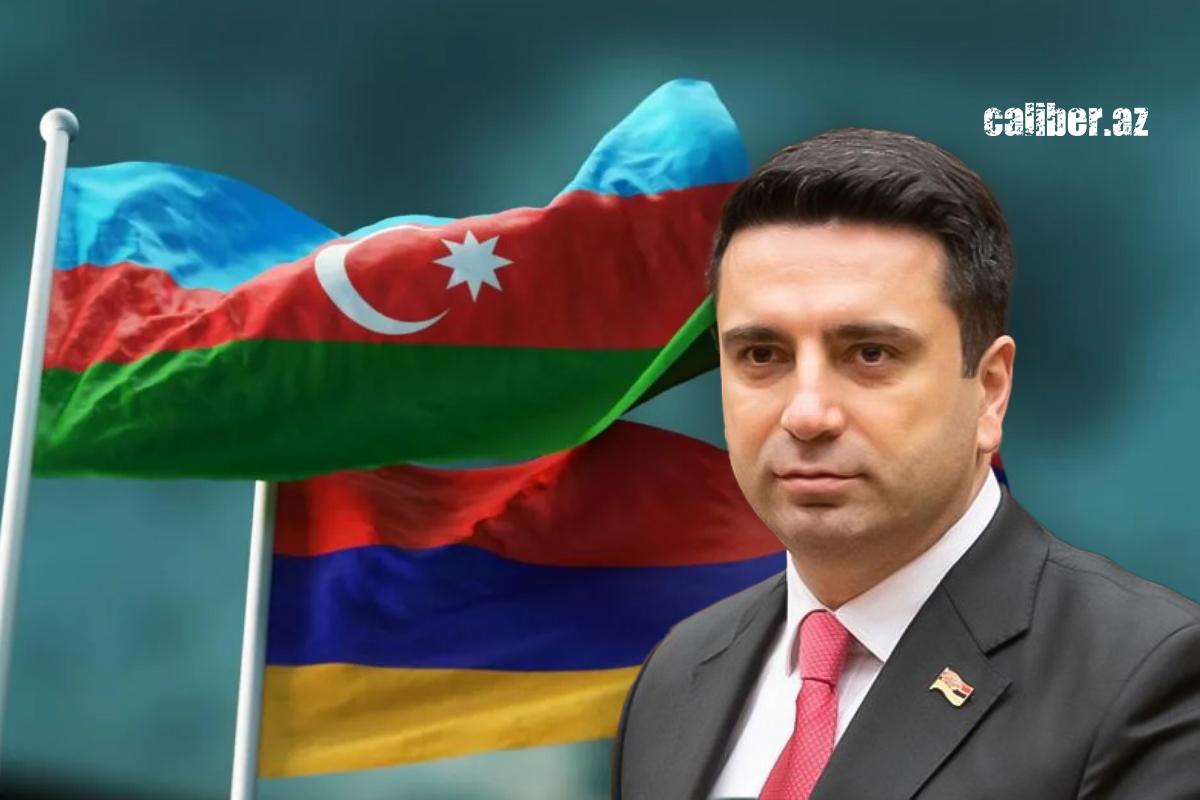
The prime minister’s stance was subsequently supported by the Speaker of the National Assembly, Alen Simonyan. Known for his often eccentric remarks, Simonyan appeared noticeably more restrained this time, yet no less substantive. In particular, he recalled that after the collapse of the Soviet Union, “they told us: people of Armenia, always dream that your home is not only here but also there, and we will support you. The goal was to keep us dependent on them. Yes, there is a party of war, and there is a party of peace. And yes, the 2026 elections will be about peace and a possible war.”
Alen Simonyan went on to further develop his argument. He emphasised that by recognising Azerbaijan’s territorial integrity in Prague, Armenia effectively recognised its own territorial integrity as well. According to him, this step allowed the country to break free from “colonial dependence, the risk of becoming a peripheral province, and the loss of its subjectivity.” “Anyone who speaks negatively about Prague wants the Republic of Armenia not to exist as an independent state… In Prague, we recognised our own territory, because Armenia begins where Azerbaijan ends,” Simonyan stated.
In essence, this statement reflects the nature of the long period of occupation of the Azerbaijani territories. Rather than demonstrating Armenia’s strength and independence, that period became a symbol of its constraint. By “granting” Armenia control over Karabakh, external actors effectively undermined its sovereignty, tying the issue of “miatsum” to political loyalty. This factor was then used as a tool of regional influence, relying on mechanisms of conflict management.
At the same time, Azerbaijan consistently moved away from such a scenario for more than two decades. The country strengthened its statehood, military, and economy, and implemented strategic projects to build and commission export oil and gas pipelines through Georgia, thereby minimising the risks of external pressure. In particular, Baku chose not to rely on the Baku–Novorossiysk route as its main export corridor, despite Moscow’s interest, and also rejected initiatives to construct an export oil pipeline through Armenia, which had been advocated by Washington. As a result, having achieved significant economic and military capacity, Azerbaijan was able to restore control over its occupied territories while simultaneously carrying out effective political and diplomatic efforts to neutralise geopolitical risks.
Thus, Azerbaijan has fulfilled its task of strengthening its sovereignty. Now it is Armenia’s turn. The ruling party’s focus on peace with its neighbours appears to be the only viable guarantee of the country’s sustainable development, security, and sovereignty.
Global developments unfolding along the region’s borders demonstrate that risks have not disappeared—on the contrary, they are intensifying. In this context, it is particularly important that power in Armenia remains in the hands of forces capable of bringing the ongoing process to its logical conclusion: the formation of a stable and genuinely sovereign state, and the emergence of a real Armenia.







 editor@caliber.az
 +994 55 444-88-98
 Азербайджан, Баку, ул. Низами, 203, Af Business House, 5-й этаж