










EU demands submission, Georgia chooses sovereignty Visa-free regime under scrutiny
The European Union began the new year by introducing visas for Georgian diplomats and officials, and threatening to extend them to all Georgians. This is because Tbilisi has refused to follow the EU’s directives in both its domestic and foreign policies. Complaining that the United States is attempting to deprive the EU of part of its sovereignty, EU leaders now seek to do the same to Georgia. Threats to revoke Georgia’s visa-free regime if it does not submit to Brussels’ demands signify precisely this. Moreover, had Tbilisi complied with the diktat, it would have faced severe consequences across multiple areas, particularly complicating its relations with neighbouring countries and with China.
The EU is once again demanding substantial concessions from its partner, offering in return trivial, symbolic gestures with little value for the country’s development—essentially, the infamous “beads in exchange for land.” But with Georgia, this approach will not work, especially given the improving relations between Tbilisi and the United States and positive trends in the region.
Tbilisi criticised for granting asylum to Russian opposition figures
Since the Georgian opposition lost the 2024 elections, the European Union has continually pressured Georgia. The main accusation against it has been “autocratization.” Allegedly, the ruling party in Tbilisi is building a “dictatorship,” even though Georgia has an elected parliament and president, as well as functioning other institutions. For liberal dogmatists, however, this does not matter—they criticise the Georgian leadership essentially for attempting to prevent foreign interference in domestic politics and for resisting being drawn into a war with Russia.
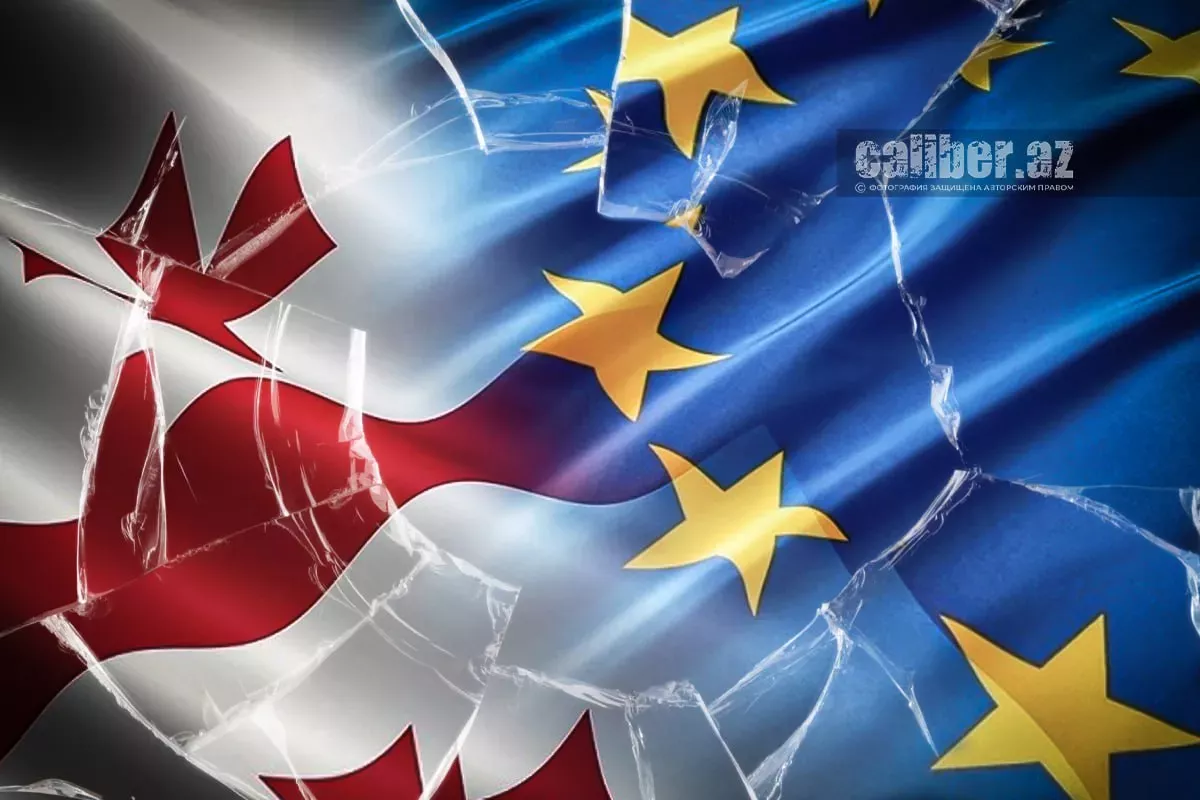
Georgia has also been accused of “anti-Western tendencies.” Although the Georgian Dream party has not abandoned its plans to join the EU, it has taken steps to restore relations with the United States, which had been undermined by former President Biden and the Democratic Party. At the same time, Tbilisi seeks to restore relations with Russia, its huge northern neighbour. Additionally, it has not abandoned beneficial projects with China and other countries disliked by Euro-liberals.
On November 4, the European Commission issued another “EU Enlargement Report,” declaring that Georgia’s status as an EU candidate country “exists in name only.” On December 19, it released a report on revoking the visa-free regime, again threatening Tbilisi with the introduction of visas if it does not comply with Brussels’ directives.
At the same time, facts show that Georgia fulfils concrete state-reform obligations within the framework of rapprochement with the EU, but is unwilling to adopt radical liberal ideology or abandon the construction of a viable Georgian state. Brussels, however, does not seek a strong and democratic Georgia—it seeks a compliant executor of its directives. As Georgian Parliament Speaker Shalva Papuashvili noted, the latest European Commission reports criticise Georgia in every possible way, while sections addressing corruption and human rights in other candidate countries, Ukraine, and Moldova—despite their problems—are removed.
In the visa revocation report, EU officials acknowledge that on July 14 they sent an official letter to the Georgian government demanding the fulfilment of certain requirements. These demands, as seen in subsequent reports, include repealing Georgian parliamentary laws such as: “On Transparency of Foreign Influence” (a copy of the American law), “On Family Values and the Protection of Minors,” “On the Registration of Foreign Agents,” as well as amendments to the laws “On Grants,” “On Political Gatherings of Citizens,” “On Broadcasting,” the Administrative Code, and the Criminal Code. Special attention is requested regarding LGBT issues.
Furthermore, Georgia is required to introduce visas for citizens of 26 countries with which the EU already has a visa regime. This concerns even neighbouring countries such as Azerbaijan, breaking historically established ties and acting destructively toward Georgia and the region—yet Brussels bureaucrats are indifferent. Brussels was also outraged by Georgia’s introduction in 2024 of a visa-free regime for Chinese citizens, declaring it “directly contrary to EU policy.” Euro-liberals are similarly concerned about the arrival of citizens from India and other Asian and Middle Eastern countries, claiming they might enter the EU over land or sea—though this is physically impossible, and similar actions by Armenia regarding Indian labour met no objections.
The absurdity of Brussels’ criticism of Georgia knows no bounds. Failing to accuse Tbilisi of bypassing anti-Russian sanctions, it accused the country of granting asylum to Russian opposition figures. According to the EU visa report, the relocation of 100,000 Russian citizens (mainly opposition-minded toward the Kremlin) after February 2022 and the establishment of 20,000 firms by them is a cause for concern—they could allegedly be spies!
As we can see, there is no logic in the accusations. Georgia is blamed simply for not following the general political line of the EU—an organisation of which it is not yet a member and whose policies it has no influence over. Brussels calculated that if in 2024 Georgians complied with EU sanctions statements and decisions 53% of the time, in previous years it was only 40%. Georgia also failed to follow most European Commission instructions regarding sanctions against Russia, Belarus, and Iran. Tbilisi has also been criticised for not participating in EU crisis-management missions since 2023—missions in which it has no influence and which often have ambiguous purposes, such as the EU intelligence mission on the Armenian side of the Azerbaijan border. Interestingly, Georgia withdrew from participation precisely when Brussels, in its rush for geopolitical expansion into a new region, initiated this operation, which immediately involved Western intelligence staff.
The issue, however, is not only the attempt to involve Georgia in questionable foreign-policy ventures but also the European liberal establishment’s attempts to overthrow the Georgian authorities elected by the people. Even official EU representatives have openly supported the Georgian opposition. So who really undermined EU-Georgia relations?
Tbilisi restores relations with the United States, damaged under Biden
It is important to note that Brussels was angered not only by Tbilisi’s refusal to join a war against Russia or follow liberal dogmas. Steps by the Georgian leadership to restore relations with the United States, seriously damaged by the previous administration, added fuel to the EU’s fire. Under Biden, even sanctions were imposed on businessman Bidzina Ivanishvili, close to Georgian Dream. Finally, American liberals from the defeated Democratic Party managed to push through the so-called MEGOBARI law, effectively supporting EU pressure on Georgia. In August, however, Republicans removed it from the National Defense Authorization Act, making its adoption highly unlikely. Consequently, these relations will likely be restored sooner or later, although Washington is currently preoccupied with other international issues.

Restoration will also be facilitated by the regional reconfiguration after Azerbaijan’s military victories and the winding down of Armenian territorial expansion projects. In November, the Trump administration discussed with Georgian leadership possible Tbilisi involvement in building the Zangezur Corridor with American participation—the “Trump Route for International Peace and Prosperity” (TRIPP).
The EU does not openly speak of Georgia-US rapprochement, but apparently keeps it in mind and considers that Trump has “entered” the South Caucasus sphere of influence, affecting both Georgia and Armenia (hence the current urgent increase of EU investments along the future Zangezur Corridor in southern Armenia).
This “American” hypothesis explains the intensity of EU criticism of Georgian foreign policy, as the publicly voiced attacks on Tbilisi’s foreign policy by Brussels appear entirely fabricated. EU bureaucrats cited Georgia’s compliance with EU sanctions as proof of alignment with Moscow, since they had no other arguments.
In reality, Georgia, for example, protested against Russian occupation of Georgian regions by refusing to participate in the 3+3 platform, through which South Caucasus countries discuss regional issues with Iran, Russia, and Türkiye. Instead of acknowledging this, the Georgian opposition and the EU highlight that on December 12, Georgia’s prime minister sat at the same table as Russian President Putin at an international event in Turkmenistan. However, at multilateral events, anyone can sit next to anyone!
Even more interesting are objections regarding Georgian Dream’s relations with China. Only liberal dogmatists, willing to oppose China purely on ideological grounds, could see these ties as problematic, weakening their small countries, while the US, for now, prefers not to openly confront China. Georgian leaders are criticised for signing a strategic cooperation declaration with China in 2023 and for visits by the prime minister and foreign minister. That many EU officials and senior leaders were there as well—this is ignored.
Even the comprador opposition acknowledges that the complaints against Tbilisi are absurd. For instance, although in 2024 the Georgian authorities attempted to hand the contract for the construction of the deep-water port in Anaklia to Chinese companies, it has not yet been signed. The port has been under construction since 2016, and several Western contractors failed, forcing the government to annul the agreements. There was no arbitrariness by Georgian Dream: when the contractors went to the International Arbitration Court, the Georgian government won in 2024. Moreover, there was nothing wrong in transferring a major national project to Chinese (or other foreign) contractors if Georgian firms could not handle it.
In other words, no scandalous actions by Tbilisi regarding Moscow or Beijing have been found. Therefore, the pro-EU opposition resorts to accusations of ties with “autocratic regimes,” even including the UAE, Central Asian, and neighbouring states (referring to Azerbaijan and Türkiye).
An unconvincing bluff
Trying to justify their policy failures, Euro-liberals and their local allies may make any accusations, but the fact is that regime-change politics have again led the EU into a dead end in the South Caucasus, this time in Georgia. Brussels’ upper echelon now holds almost no cards. Already in 2025, the EU provided Georgia no financial aid, and now it has revoked the visa-free regime for diplomatic passport holders. Current threats to cancel it for all citizens appear belated. As Georgian MP Irakli Kirtskhalia put it, this is “the last cartridge in the EU bureaucrats’ arsenal of blackmail.” They are reluctant to use it, knowing it would remove their last leverage and impact other countries. The EU has previously reintroduced visas only once, for the tiny remote country of Vanuatu in 2024. Such caution is deliberate—the withdrawal of visa-free status demonstrates the shrinking of the geopolitical space Brussels seeks to dominate.
Stripping Georgia of visa-free access would demonstrate the arbitrariness of these measures. It is not that there has been no arbitrariness before—the EU’s past refusal to admit Türkiye already showed this—but that concerned rejection was about future integration. Here, the EU would be rolling back something already granted. Previously, doubts were allegedly due to the Turks’ Muslim faith; here, the people are Christian.
Furthermore, Brussels would thereby undermine its ambitions in the Caucasus. By breaking relations with Georgia and maintaining distance from Türkiye, the EU cannot act effectively toward Armenia. Yet Armenian “Eurointegration” has become a new fashion in Brussels. Just before Christmas, EU Ambassador to Armenia Vasilis Maragos spoke about linking Armenia and Georgia’s power grids, which in the future should connect Armenia to the EU via a cable from Georgia to Romania.
In short, the EU’s threats toward Georgia appear to be a bluff, and the delay in implementing them confirms this. Moreover, these threats are a bluff because, if carried out (still uncertain), Georgia would lose almost nothing—and may even gain. Last summer, tired of EU blackmail, Georgian Prime Minister Irakli Kobakhidze broke the liberal taboo, speaking about the real value of the visa-free regime introduced by the EU in 2017. According to him, visa liberalisation provides little practical benefit to society and the country, while encouraging migration and slowing economic growth: “This is only about whether you will stand in a visa line. Going to the UK, our citizens stand in a visa line—it is a technical issue. Of course, it is inconvenient, but you get the visa and travel. The same is true for the US. This does not affect the economy at all.”
Worse, Kobakhidze emphasised that revoking visas accelerates the emigration of the economically active population to wealthier countries, as seen in the Baltic states: “After joining the EU and introducing visa-free travel, Lithuania’s population decreased by 600,000 and Latvia’s by 400,000. Why? Because there is still an economic gap between Georgia [probably a slip of the tongue, meaning the mentioned EU member states] and Western European countries. Naturally, the economy is much bigger there—that is where migration flows go. Visa-free travel encourages this.” If visas were not revoked, more Georgians would remain in the country, increasing the number of economically active citizens and boosting economic growth.
Notably, recent progress in European integration occurs where Brussels manages to “push through.” This is evident within the EU. For example, Bulgaria was recently forced to abandon the lev and adopt the euro, despite months of protests by Bulgarians, who feared losing part of their sovereignty (its influence on EU policy does not compensate for the loss of its own money), while ordinary people faced price increases. No referendums were held; protests were framed as intrigues of far-right or pro-Russian forces. Many political forces remain sceptical of the euro: the Czech Republic, despite strong positions, has yet to adopt it, a stance maintained by even liberal leaders over decades.
These trends extend beyond the EU—the Brussels leadership builds its expansion policy not on principles of equal partnership with sovereign countries but through issuing directives and imposing pseudo-liberal dogmas. Those who comply advance in “European integration.” This works with weakened, desperate countries like Ukraine, which may indeed join the EU under special conditions. But with Georgia, such an approach fails. Georgia is a strong, developed state and society unwilling to take directives from abroad—whether East or West. The absence of a place for such a country in the EU is a bad sign for the Union, which once prided itself on equality and rationality. By abandoning these principles and pursuing geopolitical expansion through the acceptance of new countries under imposed conditions, the EU leadership contributes to its rapid decline.







 editor@caliber.az
 +994 55 444-88-98
 Азербайджан, Баку, ул. Низами, 203, Af Business House, 5-й этаж