










Eurasia’s magnet: Middle Corridor and TRIPP in the US and EU spotlight Foreign experts speaking to Caliber.Az
Amid the global turbulence shaping today’s world, the Middle Corridor and the TRIPP project are gaining increasing strategic importance, receiving significant attention on the international political agenda. This is further confirmed by the fact that these transport routes became among the key topics of the visit to Azerbaijan by US Senator Steve Daines, a member of the Senate Foreign Relations Committee and chairman of the Subcommittee on Europe and Regional Security Cooperation.
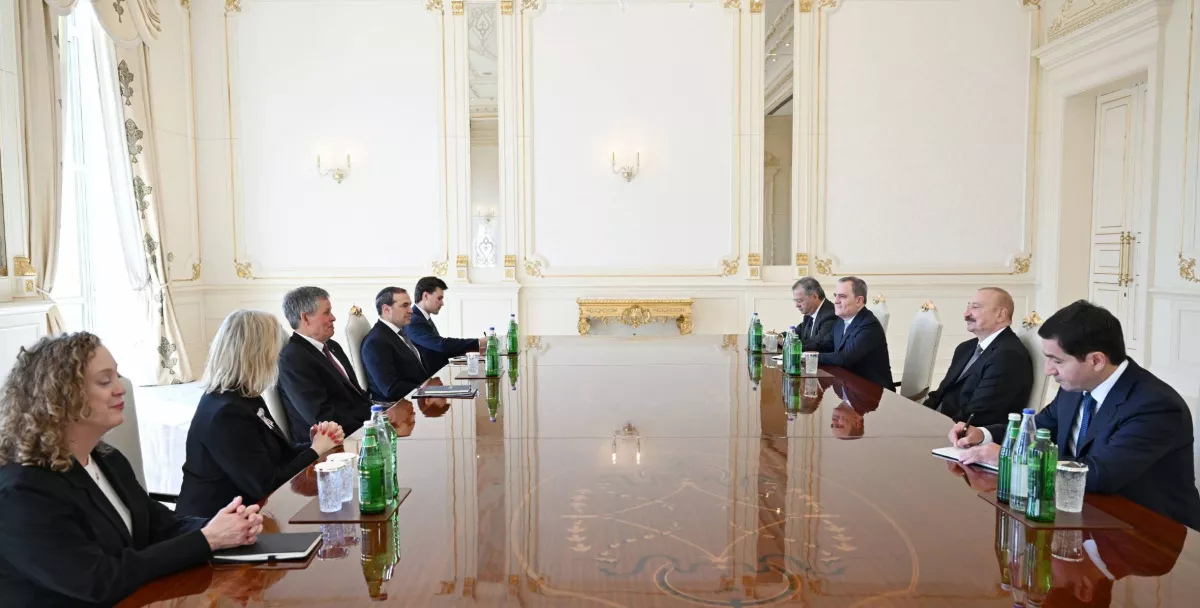
During Steve Daines’ meeting with the President of Azerbaijan, Ilham Aliyev, the sides exchanged views on strengthening dialogue between Azerbaijan and the US Senate and the prospects for partnership. They emphasised the importance of the “Charter on Strategic Partnership between the Government of the Republic of Azerbaijan and the Government of the United States of America” in terms of expanding bilateral relations, while also highlighting the significance of the TRIPP corridor in the context of regional transport connectivity.
The role of the Middle Corridor and the “Trump Route” in the development of international trade and economic integration was also a key topic of discussion during a meeting between Azerbaijan’s Minister of Economy Mikayil Jabbarov and SOCAR President Rovshan Najaf with the delegation led by Steve Daines.
In this context, a question arises: “Can a certain connection be seen between the sequence of visits by US delegations and representatives of the European Union, particularly European Commission President Ursula von der Leyen, especially given that in both cases the Middle Corridor and TRIPP were among the main topics of the talks?”
To share their views on this issue, Caliber.Az turned to experts from the United States and Europe.

American analyst Andrew Korybko believes that the main topics of the US delegation’s talks in Baku were the development of the Middle Corridor’s potential, as well as its connectivity with TRIPP.
“As for the EU, it has never lost interest in gaining access to the markets and resources of the South Caucasus and Central Asia, but the influence of the Armenian diaspora had complicated ties between Brussels and Baku until recently. Now that Azerbaijan and the European Union are establishing direct contacts, there is a chance that the EU will begin to play a practical role in this area, as it has a tremendous need for this mega-transit route,” the expert said.
In turn, Austrian political analyst Rudolf Valeev believes that the increasing number of contacts between the US and the EU with Azerbaijan, especially on the development of transport links, directly reflects Baku’s leading role in this area — not only in the South Caucasus but also across the broader region.
“The activity of the European Union and the United States in the South Caucasus is also linked to the fact that, following the ‘hot phase’ of the conflict in the Middle East, the world is gradually returning to a more familiar framework, where the Middle Corridor has become one of the key factors of global economic stability. While hostilities were ongoing in the Middle East, uncertainty and threats emanating from Iran prevented a full focus on TRIPP and the development of the Middle Corridor. After the end of the military phase of the conflict, there has been a clear understanding that this vital transport artery must be developed urgently, as the security of many routes, both maritime and overland, is under threat.
However, there are differences in approaches. While the US plan for the South Caucasus is filled with concrete measures, the European approach is clearly vague, lacking a broader vision of the situation and a comprehensive strategy. This misalignment of priorities resulted in Armenia falling within the EU’s ‘sphere of attention’, while Azerbaijan, so to speak, moved into the background.
However, apparently recognising this situation, the European Union has reduced its previous pace and resumed constructive dialogue with Baku. Nevertheless, in my view, it continues to view the Middle Corridor and TRIPP primarily through a political rather than an economic lens, and this is a major misconception. This is precisely what causes the EU’s detachment from reality — namely, the failure to understand that the development of transport routes requires concrete mechanisms rather than political statements. Following the talks in Baku, the European Union has most likely regained an understanding that urgent steps need to be taken and bridges need to be rebuilt,” Valeev concluded.







 editor@caliber.az
 +994 55 444-88-98
 Азербайджан, Баку, ул. Низами, 203, Af Business House, 5-й этаж