










Trump's team opens a new era in global politics From Venezuela to the EU
Fear has gripped many world capitals. The strategy of “outlasting Trump” has become the main goal for a wide range of political forces — from Brussels and European capitals to Tehran and Beijing. All kinds of flattery and tempting offers are being thrown at Trump just to survive until the end of his presidential term.
On January 7, the liberal outlet Politico reported that the EU is already considering how to even hand over Greenland to Trump. An insider elegantly wrapped the idea of territorial concession in the following formula: “Europe gets firmer assurances from the Trump administration for Ukraine in exchange for an expanded role for the U.S. in Greenland.”
The calculation is simple: give Trump something now, and then he’ll be gone. This is a fatal miscalculation.
The policy of the current American administration is shaped not only by the president personally, but by his team. And one of the people in that team may well become the next president of the United States. Therefore, any agreements signed with the United States under the current president will remain in force.
EU tactic: promise and endure
European politicians keep setting new records in their eagerness to please the American president. The whole world watched in astonishment as they groveled even during the open parts of the NATO summit; how European Commission President Ursula von der Leyen concluded secret (and still secret) deals with Trump, agreeing to any economic concessions and promising to purchase fantastic volumes of energy resources and investments. How much further could it possibly go?
Apparently — much further. After President Trump expressed interest in annexing Greenland, the European Union quietly discussed ways to respond. On January 5, a joint statement regarding Greenland was even published. Yet no one dared to say “no” to Trump or even hint at a readiness to actively support Denmark. Instead, the statement merely asserted that only Greenland and Denmark can make decisions about their mutual relations, and that Denmark, including Greenland, is a NATO member, meaning Arctic security should be ensured collectively in accordance with the UN Charter… And even this weak, toothless statement was signed only by France, Germany, Italy, Poland, Spain, the United Kingdom, and Denmark!
But European officials quickly started looking for ways to appease Trump — including through an elegant version of giving him what he wants. As Politico — the mouthpiece of the global liberal establishment — explained: “While that [the territorial concession of Greenland] seems like a bitter pill, it could be easier to swallow than the alternative, annoying Trump, who may retaliate by imposing sanctions, pulling out of peace negotiations — or by throwing his weight behind Putin in negotiations with Ukraine.”
The EU’s plan is clear — sign something minimally acceptable with Washington, then undo it once the American president leaves office. Much like the Afghan Taliban, who in 2019 signed their deal with Trump and, after his departure from the presidency, toppled the pro-American regime in Kabul under Biden.
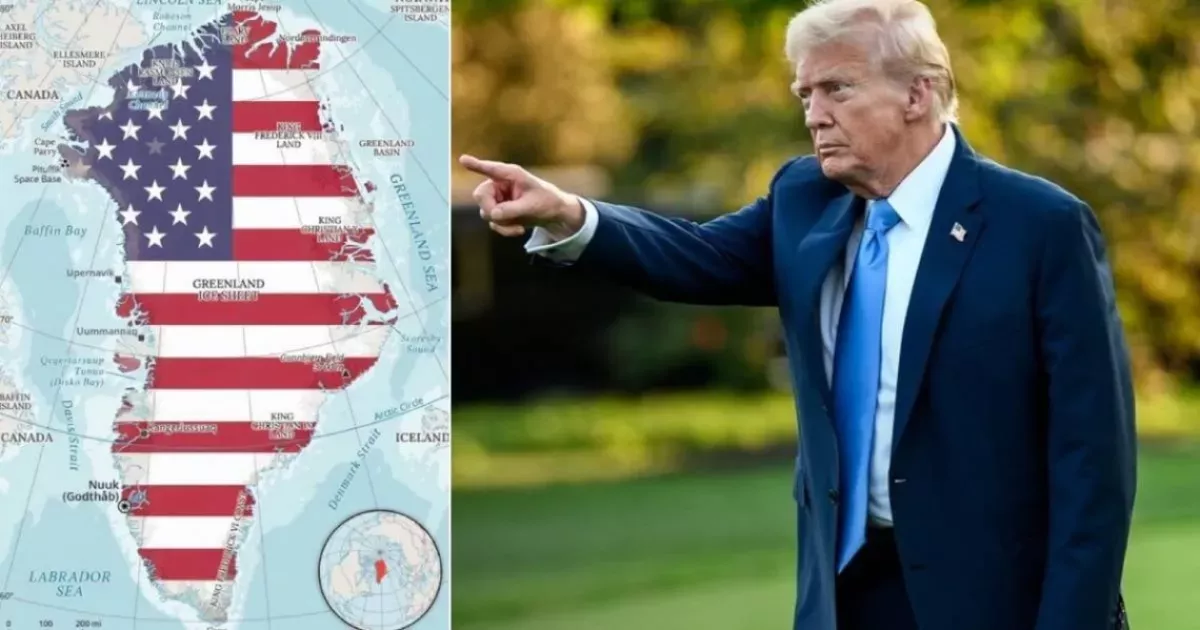
Liberal media eagerly seize on any of Trump’s eccentric gestures — like his recent, seemingly intentional pantomime in front of the press — suggesting that all his policies are some personal quirk that will soon fizzle out. But this is wrong. Trump is not acting alone; his policies are the result of his team’s efforts. The issue of transferring Greenland to the U.S. was recently raised not even by Trump himself, but by White House Deputy Chief of Staff for Policy Stephen Miller. First, his wife posted an image of the island painted in American flag colors, and then Miller himself, on CNN Monday, cryptically either warned or simply stated the fact: “Nobody is going to fight the United States over the future of Greenland.”
Moreover, U.S. Vice President J.D. Vance played a key role in the campaign to annex Greenland. When he visited the island in March last year, he told the population in imperative terms: “Yes, the people of Greenland are going to have self determination.” This language should not mislead us — one scenario for transferring Greenland envisions declaring it “independent” (an obviously meaningless notion, given the territory’s small population and economic incapacity), after which a local figurehead would sign a free association agreement with the U.S., effectively transferring sovereignty while leaving the local authorities only policing powers within the country. This relatively mild approach — compared to outright annexation — is also the option the EU would prefer.
The Collective Trump
It is clear that President Trump’s administration operates as a team of politicians who share certain ideas but are, overall, independent, ambitious, and at times may clash not only with each other but even with the president himself. This explains the wide range of Washington’s recent foreign policy moves: U.S. strikes in Venezuela and Nigeria, the revival of projects to overthrow governments in Iran, Cuba, and possibly Colombia, demands on Denmark and the EU regarding territorial concessions, and pressure on Mexico.
These operations, diverse both in scope and geography, are made possible precisely because of the ideological variety within Trump’s team. Among its key members — figures who will undoubtedly compete for even greater power at the first opportunity — are not only the aforementioned Vice President Vance and Deputy Chief of Staff Miller, but also Secretary of State Marco Rubio. And the differences between them are constantly visible.
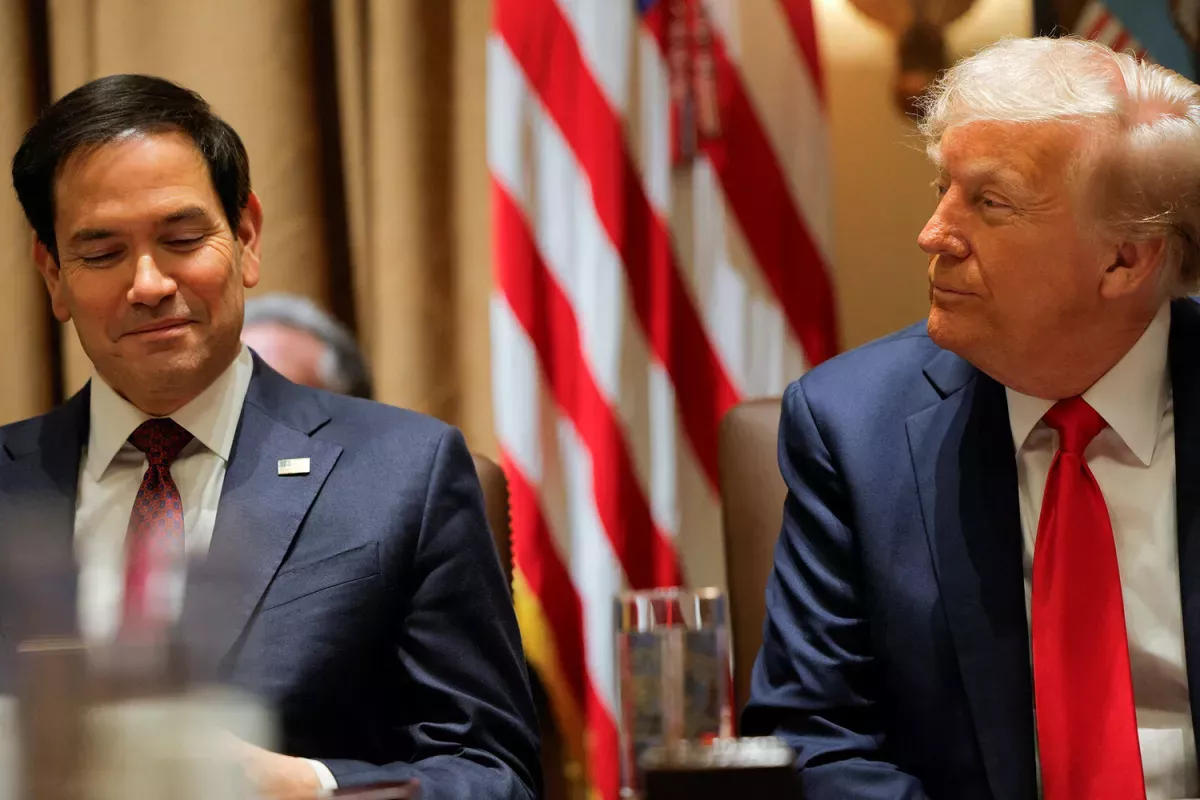
For example, it was Rubio who effectively pushed for the military operation against Venezuela and is now promoting a similar idea regarding Cuba. At the same time, he takes a more moderate stance on Europe-related issues. The Wall Street Journal recently reported: “Secretary of State Marco Rubio told lawmakers that recent administration threats against Greenland didn’t signal an imminent invasion and that the goal is to buy the island from Denmark, according to people familiar with the discussions.” Instead, Rubio said, Washington prefers to buy the island — even though, on January 6 evening, the White House announced the possibility of using military force to take control of Greenland.
In turn, Vance not only advocates for tougher actions regarding Greenland but also challenges the entire European Union. This was evident in his unprecedented public criticism of the EU’s liberal hypocrisy at last year’s Munich Security Conference, in his active contacts with illiberal new opposition parties in the EU (such as Alternative for Germany), and, finally, in his critical stance toward support for the Ukrainian government — which in recent years has become a project entirely shaped by Euro-liberal elites.
Do these differences lead to instability in U.S. foreign policy? It is more accurate to speak of flexibility in pursuing the course, as Washington’s leadership diversity provides backup options. Faced with difficulties in redirecting its European allies from confronting Russia to confronting China — the primary strategic goal of U.S. foreign policy, which Trump has always kept in mind — the American leadership responded with considerable flexibility, focusing on pushing China back in other strategic areas. In other words, Rubio took on Venezuela, a country with the world’s largest oil reserves.
At present, Beijing is not critically dependent on Venezuelan oil, but it clearly expected to receive more in the future. Moreover, punishing Venezuela — which has drawn closer to China, Russia, and Iran — is intended as a warning to other defiant resource-rich countries, particularly in Latin America, which Washington has officially declared a zone of its exclusive interests. In doing so, the U.S. presents China with a choice: either 1) accept gradual strangulation, 2) bow to the White House, or 3) confront the Americans under the least favourable conditions — far from China and close to the U.S., without having completed naval modernisation. All three options undermine Beijing’s core strategy of a “peaceful rise,” which genuinely appears to be its inevitable path to global leadership across all domains, assuming continued growth without military conflict.
The next president is already in the White House?
Notably, even amid the Venezuela crisis, the European front remains significant for U.S. policy. Indeed, there are people on the team — primarily Vance — who manage multiple directions simultaneously, and in any global dispute, the U.S. needs the European powers. They are necessary at least to weaken an opponent before the Americans themselves confront them, to cut off access to the global financial system, or to cover certain expenses.
Just before the New Year, Vance reaffirmed the U.S. goal of reshaping European policy in an interview with UnHerd. He was unrestrained in his language, naming names: “To tie it back to a more specific or direct American interest, France and the United Kingdom have nuclear weapons. If they allow themselves to be overwhelmed with very destructive moral ideas, then you allow nuclear weapons to fall in the hands of people who can actually cause very, very serious harm to the United States. The mention of the U.K. should not be surprising, as the current British Prime Minister, Keir Starmer, despite his low approval ratings, has decided to shift London’s policy toward closer alignment with the EU.
Vance’s statements on the need for a different European policy and the rejection of Euro-liberal ideology are yet another signal to European elites that “outlasting” Trump will not succeed. Notably, the BBC immediately reported that it was precisely these passages in the U.S. National Security Strategy, published in December, that “changed the context of the United Kingdom’s relationship with Europe,” pushing London toward closer ties with Euro-liberal regimes.
To recall, the U.S. strategy stated the intention to “cultivating resistance to Europe's current trajectory within European nations” and positively highlighted the “growing influence of patriotic European parties.” These passages, as the British broadcaster rightly noted, reflect the views of the current U.S. vice president.
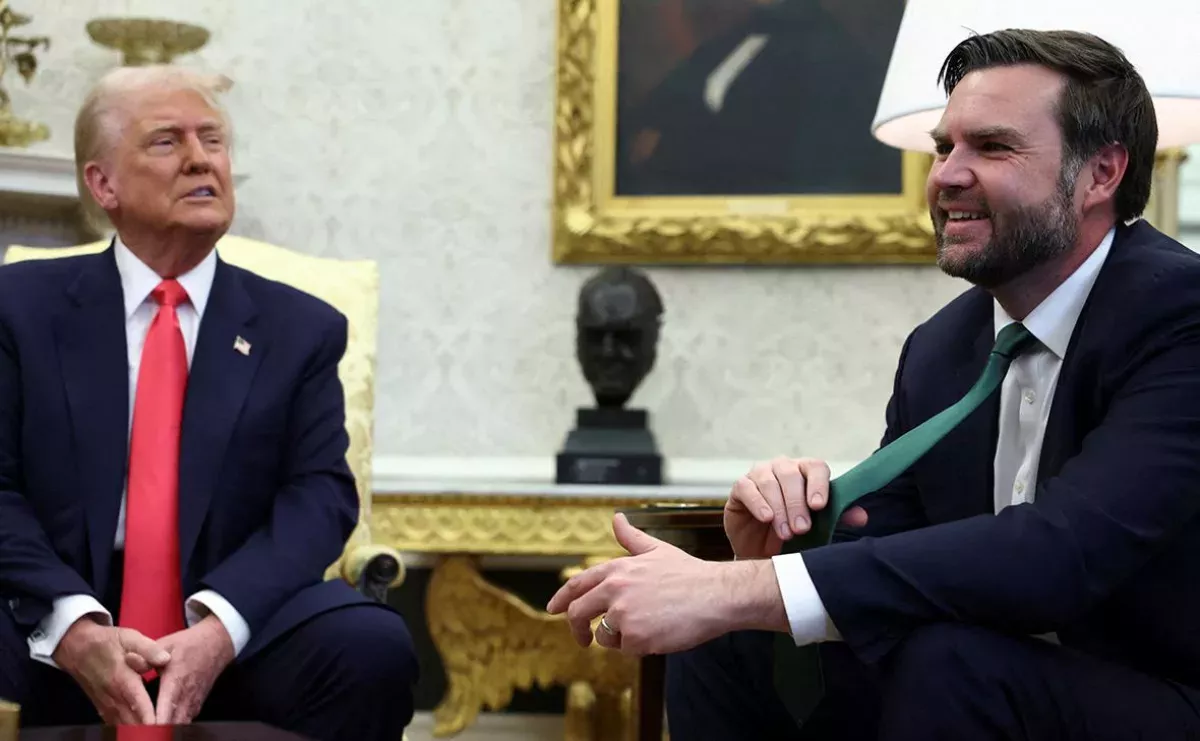
Given that Vance has been pursuing this line for a long time, it can be said that it enjoys substantial and stable support within the American establishment and among Republicans in general. It is no coincidence that by the end of the year, Vance had risen to the top among Trump’s team members in media citations, thanks to his statements on European issues and U.S. domestic policy.
In recent months, it has been openly suggested that Vance will succeed Trump as head of state. In December, his nomination as a presidential candidate for the 2028 elections was endorsed by participants of the annual U.S. conservative conference AmericaFest. According to a survey, 84% supported Vance, with Secretary of State Rubio in second place at a modest 5%, and Florida Governor Ron DeSantis in third with 3%.
Given Vance’s age and dynamism, it is plausible that he could win if he runs. In that case, the American Democratic Party and Euro-liberals would have to contend with a continuation of Trump’s “Restore American Greatness” policy — in an even tougher version advanced by Vance. A second Trump-era leadership is not a transient phenomenon but the beginning of an era. What liberal elites are currently doing in the EU and other countries, mimicking Trump’s rhetoric, will no longer be easily reversed once necessity fades.
For this reason, Azerbaijan’s policy aimed at building a partnership with the U.S., particularly regarding the Zangezur corridor, appears far more realistic and promising.







 editor@caliber.az
 +994 55 444-88-98
 Азербайджан, Баку, ул. Низами, 203, Af Business House, 5-й этаж