










Azerbaijan speaks to the US — and is being heard Vance’s visit highlights Baku’s rising regional influence
This week saw visits by U.S. Vice President J.D. Vance to Azerbaijan and Armenia. The visits were very different in terms of content and outcomes. Baku’s focus on strengthening its sovereignty and restoring territorial integrity through its own efforts has enabled the country to further develop international ties from a stronger position, laying the groundwork for a strategic partnership with the United States. Meanwhile, a sober assessment of the balance of power in the West allowed the Azerbaijani government to avoid harmful entanglements with the decayed liberal elites on whom the Armenian leadership has relied. Nevertheless, Yerevan continues trying to exploit divisions within the EU and the U.S., although the issue of the Zangezur Corridor can now be considered settled.
The Baku visit as a harbinger of a new era
Every event must be evaluated in its proper context — the circumstances surrounding it and the significant details. Regarding Vance’s visit to the South Caucasus, it is not just about a nominal figure but the actual second-in-command in President Trump’s team. It is highly likely that he will assume the presidency after Trump. And it is not only about his ambitions or track record; his rise in the political arena is supported by firm backing from Trump’s supporters, including his team, which, at present, is sometimes controversial but remains energetic, dynamic, and daring.
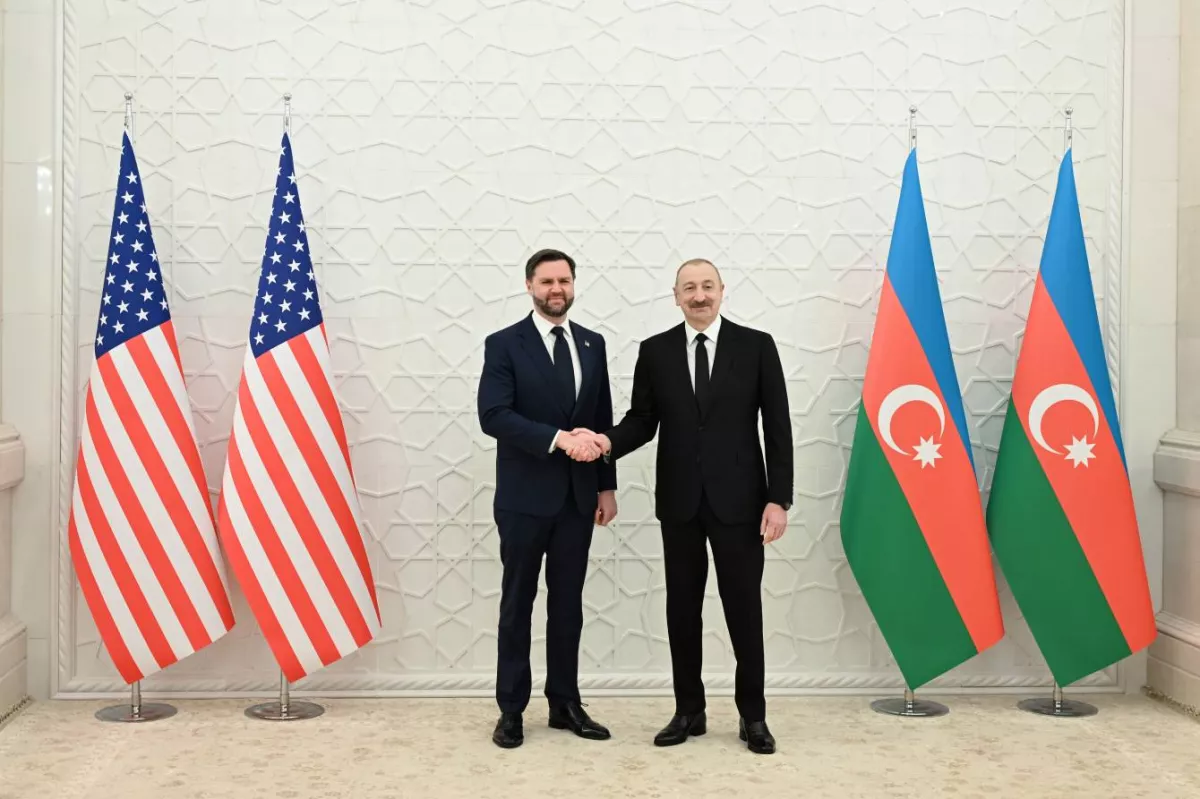
Of course, differences of opinion within this team are also noticeable, and some individuals, besides Vance, would probably not mind putting forward their own candidacy in future presidential elections. But that is theoretical; in practice, no serious splits are currently visible within Trump’s team, despite what the liberal media claim. On the contrary, even billionaire Elon Musk, who had stepped back from political affairs in recent months, has returned to collaborating with the ruling Republican administration.
In other words, it is most likely that Azerbaijan’s leadership will have to deal with Vance in the not-so-distant future. And, as experience shows, what American politicians do as vice president continues to interest them even after they assume the presidency.
It is worth noting that Vance did not necessarily have to visit Baku and Yerevan — Secretary of State Marco Rubio could have gone instead. But it was Vance who went, while Rubio attended the Munich Security Conference. In other words, we see a deliberate prioritisation: the number-two person in Trump’s team travels to the South Caucasus, while the foreign minister, also a key figure but playing a different role, goes to Europe. Moreover, on January 24, it was President Trump himself who first announced Vance’s trip to the South Caucasus.
One last important point regarding Vance: he firmly advocates overcoming the vicious legacy of the global liberal establishment, which has brought the world to the brink of global war and even devastated its own countries. Last year, he made this clear directly to European politicians at the Munich Security Conference. And this confrontation continues.

The recent “leaks” of increasingly shocking information in the Epstein case target American and European liberals — as evidenced by the resignations within British Prime Minister Starmer’s circle, including the departure of former European Commissioner Mandelson. These leaks are not simply happening objectively in the interests of Trump’s team; they are clearly being at least facilitated by it — otherwise, horrifying details, such as the barrels of acid for disposing of bodies, would never have surfaced.
All of this hits the global liberal elites on whom Armenian leaders long relied, in contrast to Azerbaijan, whose leadership understood long before the Epstein affair that the outward gloss of European liberals and the U.S. Democratic Party often conceals complete moral and political decay, and that Trump’s return to the White House was inevitable.
In short, the disclosure of Epstein-related compromising material is just one step in reshaping the European political landscape — a landscape on which the Armenian establishment has increasingly depended over the past three decades.
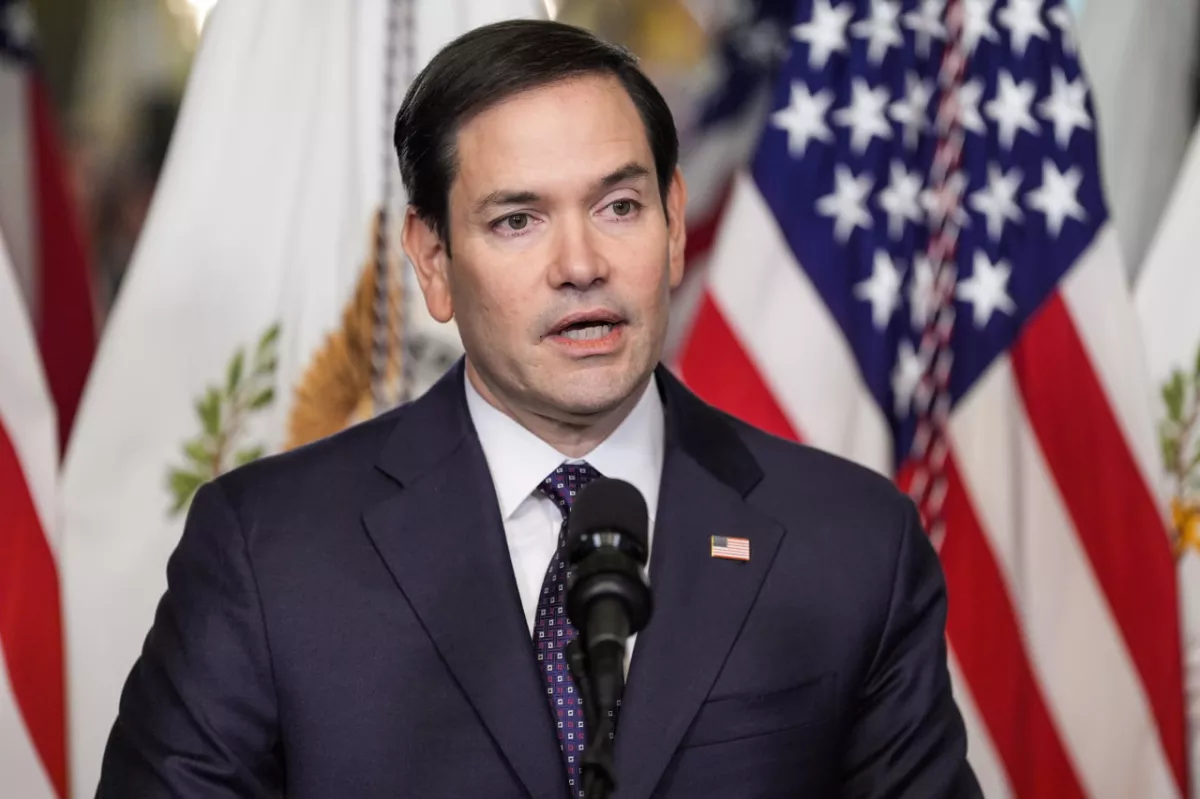
The U.S. recently announced its intention to support opposition movements and freedom of speech in Europe, and immediately after Munich, Secretary of State Rubio is scheduled to visit countries that have faced the harshest pressure from the EU leadership and global liberal elites — Slovakia and Hungary. In other words, Trump’s team, with Vance as a key member, intends to actively participate in the reconfiguration of Eurasia, and is therefore eager to engage with leaders who have previously been subjected to pressure from global liberal elites. Among these leaders is the President of Azerbaijan, and Vance’s visit to Baku, along with Rubio’s trips to Bratislava and Budapest, are in this sense not just geopolitical gestures, but also a revision of the ideological approaches of previous U.S. administrations.
Four strategic components in the Azerbaijan–U.S. agreements
But wait — perhaps we are exaggerating. After all, the U.S. vice president recently visited Yerevan as well? The negotiations in Baku and Yerevan were fundamentally different. Naturally, following diplomatic protocol, the statements emphasised equal cooperation with both countries, Azerbaijan and Armenia. But objectively, this was not entirely the case.
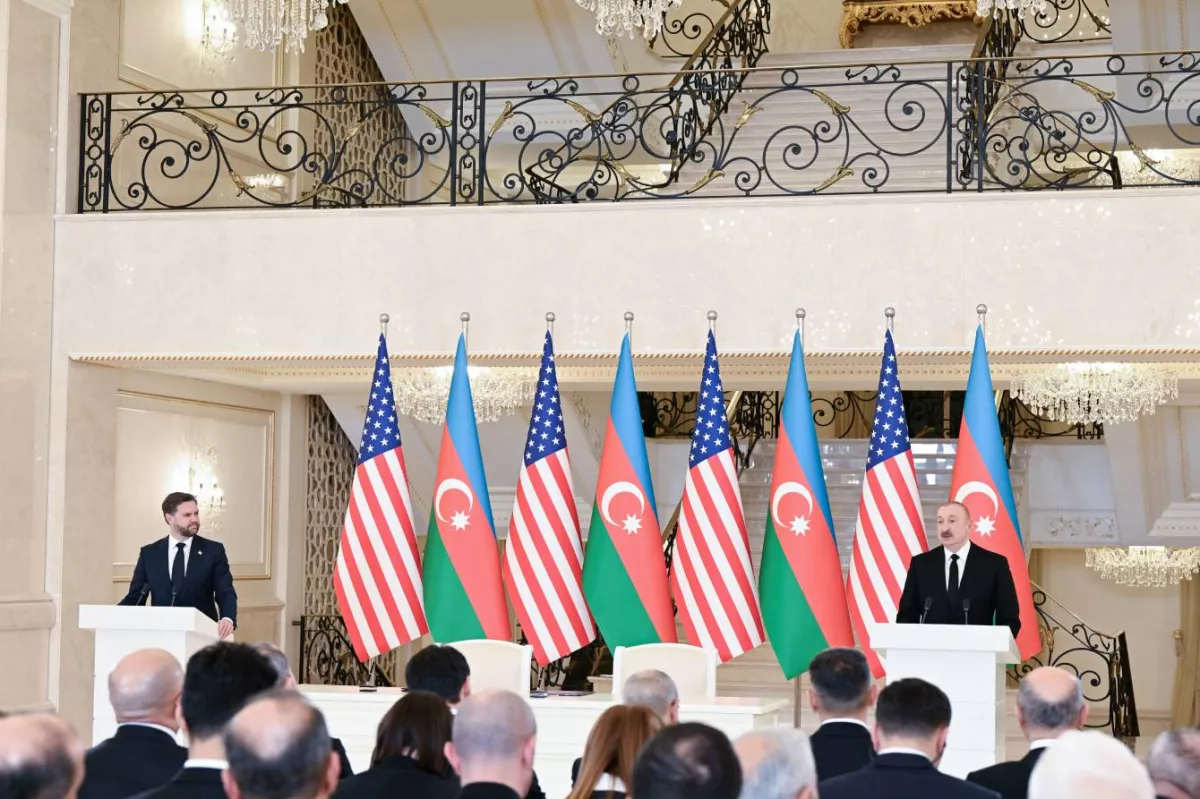
As is well known, on February 10 in Baku, President Ilham Aliyev held talks with U.S. Vice President Vance, first in a closed session and then in an expanded format, after which a Charter on Strategic Partnership was signed. It contains four key strategic points.
First, it provides for the development of cooperation in military-technical and defense spheres. Second, it consolidates Azerbaijan’s role as a partner in energy security. Third, the document envisages the development of the Trans-Caspian International Transport Route, which is of critical importance for intra-continental communications between China and Europe. Fourth, it includes the development of the “Trump Route for International Peace and Prosperity,” which will further strengthen connections between Azerbaijan’s regions.
These four points already demonstrate the scale of the agreements, which go far beyond basic deals and declarations. The first two points (military and energy) require little additional comment — their fundamental importance is obvious, and Baku is in a very strong position to conclude substantial agreements: the Azerbaijani army has long reached a high level in all respects, and Azerbaijan’s role in the energy sector is crucial for half of Eurasia, considering Caspian resources and transit routes through the country.
More attention should be paid to the last two points — the Trans-Caspian route and the Zangezur Corridor. In effect, Baku and Washington are negotiating a new geopolitical configuration not only for the South Caucasus but for a significant part of the continent. This is not just about strengthening Azerbaijan’s internal cohesion through more effective communication between its regions via the Zangezur Corridor, or about striking a blow to Armenian revanchists who had counted on Iran’s support, but also about transferring the border strip of Armenia adjacent to Iran under American oversight.
This means that Azerbaijan can consolidate and expand its regional role to become a key country in continental communications between Europe and East and South Asia. The European Union, in its ideological liberal pursuits, has not even begun to engage with Baku regarding this strategically vital route. The United States, however, has done so, and as a result, Azerbaijan can become a crucial link in a globally significant corridor through such a partnership.
Yerevan seeks to expand the EU mission under U.S. oversight
In this regard, the Armenian leadership had no comparable agenda to discuss with their American counterparts. Nevertheless, in Armenia, efforts were made — and, to put it mildly, the significance of the agreements reached was often greatly exaggerated. Following a shorter meeting in Yerevan with Vice President Vance, compared to the Baku talks, Prime Minister Pashinyan grandiosely declared: “The United States will invest in Armenia for at least 99 years. This means that the world’s strongest country is putting its resources here, creating a long-term factor of stability and security. I cannot recall a period in our history when it would have been possible to speak with such confidence about the prospect of preserving independence for such a long time.”
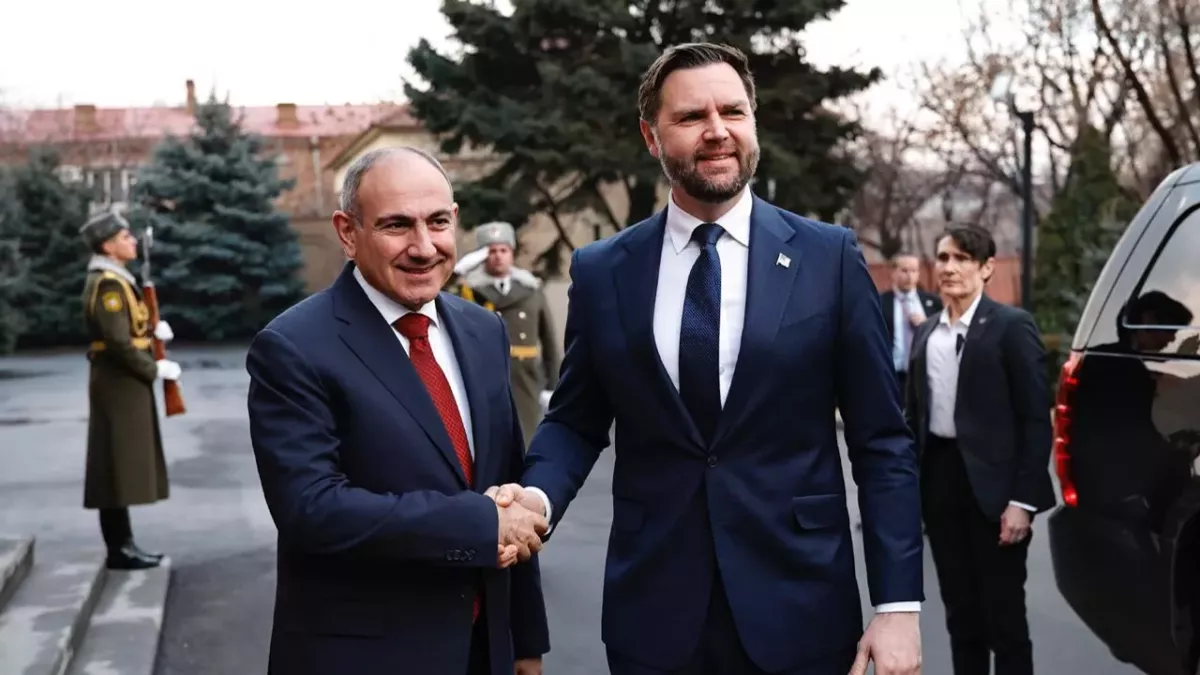
It was even initially announced that the White House had promised to invest $9 billion in Armenia. However, it soon became clear that the situation was precisely the opposite — it was the Armenians who had committed to purchasing that amount from the U.S. A relatively small sum by superpower standards, but enormous for tiny Armenia. In particular, the Armenian authorities decided to forgo a nuclear power plant in favor of small American reactors and to purchase reconnaissance drones. In the latter case, however, it is too early to talk about anything substantial — the procurement amount will only be $11 million.
Even more questions arise regarding plans to produce state-of-the-art microchips in Armenia. Yes, during Soviet times, the republic had a microelectronics industry, but thanks to the “Miatsumists” and territorial expansion, all traces of modern technology were eliminated. Moreover, Armenia lacks not only sufficiently qualified personnel willing to work for minimal wages while competing with Taiwan and others, but also the geographic conditions necessary for such production: neither the atmospheric conditions (important for this type of manufacturing) nor issues of security and communications are favourable.
Nonetheless, when Pashinyan spoke of investments, he was primarily referring to the Zangezur Corridor project — the “Trump Route for International Peace and Prosperity.” This initiative, as is known, was established on August 8 last year by the leaders of Azerbaijan, Armenia, and the U.S., and envisages the routing of all communications between Nakhchivan and the rest of Azerbaijan through southern Armenian regions along the border with Iran, which are to be placed under U.S. control.
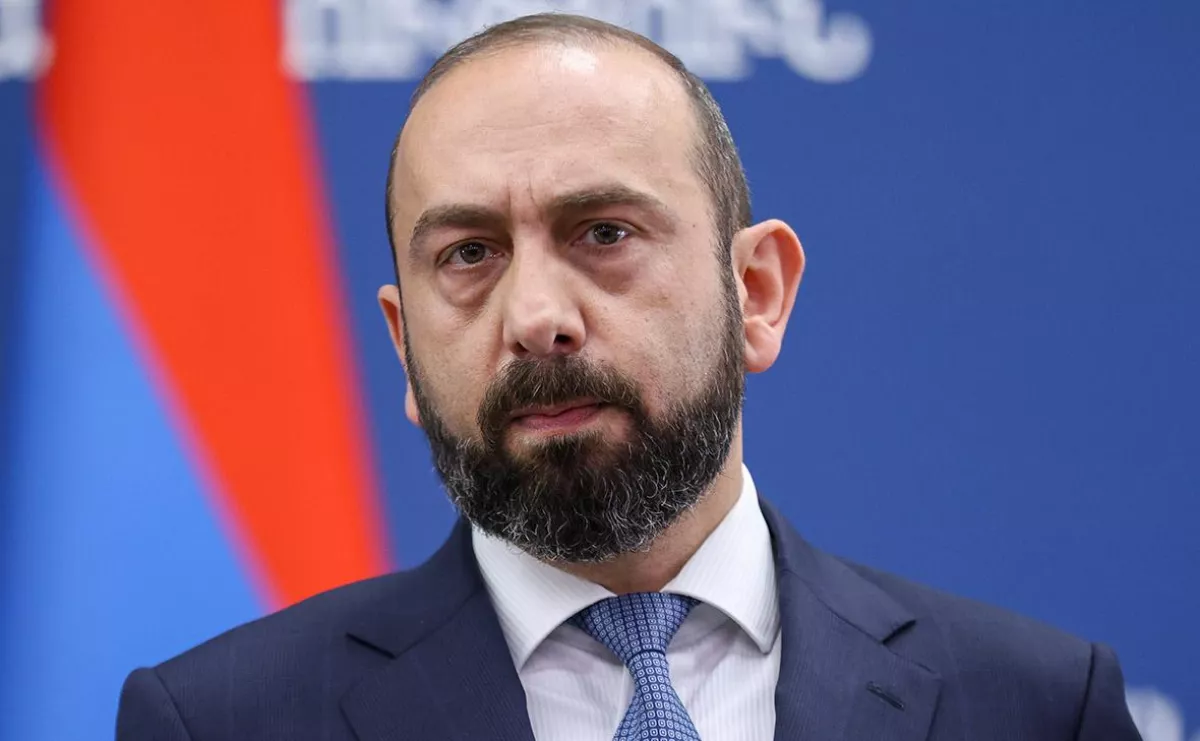
On January 14, the Armenian Ministry of Foreign Affairs released a framework agreement with Washington regarding the implementation of this project. The agreement makes it clear that Yerevan will have to strictly adhere to the terms negotiated with Trump and will not be able to “replay” the deal. Recently, Armenian Parliament Speaker Alen Simonyan, speaking in Moscow, spoke of an “Armenian-American project,” as if the U.S. would merely support the Armenian side, which would then conduct its own policy regarding the project.
Even more interestingly, on January 28, Armenian Foreign Minister Ararat Mirzoyan mentioned the possible expansion of the EU intelligence mission, which has been operating along the Armenia–Azerbaijan borders since 2023, granting it authority to participate in the management of the country’s borders.
Mirzoyan acknowledged that there is, of course, an agreement with Baku not to deploy third-party forces along the common border under the peace agreement, but Yerevan has some creative ideas in this regard. He said: “We also understand that time has passed, and now we do have peace. We should think about how this mission can continue to support our internal—maybe some border management—capacities, and maybe others.” Immediately, it was assumed that this initiative would concern only Russia — which Pashinyan is pushing out of Armenia. But more importantly, Yerevan is creating a framework to use the European Union against the U.S. and to undermine the “Trump Route” project by playing global actors against each other. If EU personnel start managing Armenia’s borders, this could generate friction with the U.S. And Yerevan has clearly not coincidentally promised to give the U.S. control over the southern territories and access to the border with Azerbaijan amidst Washington’s disputes with Euro-liberal elites.
However, on closer examination, Pashinyan’s scheme appears very fragile, since under the framework agreement, the territories in southern Armenia are effectively transferred for development to a company whose charter guarantees a U.S. majority stake for the next 99 years. Will the EU dare to obstruct it? As the example of Greenland shows, they do not even venture to defend their own territories, though they sometimes stage public demonstrations of disagreement with the U.S.
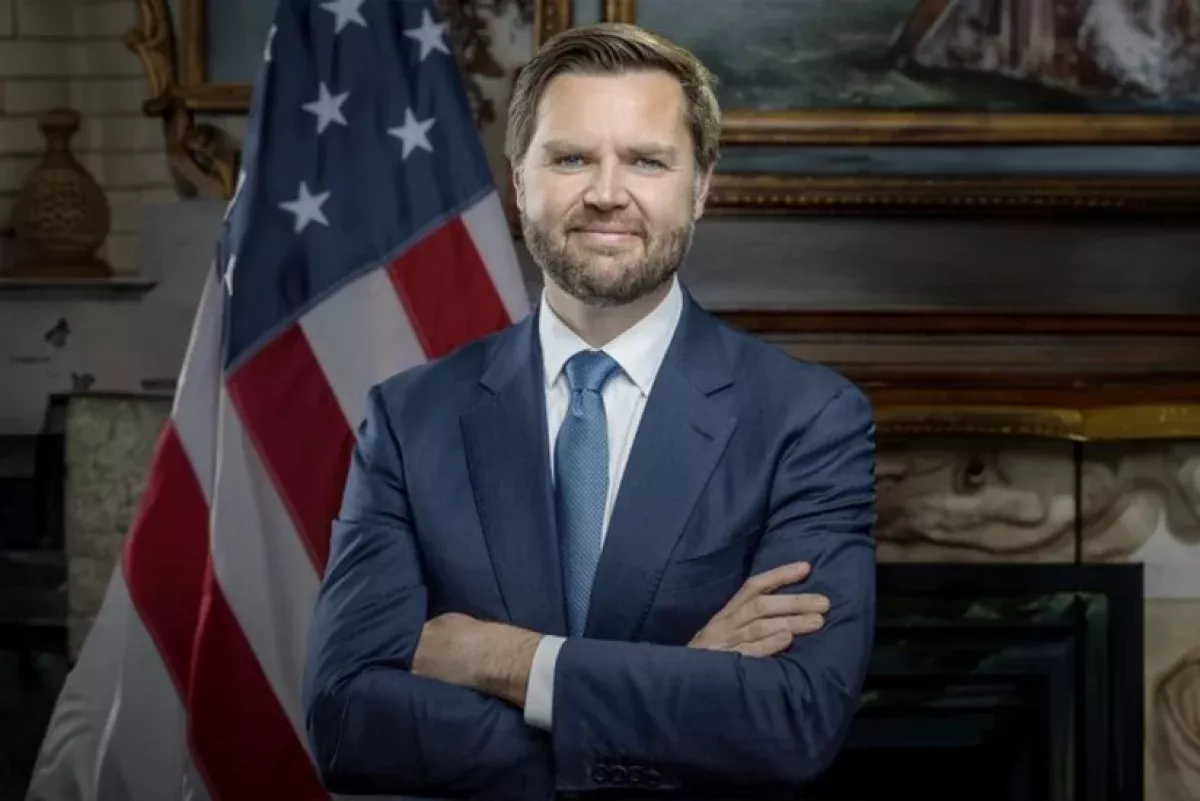
Vance recently mocked them sharply: “It's so funny because the Europeans, they're so friendly in private, and they're willing to make a lot of accommodations, and then publicly they attack us. I'm sorry, it's all bogus, the idea that they haven't made any accommodations or concessions to the United States [regarding Greenland], it's not true.” Needless to say, the EU is hardly likely to challenge the Americans over Armenia.
In short, the corridor will exist, and its foundations are not subject to the whims of the Armenian authorities’ political course. Their freedom to manoeuvre in relations with the U.S. on this and other matters is limited — due to the objectively limited value of almost everything they can offer Washington, especially compared with Azerbaijan.
Let’s be frank: even by transferring their lands to an American company, the Armenians are only creating some income and a foothold on the Iranian border for the U.S., but all of this is minor for the world’s largest power. What matters far more is a partnership with Azerbaijan in energy, Caspian communications, and simply regional stability — which Azerbaijan can provide even without Armenia, because it has the real mechanisms for this: a dynamic society, a strong economy, a capable army, and extensive international ties, not just fine speeches.
The negotiations with Vance represent another step in the construction of a new South Caucasus, in which Azerbaijan has objectively assumed the leadership role. However, this did not happen by chance. Sovereignty and a respectable place on the international stage are secured through deliberate efforts to defend one’s legitimate interests, undertaken by the people and the state representing them — if necessary, by the use of force. These efforts were not aimed at war, but rather at achieving peace and restoring the historical unity of the South Caucasus. Azerbaijan achieved entirely different results from Armenia during Vance’s visit, precisely because it had laid the groundwork for them itself.
In Yerevan, by contrast, entirely different attitudes persist. This is evident, for example, in Prime Minister Pashinyan’s recent euphoria over Vance’s visit, when he spoke of American investment promises as if they were unique guarantees for Armenia’s preservation. Azerbaijan, however, did not seek — and does not seek — any “magic wand,” understanding that the foundation of sovereignty and its preservation lies in the Azerbaijani people themselves.







 editor@caliber.az
 +994 55 444-88-98
 Азербайджан, Баку, ул. Низами, 203, Af Business House, 5-й этаж