










Belarus and the US: a complicated relationship Opposition figures, potash, and EU intrigues
Last week, the process of U.S.–Belarus normalization took a new turn. John Coale, the U.S. special envoy to Belarus, visited Minsk and held talks with President Alexander Lukashenko. During his visit, Coale announced the lifting of American sanctions on Belarusian potash — one of the country’s key export commodities. Minsk also responded with a gesture: more than a hundred prisoners were released, including well-known opposition figures such as Viktor Babariko, Maria Kolesnikova, and Ales Bialiatski.
Notably, this is not the first development in the framework of U.S.–Belarus normalization. Over the summer and autumn of this year, as a result of negotiations between the U.S. and Belarus, Lukashenko pardoned 66 Belarusian prisoners, including Sergei Tikhanovsky and 31 Ukrainian citizens. In November, the U.S. Department of the Treasury removed the Belarusian state airline Belavia from its sanctions list.
In fact, discussions that have been taking place since the second half of this year about the possibility of a “big deal” between the U.S. and Belarus have become one of the year’s most sensational stories. When Lukashenko first mentioned the “big deal,” Western media reacted with bewilderment. The New York Times wrote about a “mysterious turn in Minsk,” yet failed to explain why the U.S. was moving closer to a Belarusian leader who not long ago was pompously labelled “Europe’s last dictator.”
However, Donald Trump certainly never called Alexander Lukashenko that. More importantly, he shifted the entire direction of Washington’s foreign policy — Moscow is no longer treated as an adversary. While Biden’s actions, with certain caveats, were aimed at delivering a “strategic defeat” to Russia, Trump’s efforts, including those directed at Moscow, are primarily intended to achieve a swift end to the conflict in Ukraine. In this sense, Minsk represents an invaluable asset for a Washington seeking to stabilise NATO’s eastern flank — the ability to communicate with Moscow without intermediaries. For the U.S., Belarus is a key to de-escalation in Eastern Europe. As long as the region resembles a powder keg, Washington cannot fully focus on its priorities — above all, Asia.
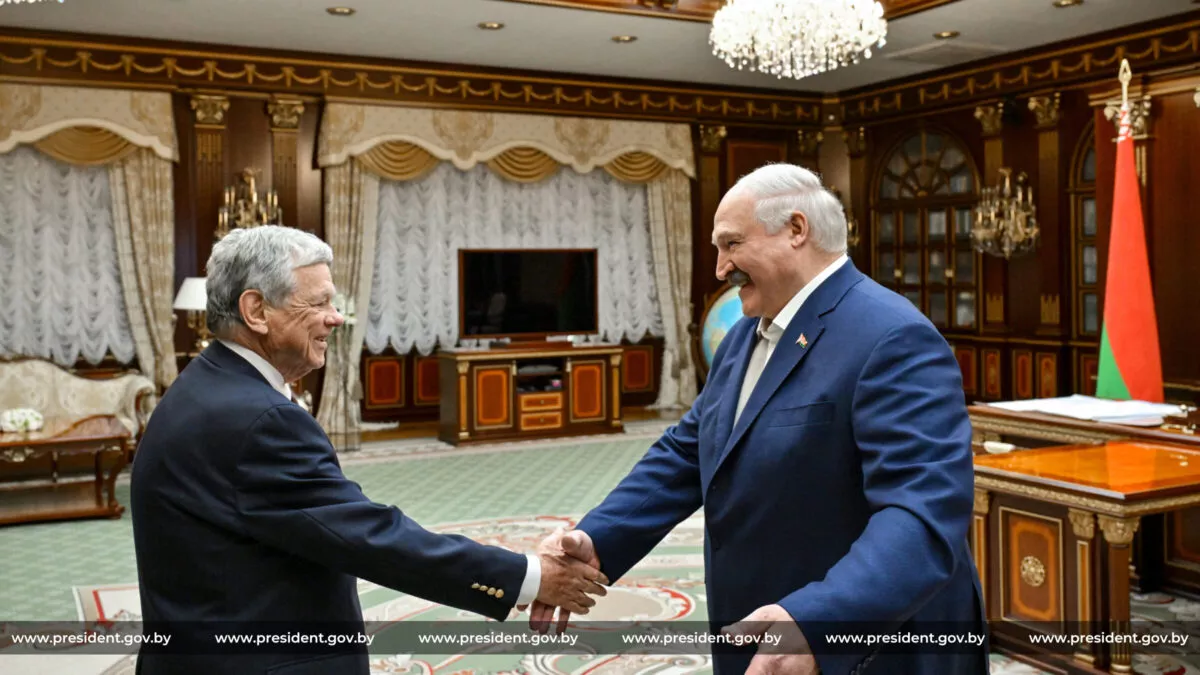
John Coale openly acknowledged that Lukashenko has become an important intermediary for the U.S. in its dialogue with the Kremlin. “He is giving us advice on what to do with the war between Russia and Ukraine. This is good advice,” Coale said after his recent meeting in Minsk. The American emphasised that the personal relationship between Lukashenko and Putin allows sensitive issues to be discussed directly. “They are old friends. And you give advice to old friends, and the old friends take it. They have a relationship, as old friends do, to discuss these issues. Naturally, President [Vladimir] Putin may accept some advice and not accept others. But it is a way to help the process,” he added.
There is also a broader context to the U.S. effort to engage with Belarus. As early as last autumn, in an article for Responsible Statecraft, American analyst Mark Episkopos from the Quincy Institute noted that renewing dialogue with Belarus is one of Donald Trump’s most underrated diplomatic victories. In his view, Washington is abandoning decades of failed pressure-based policy and seeking stable, mutually beneficial relations with Minsk. Episkopos points out that the “sanctions and isolation” approach, applied since 2020, has completely failed. Belarus not only withstood the pressure but also strengthened ties with Russia and China. Now, seeing the old course as unproductive, the U.S. is betting on pragmatic dialogue. The only effective way to reduce tensions in the region is constant contact with Belarus, not pressure and threats, the analyst emphasises.
For Lukashenko, American engagement in dialogue with his country represents an additional resource to strengthen political agency in an unstable region, not to mention the benefits of sanctions relief.
However, while Washington is betting on cautious rapprochement, Europe continues its policy of pressure on Belarus. In 2025, the European Union repeatedly tightened restrictions against Minsk, including placing Belarus in successive anti-Russian sanction packages. Poland and Lithuania temporarily closed borders, heightening tensions. Even now, despite the U.S. lifting restrictions on Belarusian potash exports, Vilnius announced it will maintain its ban on its import and transit.
As can be observed, the European Union is attempting to shift its confrontation with the U.S. over support for Ukraine onto Belarusian territory, creating another source of tension for Washington and seeking to undermine all progress in the normalisation process.
Given the extremely complex geopolitical situation Minsk faces, it must exercise utmost caution to avoid falling for European provocations aimed at destabilising the country. President Lukashenko, without a doubt, possesses the necessary intelligence, experience, and determination to keep the nation intact and secure amid the storm raging around it.







 editor@caliber.az
 +994 55 444-88-98
 Азербайджан, Баку, ул. Низами, 203, Af Business House, 5-й этаж